-50%
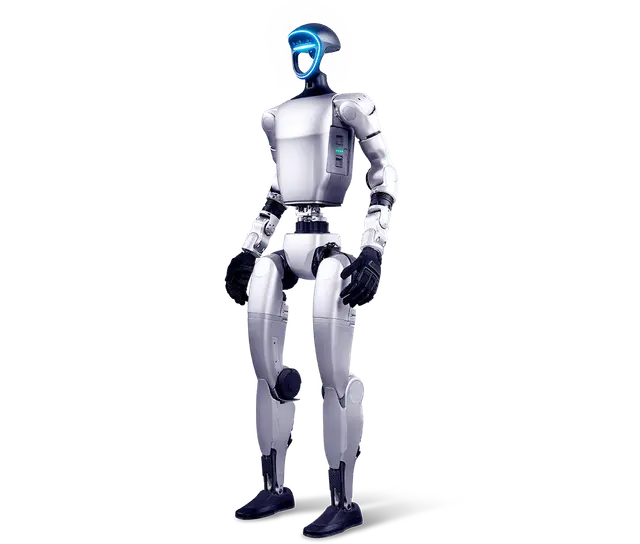
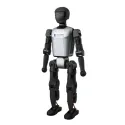
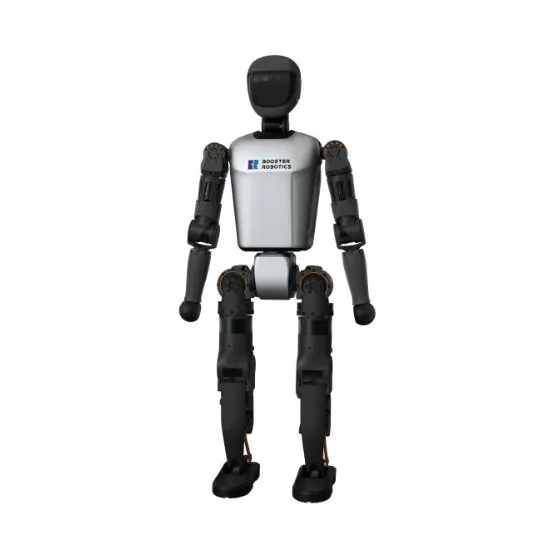
Booster T1 humanoid robot

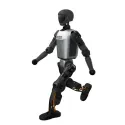
Booster T1 humanoid robot

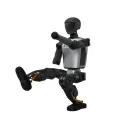
Booster T1 humanoid robot
Booster Robotics | A-000000-07535
€39,000.00
€19,500.00 VAT incl. €16,250.00 VAT excl.
Save 50%

/!\ Used robot /!\ 

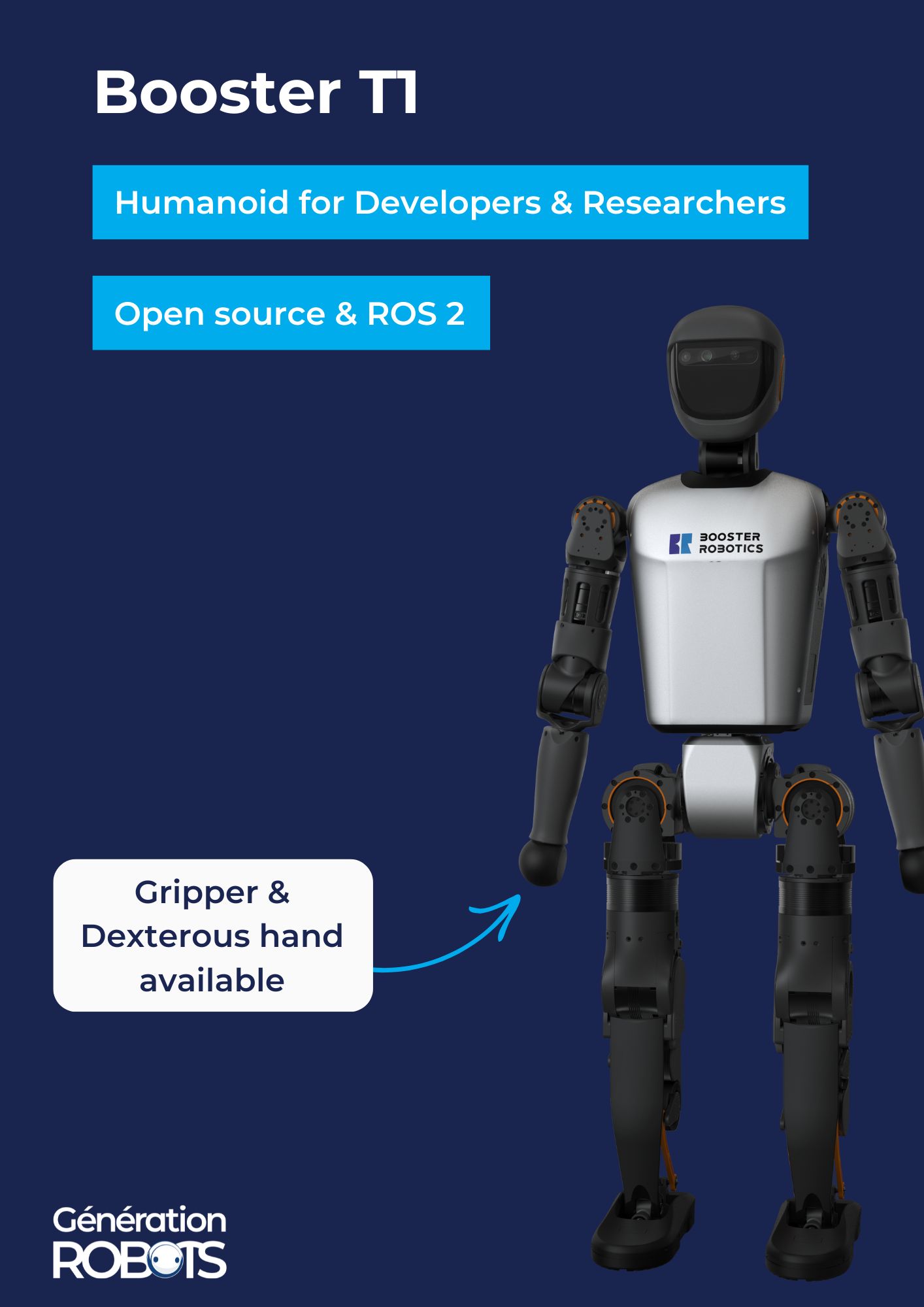
The Booster T1 is a lightweight, high-performance, open-source humanoid robot designed for developers and researchers, featuring a complete API, ROS2 compatibility, and advanced simulation and AI capabilities.

Certification CE
Version
-- Please select an item --
  • Standard
Quantity
1 Available

Get it in 24/48h! (see T&C)

Create a cart and turn it into a quote instantly!
Payment methods (see T&C)
Debit card
PayPal
Payment by invoice
Wire transfer

This item is a demonstration model, sold second-hand, and will no longer be available for purchase once stocks are exhausted.

Booster T1 humanoid robot: key points

  • An open-source humanoid robot oriented toward research and education.
  • Software and development: API, ROS2, simulation environments. Full support
  • for the communication protocol, including low-level APIs (joints/sensors) and advanced motion-control interfaces.
  • Three versions: standard, with grippers, and with robotic hands (the choice mainly depends on your grasping needs).
  • Degrees of freedom: 23 (Standard), 31 (with grippers), 41 (with dexterous hands).
  • Compute power: NVIDIA AGX Orin (200 TOPS).
  • Onboard sensors: depth camera, 9-axis IMU, microphones, speaker.
  • Battery life: 2 h walking / 4 h standing
  • Indicative lead time: 4 to 6 weeks; price on request.

The Booster T1 humanoid robot is an excellent robotics platform to develop PoCs in applied research before industrialization.

Applications and project types (locomotion, control, perception, interaction, manipulation)

The Booster T1 is designed for teams that need a large (~1.20 m) programmable humanoid robot working on applications such as: humanoid walking (balance, transitions, recovery), multimodal perception, human-machine interaction, and—depending on the version—grasping (grippers or robotic hands).

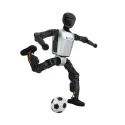
Concrete examples: RoboCup (humanoid soccer: vision, decision-making, control and strategy), warehouse automation, assistance for elderly people, or educational demonstrations.

Choosing the right Booster T1 version: Standard, with grippers, or dexterous hands

  • The standard version is suitable if your priority is locomotion, perception and interaction, without advanced manipulation goals.
  • The version with grippers targets utilitarian grasping (pick/place).
  • The version with dexterous hands is suitable for finer manipulation, typically requiring more tuning (calibration, scenarios, control).

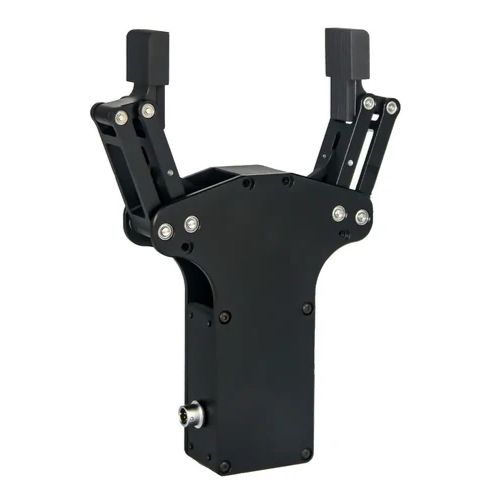
Gripper EG2-4C2

The EG2-4C electric gripper incorporates a controller and features a wide stroke, precise force and position control, as well as an automatic locking system in the event of a power cut.

  • Communication interface: RS485
  • Total stroke (both sides): 70 mm
  • Weight: 231 g
  • Grip force: 0 to 20 N
  • Grip force accuracy: ±1 N
  • Operating voltage: 24 V DC ±10%
  • Maximum speed: 70 mm/s
  • Full stroke closing time: 1.3 s
  • Protection level: IP40
  • Recommended operating temperature: 0 to 40 °C
Gripper EG2-4C2​

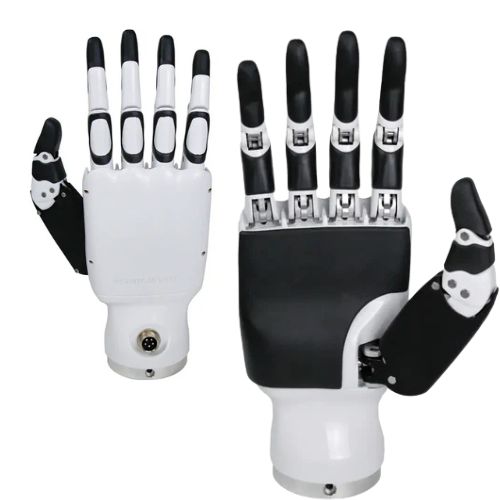
Dexterous Hands RH56DFX

The RH56DFX dextrous hand series features moderate speed, high gripping force and an integrated force sensor.
Compatible with ROS, it also has ready-to-use ROS plug-ins.

  • Active gripping force of fingertip: ≥ 3 kg
  • Tactile sensors: ≥ 17
  • Tactile data refresh rate: ≥ 30 Hz
  • Single-hand weight: 800 g
  • Power supply: DC 24V ±10%
  • Communication interface: RS485 or CAN
  • Degrees of freedom: 6
  • Number of joints: 12

What to consider before choosing

To select the most suitable version, it helps to define: the tasks your project needs to perform (locomotion, interaction, manipulation, perception, data collection, etc.), your test environment (floor type, space, access, supervision, connectivity, etc.), your software requirements (ROS2, low-level control, SDK, vision, GPU power), and your timeline.

Software ecosystem (API, ROS2, simulation)

Official resources indicate an API to control the robot and access status information, compatibility with ROS2, and simulation environments (Isaac Sim, MuJoCo, Webots) to prepare and test behaviors.

What information should you prepare for a quotation request?

Please specify: your budget (even if it’s an estimate), your project timeline (short term, awaiting funding, early study phase before the project, etc.), your address, and one sentence describing your project.

Download our brochure on the Booster T1

Brochure Booster T1

Technical specifications of the Booster T1 humanoid robot

Dimensions118 x 47 x 23 cm
Lower leg + thigh length57 cm
Arm reach45 cm
Weight30 kg
Degrees of freedom23 (standard version) / 31 (version with gripper) / 41 (version with hands)
Max. knee joint torque130 N.m
Joint encoderDual encoder
CPUHigh-performance 14-core processor
GPUNvidia AGX Orin, for 200 TOPS AI performance
Vision moduleDepth camera
IMU9-axis IMU
Voice moduleMicrophone array, speaker
Battery10.5Ah
Battery life2h (walking), 4h (standing)
Wi-Fi 6yes
Bluetooth 5.2yes
5Goptional
InterfaceUSB, Ethernet
Firmware updateyes
Edge LLMMiniCPM (optional)
Secondary developmentyes

Booster T1 robot resources

FAQ – Booster T1 humanoid robot

What level of “realistic” autonomy can I aim for right from the start?

On a research humanoid, it is generally more effective to start with constrained scenarios (motions, simple trajectories, repeatable actions), then progressively increase complexity (perception, interaction, manipulation). The right level mainly depends on your software resources, your test environment, and the time you can allocate to integration.

Which interfaces are available to control the robot (PC, smartphone, remote control)?

The Booster T1 is presented with a mobile control app via Bluetooth for certain functions (startup, basic control depending on available resources). For “project” control (tests, scenarios, automation), the most common approach is controlling from a computer over the network (Wi-Fi/Ethernet), relying on the available software interfaces.

And regarding software integration (API, ROS 2), what is planned?

Resources indicate an API (command and status feedback) as well as ROS 2 compatibility. Official repositories illustrate control via low-level exchanges (command and status feedback), and a ROS 2 SDK provides dedicated messages/services for control.

Which sensors are accessible and in what form (streams, rate, synchronization)?

For perception/AI projects, ask which outputs are exposed (depth camera, IMU, audio), at what rates, and how synchronization is handled. These details determine the feasibility of a vision/control pipeline or data collection for learning.

What workstation / network prerequisites should be anticipated?

Check the connection mode (Ethernet/Wi-Fi), the ports used, and whether your network imposes constraints (VPN, VLAN, proxy). In university or industrial environments, these can be blocking if not anticipated.

Can simulation be used for a “simulation → robot” workflow?

Yes, simulation environments are mentioned. For a project, clarify the availability of models (assets), the gap between simulation and robot (parameters, controllers), and the examples provided to accelerate setup.

What workload should be expected for manipulation (grippers or dexterous hands)?

Grasping is often the most costly part to tune: calibration, control, contact detection, repeatability. Before choosing an option, clarify your objective (pick/place vs fine gestures), target objects, and the expected level of precision.

What should be checked for real-world use (floors, space, safety)?

In practice, locomotion and stability are sensitive to the floor (friction, irregularities), available space, and supervision procedures. It is recommended to plan a safe test area and a progressive protocol (simple motions → full scenarios).

What is included in delivery (and what is optional)?

To avoid surprises, have confirmed what is included (robot, battery(ies), charger, transport elements, accessories) and what depends on the version (grippers/hands, communication options, additional parts). This is a classic pre-order checkpoint.

What support is available (documentation, examples, assistance)?

For a research/teaching team, documentation and examples often have more impact than the “spec list”. Before purchase, ask what is provided (manuals, tutorials, code samples, supervision tools) and how support is delivered (channel, response times, onboarding).

История цен

История средней цены

Одна точка данных на день; усреднение ведётся по дате наблюдения.

Средняя цена за день

Суммы в USD

$21 405,05
График средней цены в USDЛинейная диаграмма: 61 наблюдений с 2 окт. 2026 г. по 22 нояб. 2026 г..$36 000$32 000$28 000$24 000$20 0002 окт.14 окт.27 окт.9 нояб.22 нояб.2 окт. 2026 г.: средняя цена — $34 248,083 окт. 2026 г.: средняя цена — $34 248,084 окт. 2026 г.: средняя цена — $34 248,085 окт. 2026 г.: средняя цена — $34 248,086 окт. 2026 г.: средняя цена — $34 248,087 окт. 2026 г.: средняя цена — $34 248,088 окт. 2026 г.: средняя цена — $34 248,089 окт. 2026 г.: средняя цена — $34 248,0810 окт. 2026 г.: средняя цена — $34 248,0811 окт. 2026 г.: средняя цена — $34 248,0812 окт. 2026 г.: средняя цена — $34 248,0813 окт. 2026 г.: средняя цена — $34 248,0814 окт. 2026 г.: средняя цена — $34 248,0815 окт. 2026 г.: средняя цена — $34 248,0816 окт. 2026 г.: средняя цена — $34 248,0817 окт. 2026 г.: средняя цена — $34 248,0818 окт. 2026 г.: средняя цена — $34 248,0819 окт. 2026 г.: средняя цена — $34 248,0820 окт. 2026 г.: средняя цена — $34 248,0821 окт. 2026 г.: средняя цена — $34 248,0822 окт. 2026 г.: средняя цена — $34 248,0823 окт. 2026 г.: средняя цена — $34 248,0824 окт. 2026 г.: средняя цена — $34 248,0825 окт. 2026 г.: средняя цена — $34 248,0826 окт. 2026 г.: средняя цена — $34 248,0827 окт. 2026 г.: средняя цена — $34 248,0828 окт. 2026 г.: средняя цена — $34 248,0829 окт. 2026 г.: средняя цена — $34 248,0830 окт. 2026 г.: средняя цена — $34 248,0831 окт. 2026 г.: средняя цена — $34 248,081 нояб. 2026 г.: средняя цена — $34 248,082 нояб. 2026 г.: средняя цена — $34 248,083 нояб. 2026 г.: средняя цена — $34 248,084 нояб. 2026 г.: средняя цена — $34 248,085 нояб. 2026 г.: средняя цена — $34 248,086 нояб. 2026 г.: средняя цена — $34 248,087 нояб. 2026 г.: средняя цена — $34 248,088 нояб. 2026 г.: средняя цена — $34 248,089 нояб. 2026 г.: средняя цена — $34 248,0810 нояб. 2026 г.: средняя цена — $32 107,5811 нояб. 2026 г.: средняя цена — $21 405,0512 нояб. 2026 г.: средняя цена — $21 405,0513 нояб. 2026 г.: средняя цена — $21 405,0514 нояб. 2026 г.: средняя цена — $21 405,0515 нояб. 2026 г.: средняя цена — $21 405,0516 нояб. 2026 г.: средняя цена — $21 405,0517 нояб. 2026 г.: средняя цена — $21 405,0518 нояб. 2026 г.: средняя цена — $21 405,0519 нояб. 2026 г.: средняя цена — $21 405,0520 нояб. 2026 г.: средняя цена — $21 405,0521 нояб. 2026 г.: средняя цена — $21 405,0522 нояб. 2026 г.: средняя цена — $21 405,05

Средние значения рассчитываются за каждый день по UTC на основе всех зафиксированных цен предложений.