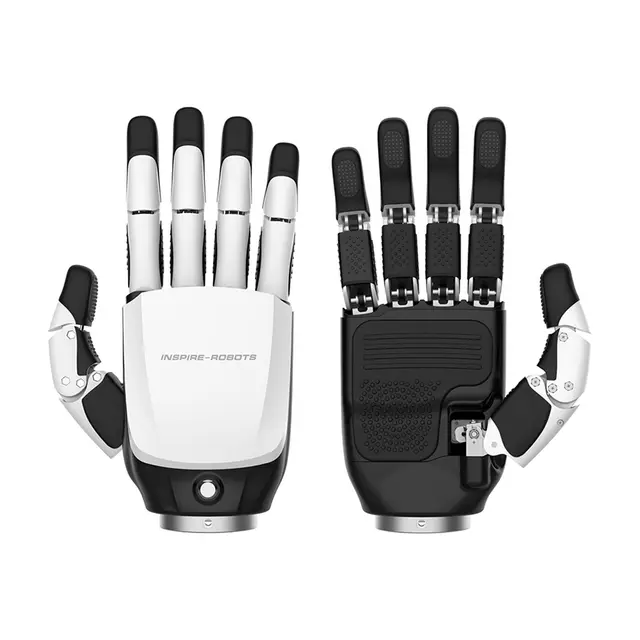
The Linkerbot Linker Hand L10 Standard is a linkage-driven dexterous robotic hand with 10 active and 10 passive degrees of freedom, built for manipulation research, humanoid robots and flexible automation. It weighs about 750 g in an aluminium-alloy frame and is made as a left or a right hand.
What sets the L10 apart in the Linker Hand range is where its ten motors go. Three drive the thumb (base pitch, abduction and rotation), four bend the base of each finger, and three move the index, ring and little fingers sideways, so the hand can spread its fingers around a wide object or hold a tool handle in a human grip. Ten passive joints let the fingers follow the shape of what they hold without a command for every contact.
Linkerbot's own motor modules drive the fingers through linkages, which keeps the motion robust and repeatable to ±0.20 mm. The hand carries up to 5 kg and pinches with 12 N. It connects over EtherCAT or CAN bus, and the SDK also handles RS-485 (Modbus). Linkerbot's Python, ROS 1 and ROS 2 SDKs include a GUI with a slider per joint, motion recording and replay, useful for teams collecting demonstration data. Force sensing, a 72-cell resistive tactile array or electronic skin can be specified for contact-rich work.
For more dexterity, the Linker Hand L20 Pro drives 16 joints including the fingertips; for a lighter hand with tactile sensing built in, see the Linker Hand O7. Compare them with all our dexterous robotic hands.
Key Capabilities
-
10 active, 10 passive joints: Ten motors drive the thumb in three axes, the base of each finger and the sideways spread of three fingers, and ten passive joints follow them.
-
Fingers that spread: The index, ring and little fingers move sideways under motor control, so the hand can widen a grasp or hold a tool handle the way a person does.
-
750 g, 5 kg payload: The aluminium-alloy hand weighs about 750 g, carries up to 5 kg and pinches with 12 N.
-
Linkage drive, ±0.20 mm: Linkerbot's own motor modules move the fingers through linkages, which keeps the motion robust and repeatable to ±0.20 mm.
-
EtherCAT or CAN: EtherCAT suits real-time control inside a larger system and CAN suits development work, and Linkerbot's SDK also speaks RS-485 (Modbus).
-
ROS 1, ROS 2 and Python: Linkerbot's SDKs include a GUI that moves each joint from a slider, records motions and plays them back.
-
Sensing options: Force sensing, a 72-cell resistive tactile array or electronic skin can be specified for contact-rich work and data collection.
Buying through Robotix Market
This unit is sourced new through established distribution channels and ships worldwide with the manufacturer warranty. Technical support is coordinated with the manufacturer's own service network. Deployment scope, configuration, and commissioning responsibilities are agreed as part of the quotation — on-site installation is not included in the product price.