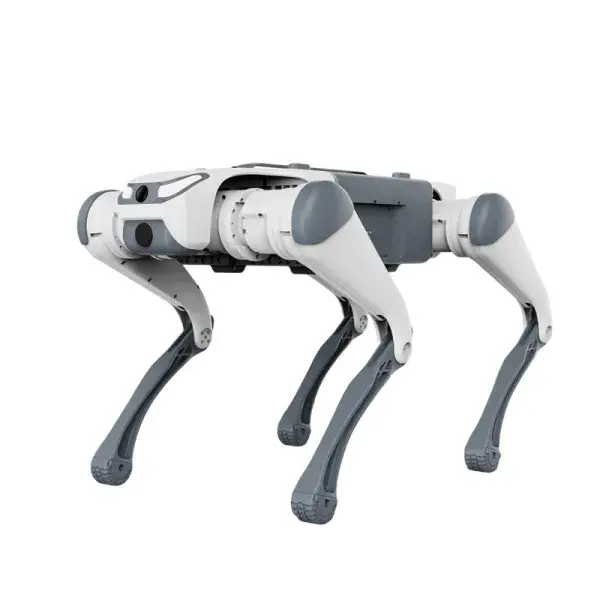
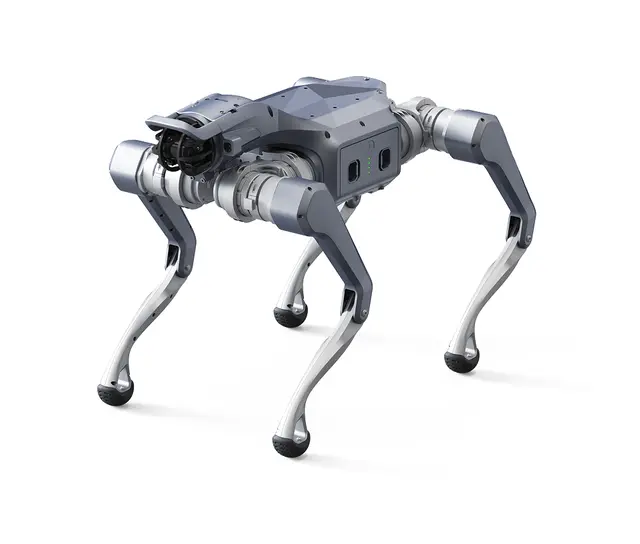
The LYNX S10 Pro is the autonomous model of DEEP Robotics' compact wheeled-legged range. Two 3D LiDARs, four ultra-wide-angle cameras and a second on-board computer let it map a site, locate itself on that map and run patrol and inspection routes without an operator steering it. Underneath is the body of the LYNX S10: about 21 kg with the battery, four legs with 16 joints and a powered 6.5 in tyre on each foot, light enough for one person to carry to the start of the route.
DEEP Robotics builds it for rounds that repeat: small substations and distribution rooms, light patrols of campuses, residential communities and factories, and daily patrols with video recording. Its LiDARs sit at the front and rear and its cameras face front, rear, left and right, so the operator sees all round the robot and the navigation software senses obstacles in every direction. Universities and labs use it as a multi-sensor platform for mapping, navigation and embodied-AI work.
LYNX S10 Pro or LYNX S10
Both models share the body, battery, runtime, 8 kg payload, climbing figures, IP66 sealing and the −20 to 55 °C range. The LYNX S10 has one front LiDAR, one front camera and one processor, and an operator drives it in Normal or Assist mode. The S10 Pro adds the rear LiDAR, three more cameras, a second octa-core processor for mapping and navigation, Navigation mode and two USB 3.0 Type-C ports for payloads.
Mapping, navigation and charging
The robot builds point cloud and grid maps on board for areas up to about 50 × 50 m; larger sites are mapped with a handheld scanner and the map is imported. In Navigation mode it follows its planned route and inspection points, stops at or steers round obstacles it senses in real time, and needs no one at the controls. For long unattended operation it recharges itself at the optional charging dock. The swappable 72 V, 4.5 Ah battery gives about 3 hours or 14 km without load and about 2 hours or 8 km with a payload, and charges in about 1.5 hours. An operator can take over at any time from the handheld remote controller, which shows the live camera views, battery level, remaining range and joint temperatures; an Android phone app is also available. Software updates arrive over the air.
Payloads and development
Equipment mounts on two rails with 12 M4 holes on the back, up to 8 kg and about 30 cm high. Five ports serve it: 24 V with 100 Mbit Ethernet, PPS and SBUS; 24 V with Gigabit Ethernet; a 72 V charge and discharge port; and two USB 3.0 Type-C ports, with up to 288 W in total for payloads and up to 100 W from the 24 V supply. Developers work through a TCP/UDP protocol that is encrypted by default, ROS 2 topics for the IMU, LiDAR point cloud, robot status and charging state, and a Motion SDK mode for joint-level control at up to 200 Hz, with DEEP Robotics' URDF model and code on GitHub and a STEP model of the robot.
Operating notes from DEEP Robotics
Its operating speed is 2 m/s, and it climbs stairs with steps up to 20 cm, single steps and platforms up to 50 cm and slopes up to 40°, depending on the surface. DEEP Robotics advises keeping it off ice, very slippery floors, sharp or broken ground and drop edges, and keeping 1 m clear around it when it starts. It is sealed to IP66 with the battery fitted: wipe it dry after rain and do not immerse it. Batteries charge at 0 to 40 °C, and the robot is stored at −20 to 70 °C.
Key Capabilities
-
On-board mapping and navigation: A second octa-core processor builds the site map, locates the robot on it and plans routes, so patrol rounds run without an operator.
-
Two LiDARs, four cameras: 3D LiDARs at the front and rear and ultra-wide-angle cameras at the front, rear, left and right give it an all-round view.
-
Autonomous charging: At the optional charging dock it recharges on its own for long unattended operation, and its swappable 72 V battery charges in about 1.5 hours.
-
Stairs, platforms and 40° slopes: Sixteen joints and a 6.5 in tyre on each foot carry it at an operating speed of 2 m/s, up stairs with 20 cm steps, onto 50 cm platforms and up 40° slopes.
-
IP66 from −20 to 55 °C: The body is sealed against dust and powerful water jets for outdoor rounds in rain, dust and cold.
-
8 kg payload, five ports: Two rails take up to 8 kg of equipment, powered and connected through three aviation ports and two USB 3.0 Type-C ports.
-
About 21 kg: One person lifts it out of its transport case by the side handles and sets it down at the start of the route.
Options such as the charging dock and the smart charging hub for charging batteries outside the robot are quoted separately.
Buying through Robotix Market
This unit is sourced new through established distribution channels and ships worldwide with the manufacturer warranty. Technical support is coordinated with the manufacturer's own service network. Deployment scope and configuration are agreed as part of the quotation, and on-site installation is not included in the product price.