Humanoide

ROBOTIS AI Sapiens K1 — Especificaciones, precio y dónde comprar (2026)

ROBOTIS's open humanoid for physical-AI research, from the Seoul maker of DYNAMIXEL servos: 1,355 mm and 35 kg, with 23 joints driven by its own DYNAMIXEL-Q quasi-direct-drive actuators, an NVIDIA Jetson Orin NX 16GB and a 460.8 Wh battery. Its ROS 2 software and 3D model are open (Apache-2.0); ROBOTIS starts selling it in November 2026, first to Korean universities and research institutes.

📅Primera fabricación
2026
🌍Origen
KR
📏Altura
1.355 m
⚖️Peso
35 kg
🦾Grados de libertad
23
🔋Batería
460.8 Wh
🛒Disponibilidad
—

What is the ROBOTIS AI Sapiens K1?

ROBOTIS's open humanoid for physical-AI research, from the Seoul maker of DYNAMIXEL servos: 1,355 mm and 35 kg, with 23 joints driven by its own DYNAMIXEL-Q quasi-direct-drive actuators, an NVIDIA Jetson Orin NX 16GB and a 460.8 Wh battery. Its ROS 2 software and 3D model are open (Apache-2.0); ROBOTIS starts selling it in November 2026, first to Korean universities and research institutes.

Specifications

Facts about the ROBOTIS AI Sapiens K1 from its project's published documentation, design files and its makers' own figures. A figure marked Estimate is worked out from those files or parts lists rather than stated by the maker.

SpecDetail
Size1,355 mm tall (ROBOTIS); its drawing gives 292 mm across the shoulder joints and 204.8 mm from chest to back. In ROBOTIS's 3D model the legs' hip joints are 250 mm apart, the thigh is 357 mm from the hip-pitch axis to the knee and the shin 294 mm from the knee to the ankle (measured).
Weight35 kg (ROBOTIS). The link masses in ROBOTIS's 3D model add up to 35.71 kg; the torso alone is 8.49 kg.
Joints23 joints, all driven by DYNAMIXEL-Q actuators: 6 per leg (hip pitch, roll and yaw, knee, ankle pitch and roll), 5 per arm (shoulder pitch and roll, an upper-arm twist, the elbow and a wrist twist) and 1 at the waist, which turns the whole upper body. The head is fixed: there is no neck joint.
Joint motorsROBOTIS's own quasi-direct-drive actuators, each with a frameless motor, 20:1 gears, two encoders and an ARM Cortex-M33: 11 QC080-240-R020-RE (waist, hips, knees, ankle pitch; 24.2 N·m continuous, 72.6 N·m peak; 845 g on ROBOTIS's AI Sapiens page, 865 g on its product page) and 12 QC060-200-R020-RE (ankle roll and arms; 10.6 and 30.0 N·m; 435 g or 455 g). ROBOTIS's 3D model allows 96.9 and 47.3 N·m.
Ankle driveEstimate: the ankle-pitch actuator sits in the shin, 185 mm above the ankle (measured), and tips the foot through a black crank and a push rod to a lever at the back of the ankle; the ankle-roll actuator sits in the ankle itself. (Estimate: Inferred from ROBOTIS's 3D model and photos: the crank and rod are drawn, but ROBOTIS does not describe the drive.)
Range of motionIn ROBOTIS's 3D model (software limits, not measured travel: ROBOTIS publishes no ranges, and round values such as the waist's ±360° and the many ±180° look like stand-in values): hip pitch ±140°, hip roll −35° to 145° (outwards), hip yaw ±180°, knee 0° to 135°, ankle pitch ±45°, ankle roll ±30°; waist ±360°; shoulder pitch ±180°, shoulder roll 0° to 180° (outwards), upper-arm twist ±180°, elbow −45° to 125°, wrist twist ±180°.
ComputerNVIDIA Jetson Orin NX 16GB (8-core Arm Cortex-A78AE, 1,024-core Ampere GPU, up to 157 TOPS) with a 256 GB SSD, Wi-Fi 5 and Bluetooth 5.0 (Realtek RTL8822CE), Ethernet ports of 2.5 and 1 Gbps, four USB-A and one USB-C. ROBOTIS's photo shows it under NVIDIA's heat sink with a fan.
BatteryA lithium-ion pack of 26 LG Energy Solution M50LT 21700 cells, 13 in series and 2 in parallel: 48 V, 10 Ah, 460.8 Wh. It slides straight into a bay in the torso next to the red emergency stop; its power button and LEDs are on the pack's side panel. ROBOTIS gives no runtime (a third-party spec listing gives about two hours).
Boards and busesROBOTIS's HAT board: an STM32H562AGI6 bridges Ethernet to five RS-485 buses at up to 6 Mbps for the 23 actuators and the IMU board; an STM32C532CCU6 handles the remote control and battery monitoring; it takes 30–60 V, gives 24 V and 12 V at up to 5 A each, and runs the emergency stop and the LEDs. In ROBOTIS's settings the right leg and the waist share one bus (7 actuators).
SensorsAn IMU board in the pelvis (an STM32C532CCU6 with an ICM-42688-P or BNO085); ROBOTIS gives an 8 kHz IMU update without saying which chip that is for. Every actuator reports its position, speed and current. ROBOTIS's photos also show a camera with two lenses behind the helmet's black band, which its specifications do not list.
Head cameraEstimate: in ROBOTIS's 3D model the camera behind the face band measures 90.7 × 25.1 × 24.7 mm, the size of Intel RealSense's D435 depth camera (90 × 25 × 25 mm); ROBOTIS does not name it. (Estimate: A match by size and look only; ROBOTIS lists no camera.)
SoftwareCyclo OS (built with the Yocto Project) and ROS 2 Jazzy in a Docker container on the Jetson; ROS 2 control runs at 1 kHz on a real-time (PREEMPT-RT) kernel and sends each actuator a target, a feed-forward torque and two impedance gains. ROBOTIS trains whole-body skills on 4,096 simulated K1s in NVIDIA Isaac Lab (about 4 hours per motion) and runs the policy on the robot at 50 Hz.
Remote controlA RadioMaster Pocket radio remote (ExpressLRS link) with E-STOP switches; the HAT board reads its channels and link quality.
SafetyA red emergency-stop button on the back of the torso cuts power to the actuators when pressed; it latches, and a twist releases it.
CoolingA fan on the computer's heat sink (ROBOTIS's photo). The actuators have no fans: a report says ROBOTIS designed the DYNAMIXEL-Q to need none.
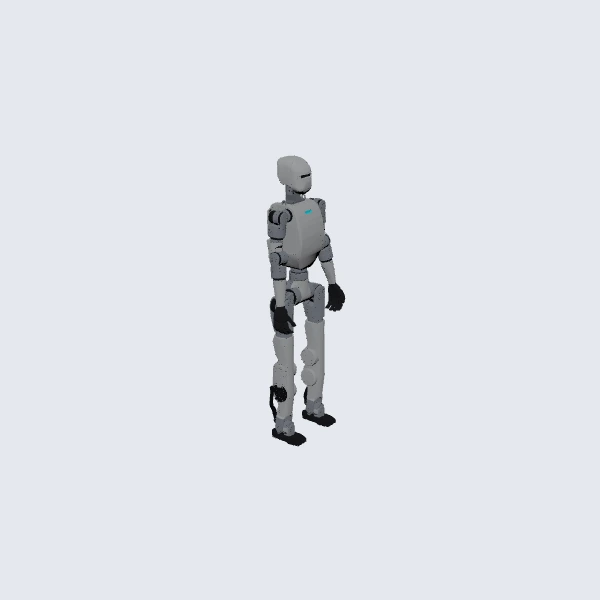
LookLight grey matt covers on the helmet, chest, back, pelvis, thighs, shins and upper arms; polished metal housings at the shoulders, hips and pelvis (aluminium alloy, per a third-party spec listing); black actuators, hands, feet and ankle linkages; a black band across the helmet over the camera, a cyan light bar on the chest and a red emergency stop (ROBOTIS's photos). ROBOTIS's product renders show a different head: an egg shape under a black cap.
HandsBlack rubber hands with fixed fingers: they cannot grip (ROBOTIS's 3D model names them rubber hands and has no finger joints).
PriceNot announced. ROBOTIS planned to publish the final specifications and price in September 2026 (iNews24); none was public on 15 Oct 2026. Its CEO said the price can be similar to or lower than the AI Worker's (from ~$60,512 before VAT at Generation Robots, converted from euros at the ECB rate of 9 Oct 2026). Lower figures are unconfirmed: early reports in April said $8,000–12,000, a Korean financial news site wrote that it would cost ₩10–20 million (~$7,454–14,909), and a third-party spec listing's database lists $8,000 with a 'Not Verified' mark. The dataset's parts-cost estimate is ~$6,825 (~$8,265 to build, with factory work), so a price under ~$10,000 would leave ROBOTIS little or no margin.
AvailabilityOfficial sales start in November 2026, first only to Korean universities and research institutes; the first batch is already sold (Sisa Journal-e, 7 Sep 2026). Through its OH!GYM! programme ROBOTIS gave K1 robots and its open-source software free to four university teams (Seoul National University, Yonsei, Seoul National University of Science and Technology and Gachon), which showed their results on 31 Aug 2026; phases 2 and 3 are planned.
Made inSeoul, South Korea: ROBOTIS builds about 10 K1s a month at first at its Magok headquarters and aims at 10,000 humanoids a year from 2027. All its Q-series actuators are to be made at its new plant in Uzbekistan, which starts partly in October 2026.
MakerROBOTIS (Seoul), the maker of DYNAMIXEL servos; it developed the AI Sapiens from March 2026 and finished it in about two months (ZDNet Korea), and it also makes the AI Worker, a humanoid on wheels.
Parts costEstimate: ~$6,825 for the parts, the dataset's line-by-line estimate of what ROBOTIS pays, scaled from the teardown costs for the Unitree G1 and NVIDIA's module price. No K1 parts list or teardown is public (ROBOTIS says its parts list is coming). The 23 actuators are 62% of it. (Estimate: No K1 teardown or price list exists; the actuator costs come from another maker’s joints.)
Open modelROBOTIS publishes the K1's URDF (25 links, 23 joints, a fixed head, one STL mesh per link in millimetres) and a MuJoCo model with the two actuator classes, under Apache-2.0 (commit 937c67d of 8 Oct 2026). Its STEP files, parts list, 3D-printable covers and circuit-board files are announced as coming.
Pose shownArms lowered as in ROBOTIS's photos (shoulder roll ±0.16 rad, elbows 1.4 rad); every other joint at 0, ROBOTIS's own 'home' pose. (Estimate: The authors' choice of arm angles, matched by eye to ROBOTIS's photos; the rest is ROBOTIS's own keyframe.)

3D model

The interactive 3D model on this page is converted from the project's published design: AI Sapiens K1 by ROBOTIS (github.com/ROBOTIS-GIT/ai_sapiens, ai_sapiens_description, K1 rev1). 3D model under the Apache License 2.0: commercial use allowed; the licence and a list of the dataset's changes travel with the model. ROBOTIS does not endorse this model.

Sources

ROBOTIS AI Sapiens K1 in 3D

Loading the 3D model…
Drag to rotate · click the model, then scroll or pinch to zoom · click a part to inspectSwipe sideways to turn · pinch to zoom · tap a part to inspect3D model credit and licence

ROBOTIS AI Sapiens K1 supply chain

Point at or select a step to light up its chain: bright lines are its direct links, softer lines the rest of the path from raw material to robot.

Swipe sideways to follow the whole chain.

ExtractionRefiningMaterialsComponentsModulesRobotsCompaniesROBOTIS makes the DYNAMIXEL-Q QC080 (its own product page).ROBOTIS makes the DYNAMIXEL-Q QC060 (its own product page).Lithium compounds (carbonate, chloride, hydroxide) are produced from mined lithium.Lithium is produced from brine and mineral operations.Mined copper is smelted and refined.Primary aluminium from smelters.Bauxite is refined to alumina for aluminium.6061 aluminium contains 0.8–1.2% magnesium.6061 aluminium contains 0.40–0.8% silicon.A lithium-ion cell has a cathode (positive electrode), typically a metal oxide or phosphate. IEA tracks the 2025 mix of LFP and nickel-based cathodes in electric-car batteries.Camera units are built around image sensors (CMOS image sensors from makers such as Sony and OmniVision).Silicon metal is made from silica in natural forms such as quartzite (USGS).Silicon metal can be refined further into ultra-high-purity semiconductor-grade silicon, called polysilicon (USGS). Chips are made on wafers: thin slices of crystalline silicon (Wikipedia).Magnesium is recovered from dolomite, serpentine, magnesium-bearing evaporite minerals and brines (USGS).In wire-bond packaging, fine gold or copper wire connects each die to its leadframe or substrate. ASE is gradually replacing gold wire with copper to cut material cost, though gold wire is still one of its main materials.Sony makes its CMOS image sensors in its own production facilities in Japan (Nagasaki, Kumamoto). SIA/BCG count optoelectronics and sensors in one fab group with discrete and analog chips (DAO), apart from logic.Bosch makes its MEMS sensors in its own fabs in Reutlingen and Dresden; a MEMS sensor is a MEMS element plus an evaluation chip (ASIC).A MEMS sensor is packed in a semiconductor housing, such as an LGA package (Bosch).Mined cobalt is refined further into chemicals or metal (Cobalt Institute). In 2025 DR Congo's export restrictions left refiners short of cobalt hydroxide feed and forced some to limit production, though world refined output still rose 5% to 240 kt (Cobalt Institute).Cobalt sulphate, the largest refined cobalt product, is typically used in NCM (NMC) batteries, and cobalt tetroxide often in LCO batteries (Cobalt Institute). Cobalt-free substitutes that use iron and phosphorus (LFP) held a significant market share in China (USGS).Mined nickel ore and concentrate go to smelters and refineries. In Indonesia, laterite ore is processed into nickel pig iron and ferronickel for stainless steel, or into battery intermediates such as mixed hydroxide precipitate (IEA); the US Eagle Mine's concentrate is exported to smelters (USGS).Battery cathodes need nickel sulphate, made from Class I nickel metal or from intermediates such as mixed hydroxide precipitate and nickel matte (IEA). LFP (lithium iron phosphate) cathodes contain no nickel.Lithium-ion cathodes are lithium compounds, generally a layered oxide (such as lithium cobalt oxide), a phosphate (lithium iron phosphate) or a spinel (lithium manganese oxide). Batteries took an estimated 88% of world lithium in 2025 (USGS).Natural graphite flakes must be made into spherical particles, purified to over 99.95% carbon and coated before they can be used in lithium-ion battery anodes (IEA). Natural graphite is now a small part of anode supply: under 8% of China's 2025 anode shipments (GGII), and about 14% worldwide in 2022 (Rystad).Synthetic graphite is made by calcining and graphitising petroleum coke or needle coke at nearly 3,000 °C (IEA). It was 92.7% of China's 2025 anode shipments (GGII).The negative electrode (anode) of a conventional lithium-ion cell is typically graphite. IEA's 2025 data on electric-car battery anodes show only graphite and silicon-doped graphite.Solder is the largest use of tin, 51% of world tin use in 2023 (International Tin Association; in the US solder took 11%, USGS). The common lead-free alloy SAC305 is 96.5% tin (AIM).Tin-lead solder is nearly half lead (PubChem), but the electronics industry has moved toward lead-free solders (USGS): 92% of solder for electronics was lead-free in 2023 (ITA).The lead-free alloy SAC305 contains 3% silver (AIM). In the US, brazing and solder took 3% of silver (USGS).The lead-free alloy SAC305 contains 0.5% copper (AIM).FR-4 laminate is woven fibreglass cloth with an epoxy binder (Wikipedia), and fibreglass is made from silica sand (Covia).A thin layer of copper foil is laminated to one or both sides of an FR-4 panel; these are called copper-clad laminates (Wikipedia; ChinaBaogao).FR-4 epoxy resin systems typically use bromine to resist fire (Wikipedia); a grade of the brominated flame retardant TBBPA is used to make epoxy resins for circuit boards (Wikipedia). Brominated flame retardants are one of bromine's two leading uses (USGS).Barite is used to make barium carbonate, which goes into dielectrics (Wikipedia). Barium titanate, the dielectric ceramic used in capacitors, can be made by heating barium carbonate with titanium dioxide (Wikipedia).Barium titanate, the ceramic in high-capacitance MLCCs, can be made by heating barium carbonate with titanium dioxide (Wikipedia); titanium dioxide comes from ilmenite and rutile (USGS).99% of MLCCs made worldwide use base-metal electrodes of nickel or copper; the industry moved from palladium and silver to cut cost (NASA, 2015). TDK replaced palladium electrodes with nickel in 1993 (Wikipedia).Platinum-group metals are used in multilayer ceramic capacitors (USGS). High-reliability MLCCs use palladium-silver electrodes (NASA, 2015).High-reliability MLCCs use precious-metal electrodes of palladium and silver (NASA, 2015).Connector contacts are copper alloys: beryllium copper is called the best copper alloy for contacts, connectors and cables (Wikipedia), and phosphor bronze (copper-tin-phosphorus) can replace it (USGS).Copper-clad laminate is the core material of circuit boards (ChinaBaogao); FR-4 is a common material for printed circuit boards (Wikipedia).Parts are soldered onto bare boards: Adafruit's BNO055 board is a "breakout PCB", and the Raspberry Pi Zero 2 W brief warns against damage to the printed circuit board.SAC305 lead-free solder is made for soldering printed circuits, by wave, hand and SMT reflow soldering (Conro; AIM).MLCCs store and release charge and absorb noise in phones, home appliances and IoT devices (Murata). The Raspberry Pi's RP3A0 package includes the decoupling capacitors that smooth its supply voltage (Raspberry Pi).Boards carry connectors: the Raspberry Pi Zero 2 W brief speaks of the board and its connectors, and Waveshare's servo adapter has a USB-C connector and a power connector.NVIDIA's Jetson Thor modules are 100 × 87 mm and plug in through a 699-pin board-to-board (B2B) connector (NVIDIA).Brass is copper and zinc: CW614N free-cutting brass is about 39% zinc. In the US, brass and bronze are the second use of zinc after galvanized steel.Brass is mostly copper: 57–59% in CW614N free-cutting brass.Free-cutting brass such as CW614N holds 2.5–3.5% lead so it machines cleanly; lead-free brasses exist.XT30 battery plugs (G1 harness, Open Duck Mini) have gold-plated brass contacts.Antimony is used in circuit boards to cut flammability further. A review lists two studies of scrap PC boards, parts and solder still on, with 0.45% and 1.97% antimony, so the share in the laminate alone is not known.Heat sinks are often aluminium: the Go2's main board has two fans blowing over an aluminium heat sink (Simplexity).In the Unitree G1, the heat pipe and heat spreaders that teardowns show are copper: a copper heat pipe presses against a motor (a published teardown), and copper heat-spreader plates cool its knees (China Post Securities).Rubber hands: ROBOTIS's 3D model names each hand a 'rubber hand'.Lithium-ion cells: 26 LG Energy Solution M50LT 21700 cells, 13 in series and 2 in parallel (ROBOTIS).A circuit board with two STM32 microcontrollers, an Ethernet chip and power converters (ROBOTIS).Yellow Amass power plugs and the bus connectors on the board (ROBOTIS's photo).The motion sensor: an ICM-42688-P or a BNO085 (ROBOTIS).A small circuit board with an STM32C532CCU6 microcontroller (ROBOTIS).ROBOTIS: a frameless BLDC motor (a low-inertia inner-rotor PMSM).ROBOTIS: an ARM Cortex-M33 controller board in every QC080.ROBOTIS: Amass XT30U(2+2)-F connectors.ROBOTIS: a frameless BLDC motor (a low-inertia inner-rotor PMSM).ROBOTIS: an ARM Cortex-M33 controller board in every QC060.ROBOTIS: Amass XT30U(2+2)-F connectors.ASML's DUV machines, 'the workhorses of the industry', print the majority of layers in chips, older-generation chips included (ASML annual report 2025).The frame, housings, covers, hands and ankle linkages that make up the K1's body (ROBOTIS's 3D model and drawing).11 QC080 actuators: the waist, both hips (pitch, roll and yaw), both knees and both ankle-pitch joints (ROBOTIS's specifications and MuJoCo model).12 QC060 actuators: both ankle-roll joints and all ten arm joints (ROBOTIS's specifications and MuJoCo model).One battery pack, which slides into a bay in the torso (ROBOTIS).The HAT board on top of the computer: the DYNAMIXEL hub, the power rails, the emergency stop and the battery monitor (ROBOTIS).The IMU board in the pelvis (ROBOTIS's electrical page and software).An NVIDIA Jetson Orin NX 16GB module (up to 157 TOPS) with a 256 GB SSD (ROBOTIS).A camera with two lenses behind the helmet's face band (ROBOTIS's close-up photo and 3D model); ROBOTIS's specifications do not name it.A fan on NVIDIA's heat sink over the Jetson module (ROBOTIS's photo of the computer).Cables join the battery, the boards and the 23 actuators: five RS-485 buses from the HAT board, with Amass XT30 (2+2) plugs on every actuator (ROBOTIS).Circuit boards besides the computer and ROBOTIS's own two: the carrier board under the Jetson (two Ethernet ports, four USB-A ports, a 9–19 V input) and the chest's light (ROBOTIS's photo and docs).ROBOTIS makes this robot.Quartz and silica sandQuartz and silica sandMagnesium ores and brinesMagnesium ores and brinesOil, gas and coal(plastics feedstock)Oil, gas and coal (plastics feedstock)Lithography machines (chipprinting)Lithography machines (chip printing)Mature-node chipfabrication (28 nm and…Mature-node chip fabrication (28 nm and older; analog and sensor chips)Aluminium alloysAluminium alloysBattery-grade lithiumcompoundsBattery-grade lithium compoundsLithium chemicalconversionLithium chemical conversionCopper smelting andrefiningCopper smelting and refiningAlumina refining andaluminium smeltingAlumina refining and aluminium smeltingLithium miningLithium miningCopper miningCopper miningBauxite miningBauxite miningMagnesium smeltingMagnesium smeltingSilicon metal smeltingSilicon metal smeltingChip packaging and test(OSAT)Chip packaging and test (OSAT)Frameless torque motorsFrameless torque motorsImage sensorsImage sensorsIMUs (motion sensors)IMUs (motion sensors)Lithium-ion cellsLithium-ion cellsAI compute modulesAI compute modulesCameras and depth camerasCameras and depth camerasCobalt miningCobalt miningCobalt refining (chemicalsand metal)Cobalt refining (chemicals and metal)Nickel miningNickel miningNickel smelting andrefiningNickel smelting and refiningNatural graphite miningNatural graphite miningBattery anode graphite(spherical natural and…Battery anode graphite (spherical natural and synthetic)Cathode active material(NMC, NCA, LCO, LFP)Cathode active material (NMC, NCA, LCO, LFP)Titanium minerals(ilmenite and rutile)Titanium minerals (ilmenite and rutile)Soft covers (textiles,foams, soft polymer skins)Soft covers (textiles, foams, soft polymer skins)Tin miningTin miningLead miningLead miningSilver miningSilver miningPalladium mining(platinum-group metals)Palladium mining (platinum-group metals)Antimony miningAntimony miningBromine (from brines)Bromine (from brines)Barite mining (barium)Barite mining (barium)Solder (tin alloys:lead-free SAC and…Solder (tin alloys: lead-free SAC and tin-lead)Copper-clad laminate (FR-4glass-fibre epoxy board…Copper-clad laminate (FR-4 glass-fibre epoxy board material)Printed circuit boards(bare boards)Printed circuit boards (bare boards)Multilayer ceramiccapacitors (MLCC)Multilayer ceramic capacitors (MLCC)Connectors and wiringharnessesConnectors and wiring harnessesElectronics assembly(circuit boards with part…Electronics assembly (circuit boards with parts soldered on)Zinc miningZinc miningBrass (copper-zinc alloy)Brass (copper-zinc alloy)Cooling fans and heatsinksCooling fans and heat sinksROBOTISROBOTISROBOTIS AI Sapiens K1ROBOTIS AI Sapiens K1Structure: ROBOTIS AISapiens K1Structure: ROBOTIS AI Sapiens K1ROBOTIS DYNAMIXEL-Q QC080actuatorROBOTIS DYNAMIXEL-Q QC080 actuatorROBOTIS DYNAMIXEL-Q QC060actuatorROBOTIS DYNAMIXEL-Q QC060 actuatorAI Sapiens battery pack(13S2P, 48 V, 10 Ah)AI Sapiens battery pack (13S2P, 48 V, 10 Ah)AI Sapiens HAT board(DYNAMIXEL hub and power)AI Sapiens HAT board (DYNAMIXEL hub and power)AI Sapiens IMU boardAI Sapiens IMU board