Precio medio diario
Importes en USD
Descripción
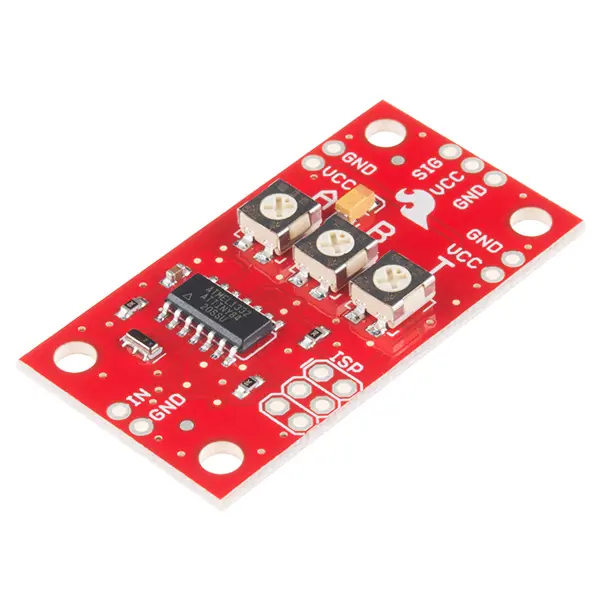
Simple, Code-Free Control for Continuous Rotation Servos The SparkFun Continuous Rotation (CR) Servo Trigger is designed for one purpose: to make controlling continuous rotation servos effortless. It's the perfect solution for artists, students, and hobbyists who need to create simple, switch-activated motion—like driving a small robot, spinning a prop, or opening a gate—without the hassle of writing or debugging code. Intuitive Dial-Based Speed Control Operation is incredibly straightforward. Connect your continuous rotation servo, a power source (5.5V max), and a trigger (like a button or logic signal). The board features three on-board potentiometers to set the exact behavior: Speed "A": Use this pot to set the servo's speed and direction when the switch is open. You can dial this in to be "Stop" (typically a 1500µs pulse), full-reverse, or any speed in between. Speed "B": Use this pot to set the servo's speed and direction when the switch is closed (e.g., "Full Speed Forward"). Time "T": This pot controls the ramp time, allowing you to set how long it takes to accelerate from Speed A to Speed B and decelerate back. You can create a sudden "jolt" or a slow, smooth spin-up. A Community-Driven Design This board is a direct response to feedback from our original Servo Trigger. Users loved the "no-code" simplicity but needed a version specifically for continuous rotation servos. This CR version comes pre-programmed with that logic. At its heart, an Atmel ATtiny84 microcontroller manages the control, drawing only about 5mA at 5V (not including the servo). For larger installations, the CR Servo Trigger can be easily daisy-chained by connecting the VCC and GND pads of adjacent boards. Note: This idea originally came from our friend in the Oakland area, CTP. If you see him, please give him a high-five for us.
Simple, Code-Free Control for Continuous Rotation Servos The SparkFun Continuous Rotation (CR) Servo Trigger is designed for one purpose: to make controlling continuous rotation servos effortless. It's the perfect solution for artists, students, and hobbyists who need to create simple, switch-activated motion—like driving a small robot, spinning a prop, or opening a gate—without the hassle of writing or debugging code. Intuitive Dial-Based Speed Control Operation is incredibly straightforward. Connect your continuous rotation servo, a power source (5.5V max), and a trigger (like a button or logic signal). The board features three on-board potentiometers to set the exact behavior: Speed "A": Use this pot to set the servo's speed and direction when the switch is open. You can dial this in to be "Stop" (typically a 1500µs pulse), full-reverse, or any speed in between. Speed "B": Use this pot to set the servo's speed and direction when the switch is closed (e.g., "Full Speed Forward"). Time "T": This pot controls the ramp time, allowing you to set how long it takes to accelerate from Speed A to Speed B and decelerate back. You can create a sudden "jolt" or a slow, smooth spin-up. A Community-Driven Design This board is a direct response to feedback from our original Servo Trigger. Users loved the "no-code" simplicity but needed a version specifically for continuous rotation servos. This CR version comes pre-programmed with that logic. At its heart, an Atmel ATtiny84 microcontroller manages the control, drawing only about 5mA at 5V (not including the servo). For larger installations, the CR Servo Trigger can be easily daisy-chained by connecting the VCC and GND pads of adjacent boards. Note: This idea originally came from our friend in the Oakland area, CTP. If you see him, please give him a high-five for us.
Historial de precios
Un punto de datos por día, calculado según la fecha de observación.
Importes en USD
Los promedios se calculan por día UTC a partir de todos los precios de oferta registrados.
RoboSavvy · London, GB
£13,57
RoboSavvy · London, GB
£12,25
RoboSavvy · London, GB
£12,37
RoboSavvy · London, GB
£13,86
RoboSavvy · London, GB
£12,25
RoboSavvy · London, GB
£14,17
RoboSavvy · London, GB
£12,25
RoboSavvy · London, GB
£12,92
RoboSavvy · London, GB
£11,92
RoboSavvy · London, GB
£13,11
RoboSavvy · London, GB
£14,20
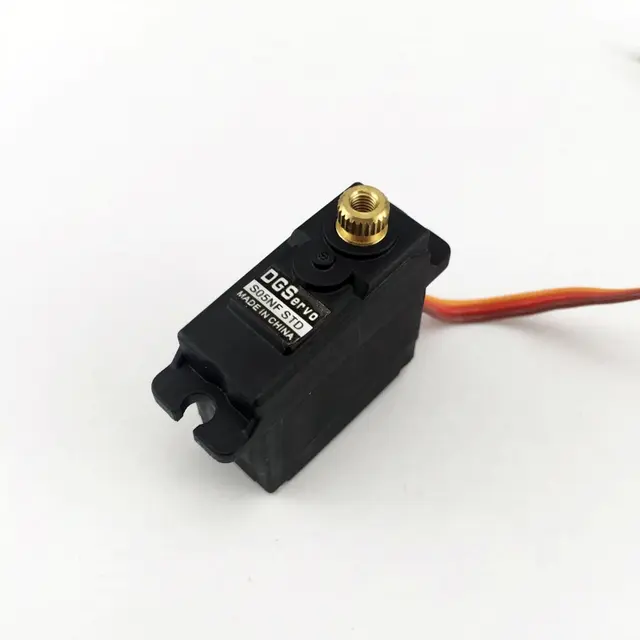
RoboSavvy · London, GB
£14,25
🍪 Preferencias de cookies
Usamos cookies para medir el rendimiento. Política de privacidad