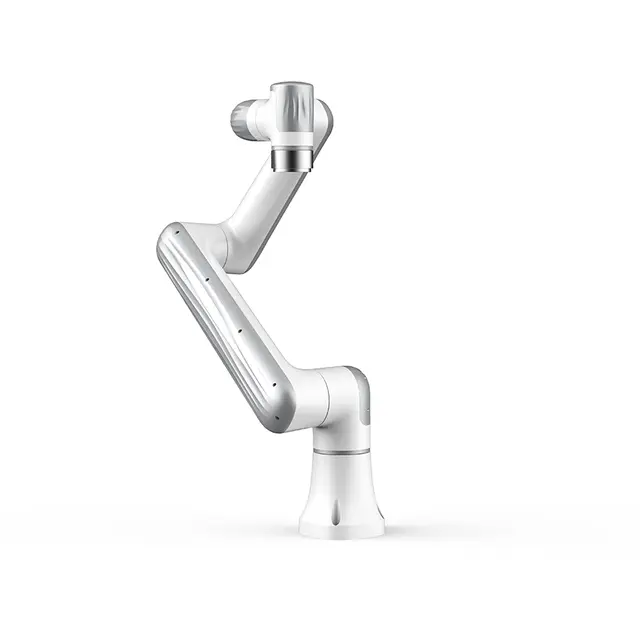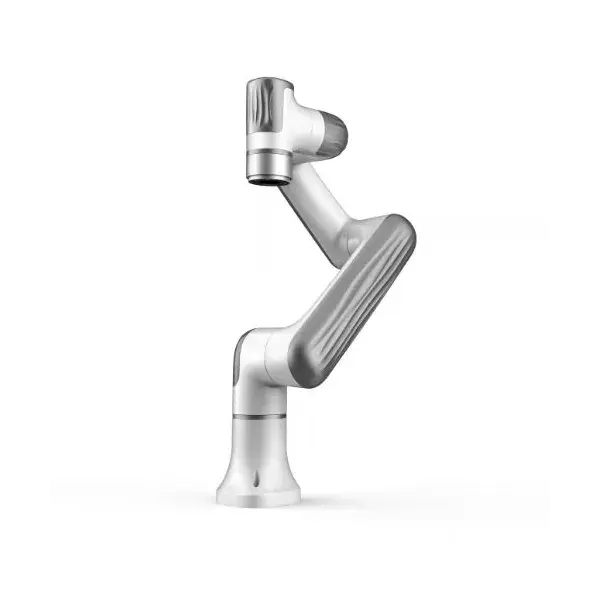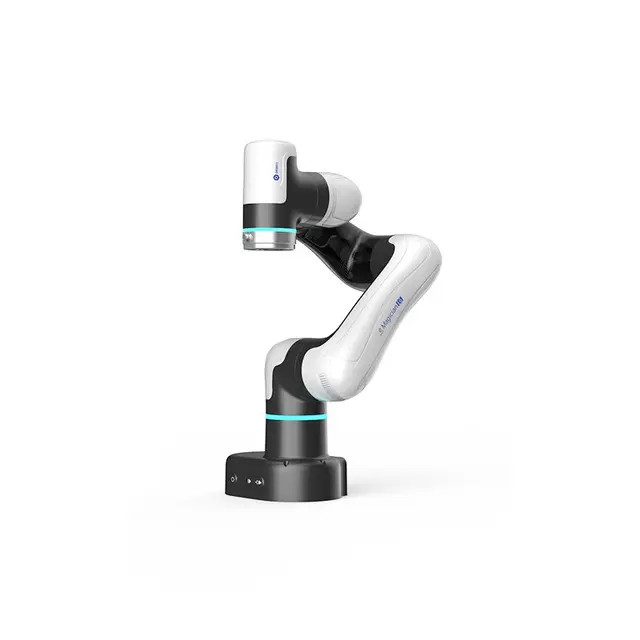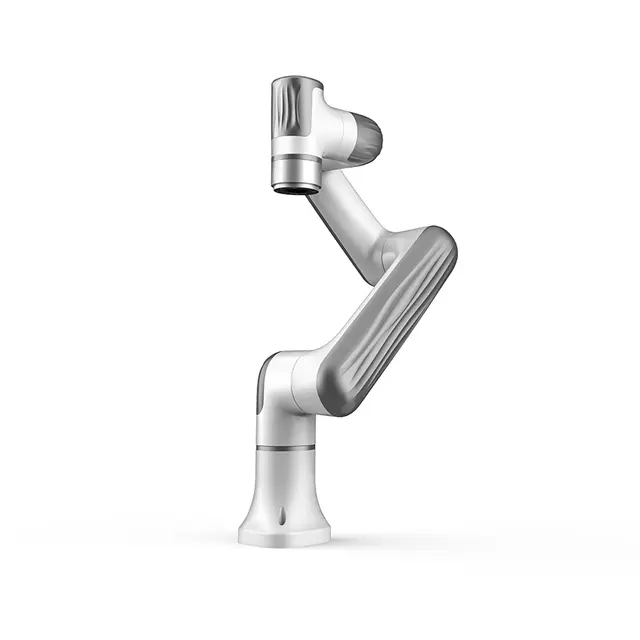
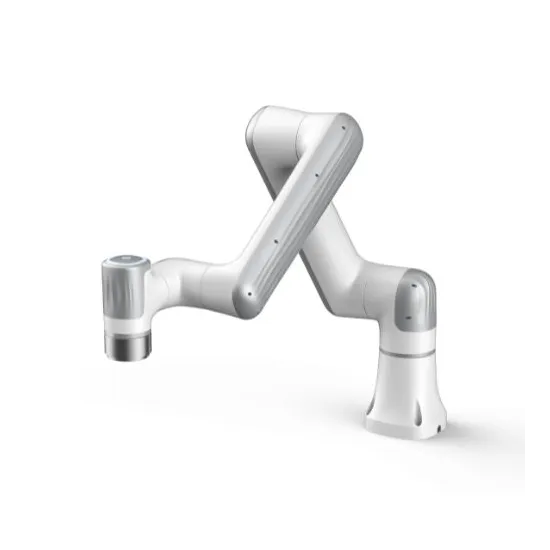
DOBOT Nova 5 Collaborative Robotic Arm

DOBOT Nova 5 Robotic Arm

DOBOT Nova 5 Collaborative Robotic Arm
Dobot | A-000000-08071
€7,680.00 VAT incl. €6,400.00 VAT excl.

The DOBOT Nova 5 is an ultra-compact industrial robotic arm (6 axes) designed for light industry and integrations in space-constrained environments.

Color
-- Please select an item --
  • Black
  • White
Quantity
Delivery within 2 weeks

Create a cart and turn it into a quote instantly!
Payment methods (see T&C)
Debit card
PayPal
Payment by invoice
Wire transfer

A compact “industrial” cobot: accurate, safe, and easy to deploy

  • Ultra-compact form factor: designed to integrate easily into small spaces and existing lines, with a modular structure that simplifies adaptation and expansion.
  • Payload / reach: 5 kg payload with an 850 mm working radius.
  • Accuracy: ±0.05 mm repeatability for tasks that require consistent performance.
  • Speed: max linear speed 2 m/s (and max joint speed 100°/s).
  • Human-robot collaboration: 5-level adjustable collision detection, electromagnetic braking for emergency stops, and configurable interference zones.
  • Protection rating (arm): IP54 for workshop environments (dust/splashes).
  • Flexible deployment: “block-based” programming + user-friendly interface, with optional wireless tablet connectivity for more operational freedom.
  • Open ecosystem: supports a wide range of end-effectors and an integration SDK (C++, C#, Python, ROS1, ROS2).

If you are looking for a compact robotic arm that is easy to deploy and flexible enough for pick-and-place, light assembly, sample preparation, and testing/quality inspection, the DOBOT Nova 5 is a very suitable option.

Applications and project types (light industry, flexible automation)

With its 850 mm reach, 5 kg payload, and consistent positioning, the Nova 5 is designed for cells and workstations seeking compact automation: pick & place, light assembly, loading/unloading of small machines, testing and quality inspection, and repetitive island operations.

Typical industries (light industry): consumer electronics, semiconductors, automotive (sub-assemblies), lithium batteries, healthcare, laboratories.

Software ecosystem and integration (DobotStudio Pro, SDK, industrial-ready)

The Nova 5 relies on DobotStudio Pro, an environment optimized for industrial deployments, with an accessible approach (graphical programming) and operations-focused features such as operation logs and permission management for traceability.

For software integration, the ecosystem is open via SDK (C++, C#, Python) and robotic middleware (ROS1/ROS2) to fit into existing architectures (vision, supervision, application control).

Technical specifications – DOBOT Nova 5

Axes6
Weight (arm)14 kg
Max payload5 kg
Working radius850 mm
Max TCP speed2 m/s
Repeatability±0.05 mm
Max joint speedJ1–J6: 100°/s
Joint rangeJ1 ±360°; J2 ±180°; J3 ±160°; J4 ±360°; J5 ±360°; J6 ±360°
Protection rating (arm)IP54
Noise70 dB(A)
Temperature0–50°C
Installation orientationAny orientation
Power consumptionTypical 230 W / Max 770 W
Robot → controller cable length3 m
MaterialsAluminum alloy + ABS plastic
End-of-arm I/ODI 2 inputs; DO 2 outputs; RS485 supported
Controller (dimensions)200 × 120 × 55 mm
Controller (weight)1.3 kg
Input power30–60 V DC
I/O power supply24 V, Max 2 A (Max 0.5 A per channel)
I/O interfaces (controller)DI 8 (NPN/PNP); DO 8 (NPN/PNP); AI 2 (0–10 V); AO 2 (0–10 V)
CommunicationNetwork x2 (TCP/IP, Modbus TCP); USB x2; RS485 x1 (Modbus RTU)
Protection rating (controller)IP20
Humidity≤95% (non-condensing)
CoolingPassive heat dissipation
Teaching modePC + App (Android / iOS)

Resources – DOBOT Nova 5

FAQ – DOBOT Nova 5

Is the Nova 5 suitable for very tight workspaces?

Yes. The Nova 5 is designed for compact integrations and workstations where space is limited (cells, existing lines, small machines).

Can it be used on multiple lines or switched easily between applications?

Yes. The Nova 5 targets workshops that need to alternate products, references, or small batches. It is designed to switch from one project to another and support evolving production needs.

Can it be deployed on a mobile workstation (cart, rolling bench)?

Yes. The Nova 5 is well suited for deployment on a mobile workstation: the robot can be moved between different stations depending on production, testing, or inspection needs.

Do you need coding skills to get started?

No. The Nova Series offers block-based (graphical) programming and a quick-to-learn interface, aiming to reduce startup time and simplify day-to-day operation.

What safety features are included?

The Nova 5 includes 5-level adjustable collision detection, electromagnetic braking for emergency stops, and configurable interference zones to reduce risk in shared environments.

Which tools and systems can it integrate with?

The Nova 5 supports a wide range of end-effectors and an open ecosystem via SDK (C++, C#, Python) and ROS1/ROS2, enabling integration into broader automation, vision, or supervision projects.

Historique des prix

Historique des prix moyens

Un point de données par jour, calculé selon la date d’observation.

Prix moyen quotidien

Montants en USD

$8 430,30
Graphique de l’historique des prix moyens en USDGraphique linéaire de 61 observations du 2 oct. 2026 au 22 nov. 2026.$8 430,33$8 430,32$8 430,31$8 430,30$8 430,292 oct.14 oct.27 oct.9 nov.22 nov.2 oct. 2026 : moyenne de $8 430,303 oct. 2026 : moyenne de $8 430,304 oct. 2026 : moyenne de $8 430,305 oct. 2026 : moyenne de $8 430,306 oct. 2026 : moyenne de $8 430,307 oct. 2026 : moyenne de $8 430,308 oct. 2026 : moyenne de $8 430,309 oct. 2026 : moyenne de $8 430,3010 oct. 2026 : moyenne de $8 430,3011 oct. 2026 : moyenne de $8 430,3012 oct. 2026 : moyenne de $8 430,3013 oct. 2026 : moyenne de $8 430,3014 oct. 2026 : moyenne de $8 430,3015 oct. 2026 : moyenne de $8 430,3016 oct. 2026 : moyenne de $8 430,3017 oct. 2026 : moyenne de $8 430,3018 oct. 2026 : moyenne de $8 430,3019 oct. 2026 : moyenne de $8 430,3020 oct. 2026 : moyenne de $8 430,3021 oct. 2026 : moyenne de $8 430,3022 oct. 2026 : moyenne de $8 430,3023 oct. 2026 : moyenne de $8 430,3024 oct. 2026 : moyenne de $8 430,3025 oct. 2026 : moyenne de $8 430,3026 oct. 2026 : moyenne de $8 430,3027 oct. 2026 : moyenne de $8 430,3028 oct. 2026 : moyenne de $8 430,3029 oct. 2026 : moyenne de $8 430,3030 oct. 2026 : moyenne de $8 430,3031 oct. 2026 : moyenne de $8 430,301 nov. 2026 : moyenne de $8 430,302 nov. 2026 : moyenne de $8 430,303 nov. 2026 : moyenne de $8 430,304 nov. 2026 : moyenne de $8 430,305 nov. 2026 : moyenne de $8 430,306 nov. 2026 : moyenne de $8 430,307 nov. 2026 : moyenne de $8 430,308 nov. 2026 : moyenne de $8 430,309 nov. 2026 : moyenne de $8 430,3010 nov. 2026 : moyenne de $8 430,3011 nov. 2026 : moyenne de $8 430,3012 nov. 2026 : moyenne de $8 430,3013 nov. 2026 : moyenne de $8 430,3014 nov. 2026 : moyenne de $8 430,3015 nov. 2026 : moyenne de $8 430,3016 nov. 2026 : moyenne de $8 430,3017 nov. 2026 : moyenne de $8 430,3018 nov. 2026 : moyenne de $8 430,3019 nov. 2026 : moyenne de $8 430,3020 nov. 2026 : moyenne de $8 430,3021 nov. 2026 : moyenne de $8 430,3022 nov. 2026 : moyenne de $8 430,30

Les moyennes sont calculées par jour UTC à partir de tous les prix d’offre enregistrés.