humanoidalny

LimX Dynamics Oli — specyfikacja, cena i gdzie kupić (2026)

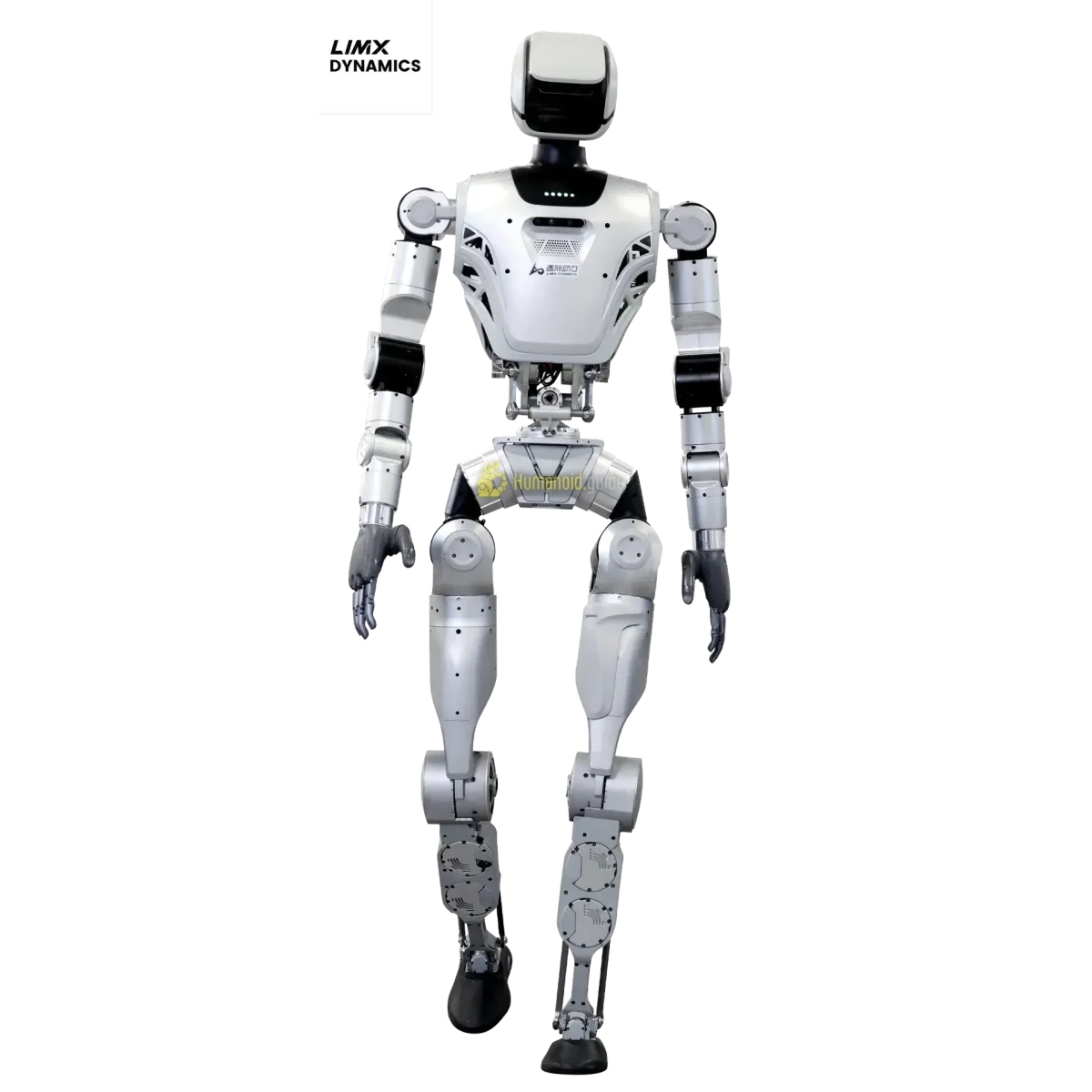
The LimX Oli is a full-size humanoid robot developed by LimX Dynamics in Shenzhen, China. Pricing has not been officially confirmed. Key specs: 43 degrees of freedom, height 165 cm, weight 55 kg, battery life 1.5 hours. The Oli is currently in development as a research platform for embodied AI and general-purpose automation. It is not yet commercially available.

💰Cena
$60 000
📅Pierwsza budowa
2025
🌍Pochodzenie
CN
📏Wysokość
165 cm
⚖️Masa
55 kg
🦾Stopnie swobody
43
🏃Maks. prędkość
5 km/h
📦Udźwig
3 kg
🔋Bateria
1.5 hours
🛒Dostępność
Tylko dla przedsiębiorstw

What is the Limx Oli?

The LimX Oli is a full-size humanoid robot from LimX Dynamics, a Shenzhen-based robotics company founded in 2022. Designed as an embodied-AI R&D platform, it stands 165 cm tall and offers 43 degrees of freedom (10 in the hands). The robot features dual depth cameras (Intel RealSense D435i), an RK3588 compute module, and runs Linux with WiFi 6 and Gigabit Ethernet connectivity. Its open Python SDK and simulator compatibility make it scalable to higher-DOF, dexterous configurations. Oli is positioned alongside LimX's Luna humanoid and TRON biped series, targeting university labs and corporate AI teams exploring real-world locomotion and manipulation. While still in development, it represents a new entrant in the competitive Chinese humanoid market.

Specifications

Here are the full technical specifications.

SpecValue
Height165 cm
Weight55 kg
Degrees of freedom43
Battery life1.5 hours
Max speed5 km/h
Payload3 kg
Price (new)Undisclosed
Price (used range)N/A

Price & Value

New MSRP: Undisclosed (rumored ~$60,000)

Used range: N/A

No official price has been published for the LimX Oli. Unverified sources mention a $60,000 target, but this should be treated as speculative. In the humanoid research market, comparable platforms like Unitree H1 and Fourier GR-1 also lack clear pricing, making direct value comparisons difficult. Given its early-stage development, any discussion of depreciation or total cost of ownership is premature. Prospective buyers should contact LimX Dynamics directly for quotes, knowing that early adopter pricing and support packages may be negotiable. For research labs, the Oli's open ecosystem may justify a mid-range price if it reaches production, but until a firm MSRP is set, the value proposition remains hypothetical.

Who Is It For?

Best for: - University and corporate AI research labs (43 DOF and Python SDK enable embodied AI development)

Not for: - Field deployment in heavy industry (low 3 kg payload rating limits real-world material handling)

Alternatives & Comparison

The LimX Oli enters a growing field of full-size humanoid research platforms. Below we compare it to other humanoids targeting similar applications.

ModelPriceAvailableKey Difference
Unitree H1UndisclosedpreorderProven dynamic locomotion with no hands included
Fourier GR-1UndisclosedpreorderHeavier payload (unknown) but slower speed
Tesla OptimusUndisclosednoBacked by Tesla’s AI ecosystem but much longer timeline to availability

Verdict: For research groups wanting a 2025-era unit with immediate SDK access, the LimX Oli (once available) could be the most open and hacker-friendly. Unitree H1 is a better choice if dynamic walking/obstacle avoidance is the priority. Fourier GR-1 may suit those needing higher manipulation payload. Tesla Optimus remains a long-term bet with an uncertain release date, so it’s not a practical alternative today.

Use Cases & Capabilities

Embodied AI Research

The Oli is purpose-built for embodied AI development. Its 43 degrees of freedom and dual RealSense cameras provide rich sensory feedback for training reinforcement learning agents in simulation and transferring policies to real hardware. The Python SDK lowers the barrier for algorithm prototyping, while the RK3588 board offers enough onboard compute for edge inference. Researchers can tackle whole-body control, dexterous manipulation with 10 degrees of freedom in the hands, and navigation in indoor environments. The 5 km/h top speed is adequate for lab tests but insufficient for outdoor delivery scenarios. Battery life of 1.5 hours per charge will require frequent swaps during long experiments, and the 3 kg payload means the robot is limited to light objects like tools or sensors, not heavy packages.

History & Background

LimX Dynamics was founded in 2022 by Pan Jia, a former key figure at UBTech and other robotics startups. The company quickly gained attention with its TRON 1 bipedal robot, designed as a reinforcement learning teaching tool, followed by the more advanced TRON 2 wheeled humanoid. In early 2025, LimX announced two full-size humanoids: Luna and Oli. While Luna was showcased as the premium model with advanced manipulation, Oli was positioned as a lower-cost, research-oriented variant sharing the same 165 cm stature and core control architecture. Both robots were demonstrated with the company’s in-house VGM (Versatile Grasp Model) and COSA (Cognitive Operating System Architecture) algorithms, highlighting a strong emphasis on embodied AI. As of 2026, Oli remains in the development and testing phase, with no confirmed release date.

Buying Used — What to Check

Verify payload rating Early reviews may reveal the actual safe payload versus specsheet values; critical if you plan any manipulation tasks.

Check battery condition 1.5-hour runtime implies frequent cycling; used batteries may degrade faster, so ask for cycle count before purchase.

Confirm software maturity Pre-production units may run immature software stacks; ensure the SDK and documentation match your research needs.
Często zadawane pytania

LimX Dynamics has not released an official price for the Oli. Unofficial sources suggest a $60,000 figure, but this is unconfirmed. Contact the manufacturer for a quote.
The Oli can walk at up to 5 km/h (walking speed 3 km/h), manipulate light objects up to 3 kg with its 10-finger hands, and navigate indoor environments using dual Intel RealSense depth cameras. It’s designed for researching embodied AI, reinforcement learning, and whole-body control.
No, the Oli is still in development. There is no release date, pre-order system, or confirmed production timeline as of 2026. Interested parties should monitor LimX Dynamics’ official website for announcements.
Both are full-size humanoids around 165 cm. The Oli has 43 DOF vs the H1’s published 19–25? (Unitree H1 hands are not included in some configs). The H1 is more focused on dynamic locomotion and is already available for enterprise orders, while Oli is an open research platform with a Python SDK still in prototyping. The H1’s price is also undisclosed, making direct cost comparison impossible.
Height: 165 cm. Weight: 55 kg. Degrees of freedom: 43 overall, 10 in the hands. Battery life: 1.5 hours. Max speed: 5 km/h. Payload: 3 kg. Compute: Rockchip RK3588 with 8 GB RAM and 64 GB storage. Sensors: Intel RealSense D435i stereo cameras. OS: Linux.
LimX Dynamics, a robotics startup headquartered in Shenzhen, China, and founded in 2022. The company is known for the TRON series of bipedal robots and is now expanding into humanoids.
The Oli’s battery provides approximately 1.5 hours of runtime per charge. LimX has not disclosed charging time or whether the battery is swappable.
Since the Oli is not yet released, no industries have deployed it. The intended primary use is academic and corporate research in embodied AI, locomotion, and manipulation.

LimX Oli in 3D

Loading the 3D model…
Drag to rotate · click the model, then scroll or pinch to zoom · click a part to inspectSwipe sideways to turn · pinch to zoom · tap a part to inspect3D model credit and licence

LimX Oli supply chain

Point at or select a step to light up its chain: bright lines are its direct links, softer lines the rest of the path from raw material to robot.

Swipe sideways to follow the whole chain.

ExtractionRefiningMaterialsComponentsModulesRobotsCompaniesMined copper is smelted and refined.Primary aluminium from smelters.Bauxite is refined to alumina for aluminium.6061 aluminium contains 0.8–1.2% magnesium.6061 aluminium contains 0.40–0.8% silicon.Camera units are built around image sensors (CMOS image sensors from makers such as Sony and OmniVision).Silicon metal is made from silica in natural forms such as quartzite (USGS).Chips are made on wafers: thin slices of semiconductor such as crystalline silicon (Wikipedia). Silicon metal can be refined further into ultra-high-purity semiconductor-grade silicon, called polysilicon (USGS).Silicon metal can be refined further into ultra-high-purity semiconductor-grade silicon, called polysilicon (USGS). Chips are made on wafers: thin slices of crystalline silicon (Wikipedia).Memory is made on silicon wafers (Micron lists silicon wafers among its key materials); wafer silicon is refined from silicon metal (USGS).Magnesium is recovered from dolomite, serpentine, magnesium-bearing evaporite minerals and brines (USGS).In wire-bond packaging, fine gold or copper wire connects each die to its leadframe or substrate. ASE is gradually replacing gold wire with copper to cut material cost, though gold wire is still one of its main materials.Sony makes its CMOS image sensors in its own production facilities in Japan (Nagasaki, Kumamoto). SIA/BCG count optoelectronics and sensors in one fab group with discrete and analog chips (DAO), apart from logic.Bosch makes its MEMS sensors in its own fabs in Reutlingen and Dresden; a MEMS sensor is a MEMS element plus an evaluation chip (ASIC).A MEMS sensor is packed in a semiconductor housing, such as an LGA package (Bosch).Micron makes its memory in its own fabs; most of its 2026 DRAM output came from Taiwan. SIA/BCG: DRAM capacity is highly concentrated in South Korea.Micron's manufacturing runs from wafer fabrication through assembly and test, with subcontractors for some steps.Mined nickel ore and concentrate go to smelters and refineries. In Indonesia, laterite ore is processed into nickel pig iron and ferronickel for stainless steel, or into battery intermediates such as mixed hydroxide precipitate (IEA); the US Eagle Mine's concentrate is exported to smelters (USGS).Solder is the largest use of tin, 51% of world tin use in 2023 (International Tin Association; in the US solder took 11%, USGS). The common lead-free alloy SAC305 is 96.5% tin (AIM).Tin-lead solder is nearly half lead (PubChem), but the electronics industry has moved toward lead-free solders (USGS): 92% of solder for electronics was lead-free in 2023 (ITA).The lead-free alloy SAC305 contains 3% silver (AIM). In the US, brazing and solder took 3% of silver (USGS).The lead-free alloy SAC305 contains 0.5% copper (AIM).FR-4 laminate is woven fibreglass cloth with an epoxy binder (Wikipedia), and fibreglass is made from silica sand (Covia).A thin layer of copper foil is laminated to one or both sides of an FR-4 panel; these are called copper-clad laminates (Wikipedia; ChinaBaogao).FR-4 epoxy resin systems typically use bromine to resist fire (Wikipedia); a grade of the brominated flame retardant TBBPA is used to make epoxy resins for circuit boards (Wikipedia). Brominated flame retardants are one of bromine's two leading uses (USGS).Barite is used to make barium carbonate, which goes into dielectrics (Wikipedia). Barium titanate, the dielectric ceramic used in capacitors, can be made by heating barium carbonate with titanium dioxide (Wikipedia).Barium titanate, the ceramic in high-capacitance MLCCs, can be made by heating barium carbonate with titanium dioxide (Wikipedia); titanium dioxide comes from ilmenite and rutile (USGS).99% of MLCCs made worldwide use base-metal electrodes of nickel or copper; the industry moved from palladium and silver to cut cost (NASA, 2015). TDK replaced palladium electrodes with nickel in 1993 (Wikipedia).Platinum-group metals are used in multilayer ceramic capacitors (USGS). High-reliability MLCCs use palladium-silver electrodes (NASA, 2015).High-reliability MLCCs use precious-metal electrodes of palladium and silver (NASA, 2015).Connector contacts are copper alloys: beryllium copper is called the best copper alloy for contacts, connectors and cables (Wikipedia), and phosphor bronze (copper-tin-phosphorus) can replace it (USGS).Copper-clad laminate is the core material of circuit boards (ChinaBaogao); FR-4 is a common material for printed circuit boards (Wikipedia).Parts are soldered onto bare boards: Adafruit's BNO055 board is a "breakout PCB", and the Raspberry Pi Zero 2 W brief warns against damage to the printed circuit board.SAC305 lead-free solder is made for soldering printed circuits, by wave, hand and SMT reflow soldering (Conro; AIM).MLCCs store and release charge and absorb noise in phones, home appliances and IoT devices (Murata). The Raspberry Pi's RP3A0 package includes the decoupling capacitors that smooth its supply voltage (Raspberry Pi).Boards carry connectors: the Raspberry Pi Zero 2 W brief speaks of the board and its connectors, and Waveshare's servo adapter has a USB-C connector and a power connector.NVIDIA's Jetson Thor modules are 100 × 87 mm and plug in through a 699-pin board-to-board (B2B) connector (NVIDIA).Brass is copper and zinc: CW614N free-cutting brass is about 39% zinc. In the US, brass and bronze are the second use of zinc after galvanized steel.Brass is mostly copper: 57–59% in CW614N free-cutting brass.Free-cutting brass such as CW614N holds 2.5–3.5% lead so it machines cleanly; lead-free brasses exist.XT30 battery plugs (G1 harness, Open Duck Mini) have gold-plated brass contacts.Antimony is used in circuit boards to cut flammability further. A review lists two studies of scrap PC boards, parts and solder still on, with 0.45% and 1.97% antimony, so the share in the laminate alone is not known.Seven micro brushless joint motors in each Dex3-1 (Unitree's F-1515 series, 45 g each): six drive their joints directly, one through gears (Unitree).The Dex3-1's tactile version has 33 pressure sensors in 9 arrays (palm, finger pads and fingertips) that feel from 10 g to 2,500 g (Unitree). Unitree makes them an option.The RK3588 is made on an 8 nm process (Rockchip).MEMS microphones are silicon chips: the diaphragm is etched into a silicon wafer (Wikipedia). Pollen's HAT uses a MEMS microphone.Heat sinks are often aluminium: the Go2's main board has two fans blowing over an aluminium heat sink (Simplexity).In the Unitree G1, the heat pipe and heat spreaders that teardowns show are copper: a copper heat pipe presses against a motor (a published teardown), and copper heat-spreader plates cool its knees (China Post Securities).Magnet wire is drawn from rod of pure electrolytic copper: Elektrisola starts from 8 mm rod with at least 99.90% copper, and most magnet wire is fully annealed, electrolytically refined copper (Elektrisola; Wikipedia).Small DC and brushless motors' coils are wound from magnet wire, usually copper (Wikipedia); maxon says its coreless windings are enamelled copper wire, a copper core with lacquer insulation (maxon). Nidec does not say what wire its coils use.LimX's model gives this motor a gearbox ratio of 25:1; the gear type is not published.LimX's model gives this motor a gearbox ratio of 36:1; the gear type is not published.LimX's model gives this motor a gearbox ratio of 25:1; the gear type is not published.LimX's model gives this motor a gearbox ratio of 28.17:1; the gear type is not published.LimX's table: 'Motion Control (RK3588/8G/64G)'.LimX's table: 'Perception (Orin NX (157TOPS)/16G/1T)', an NVIDIA Jetson Orin NX module.LimX's table: 8 GB and 16 GB of memory on the two computers.The computers' circuit boards; LimX does not describe them.LimX's table: '2-Finger Gripper (1 DoF)': one motor works both fingers.ASML's EUV machines print the most critical layers of the most advanced chips. DUV machines, which ASML also makes, print most of the layers in microchips (ASML annual report 2025).DUV machines, which ASML also makes, print most of the layers in microchips, and ASML's EUV machines (the NXE:3800E) are being adopted by advanced DRAM makers (ASML annual report 2025).ASML's DUV machines, 'the workhorses of the industry', print the majority of layers in chips, older-generation chips included (ASML annual report 2025).Eight joint motors of this size: hip pitch, roll and yaw and the knee in each leg (LimX's model).Seven joint motors of this kind: two per ankle and three at the waist (LimX's model).Eight joint motors of this kind: the shoulder pitch, roll and twist and the elbow of each arm (LimX's model).Eight joint motors of this size: the wrists' twist, bend and roll and the head's turn and nod (LimX's model).The frame, shells, head, hands, shoes and linkage rods that make up the LimX Oli's body.A slide-out 9,500 mAh battery module, charged by a 58.8 V, 10 A charger (LimX).A Rockchip RK3588 computer for motion control and an NVIDIA Jetson Orin NX for perception (LimX).Two one-motor two-finger grippers, standard alongside the fixed hands (LimX's table).Two depth cameras, in the head and on the chest (LimX's table); LimX does not name them (a RealSense D435 head camera is the authors' low-confidence estimate).A 6-axis IMU of LimX's own design (LimX's table), at the pelvis in LimX's model.Microphones for its voice interaction module (LimX's table and page).A speaker: LimX's voice module holds natural spoken conversations in Chinese and English.Air cooling of the main control area (LimX's table), which needs fans and heat sinks.Connectors and wiring: LimX's table lists USB 3.0/3.2, gigabit Ethernet and four power outputs, which its picture shows on a panel low on the back.An optional five-finger hand with 6 motors (LimX's table); the standard hands are fixed.LimX Dynamics makes Oli.Quartz and silica sandQuartz and silica sandMagnesium ores and brinesMagnesium ores and brinesLithography machines (chipprinting)Lithography machines (chip printing)Mature-node chipfabrication (28 nm and…Mature-node chip fabrication (28 nm and older; analog and sensor chips)Memory chip fabrication(DRAM)Memory chip fabrication (DRAM)Aluminium alloysAluminium alloysCopper smelting andrefiningCopper smelting and refiningAlumina refining andaluminium smeltingAlumina refining and aluminium smeltingCopper miningCopper miningBauxite miningBauxite miningMagnesium smeltingMagnesium smeltingSilicon metal smeltingSilicon metal smeltingLeading-edge chipfabrication (under 10 nm)Leading-edge chip fabrication (under 10 nm)Chip packaging and test(OSAT)Chip packaging and test (OSAT)Precision reduction gears(heavy robot joints)Precision reduction gears (heavy robot joints)Small precision motors (DCand BLDC)Small precision motors (DC and BLDC)Memory chips (DRAM /LPDDR)Memory chips (DRAM / LPDDR)Image sensorsImage sensorsIMUs (motion sensors)IMUs (motion sensors)Tactile sensorsTactile sensorsAI compute modulesAI compute modulesCameras and depth camerasCameras and depth camerasNickel miningNickel miningNickel smelting andrefiningNickel smelting and refiningTitanium minerals(ilmenite and rutile)Titanium minerals (ilmenite and rutile)Tin miningTin miningLead miningLead miningSilver miningSilver miningPalladium mining(platinum-group metals)Palladium mining (platinum-group metals)Antimony miningAntimony miningBromine (from brines)Bromine (from brines)Barite mining (barium)Barite mining (barium)Solder (tin alloys:lead-free SAC and…Solder (tin alloys: lead-free SAC and tin-lead)Copper-clad laminate (FR-4glass-fibre epoxy board…Copper-clad laminate (FR-4 glass-fibre epoxy board material)Printed circuit boards(bare boards)Printed circuit boards (bare boards)Multilayer ceramiccapacitors (MLCC)Multilayer ceramic capacitors (MLCC)Connectors and wiringharnessesConnectors and wiring harnessesElectronics assembly(circuit boards with part…Electronics assembly (circuit boards with parts soldered on)Zinc miningZinc miningBrass (copper-zinc alloy)Brass (copper-zinc alloy)Copper magnet wire(enamelled)Copper magnet wire (enamelled)Dexterous handsDexterous handsRockchip RK3588 SoCRockchip RK3588 SoCMicrophonesMicrophonesSmall speakersSmall speakersCooling fans and heatsinksCooling fans and heat sinksLimX DynamicsLimX DynamicsLimX OliLimX OliStructure: LimX OliStructure: LimX OliLimX joint motor, 140 N·m(Oli)LimX joint motor, 140 N·m (Oli)LimX joint motor, 42 N·mwith a 36:1 gearbox (Oli…LimX joint motor, 42 N·m with a 36:1 gearbox (Oli ankles and waist)LimX joint motor, 42 N·mwith a 25:1 gearbox (Oli…LimX joint motor, 42 N·m with a 25:1 gearbox (Oli arms)LimX joint motor, 19 N·m(Oli wrists and neck)LimX joint motor, 19 N·m (Oli wrists and neck)Oli battery module (9,500mAh, charged at 58.8 V)Oli battery module (9,500 mAh, charged at 58.8 V)Oli computers (RockchipRK3588 and NVIDIA Jetson…Oli computers (Rockchip RK3588 and NVIDIA Jetson Orin NX)Oli two-finger gripper (1motor)Oli two-finger gripper (1 motor)

Zdjęcia2

LimX Dynamics Oli photo 1
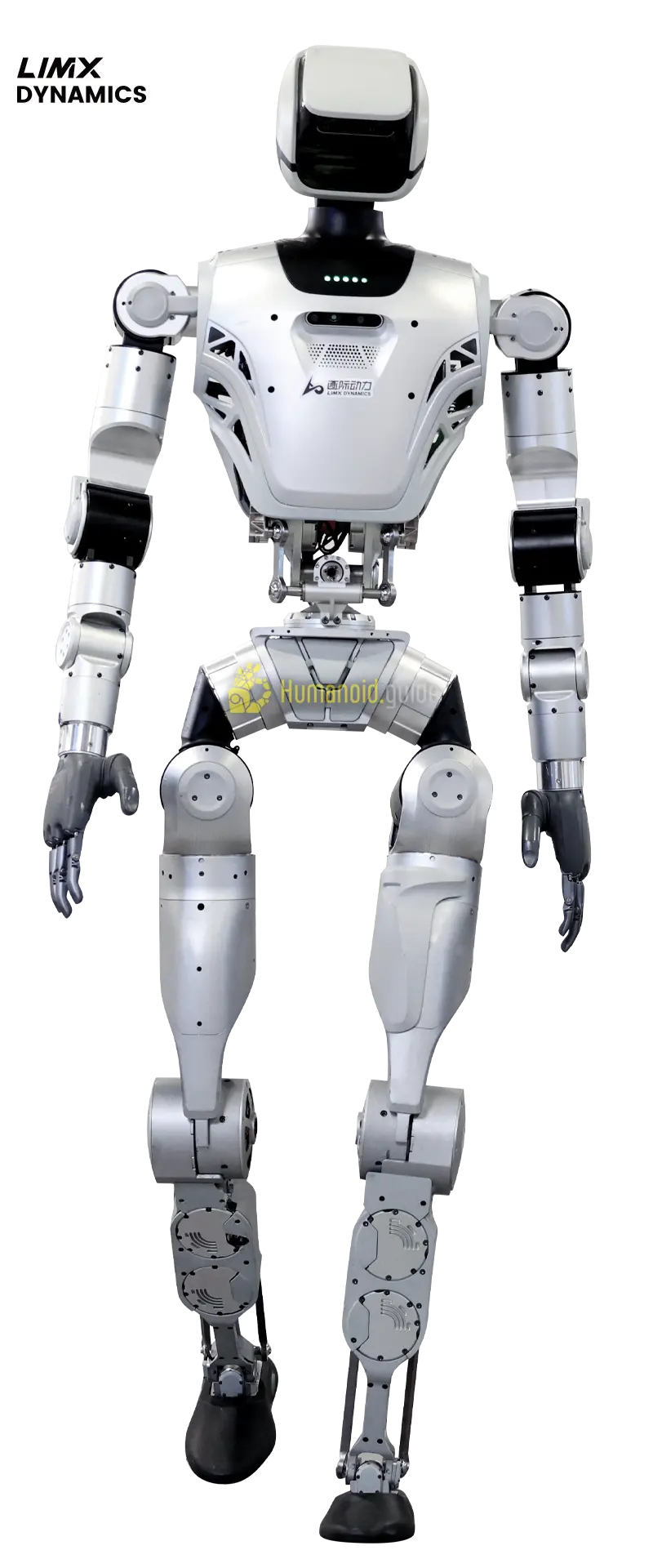
LimX Dynamics Oli photo 2