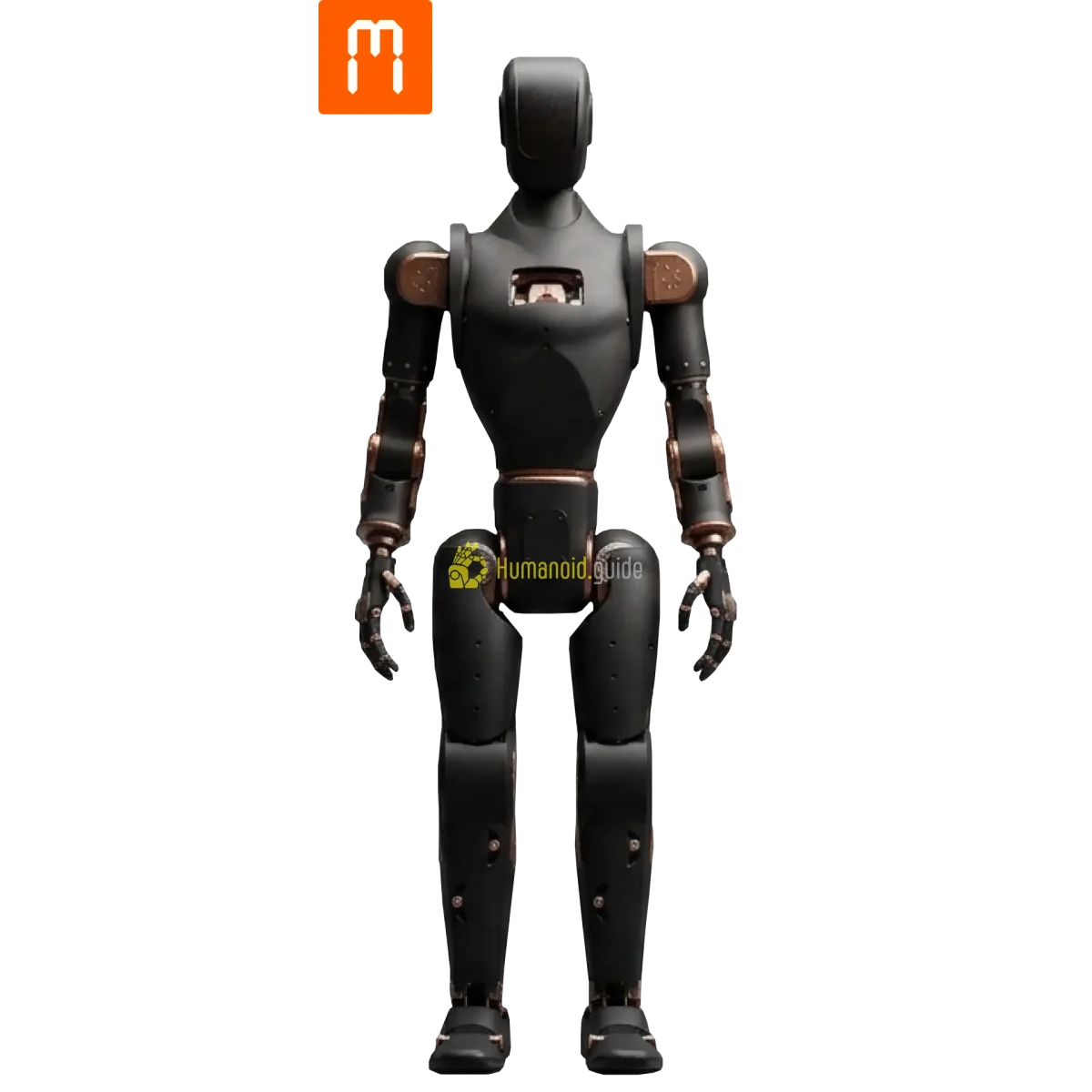
ヒューマノイドロボット

Menlo AI Asimov — 仕様・価格・購入先(2026)

The Menlo AI Asimov is a humanoid robot DIY kit made by Menlo AI in Singapore. Price: $15,000. Key specs: 120 cm height, 27 DOF, 35 kg payload, 1.5-hour battery life. The Asimov is available now as a research and development platform for labs, universities, and robotics enthusiasts. It features electric actuators and onboard compute for running AI models, making it suitable for manipulation and locomotion research.

💰価格
$10,000 – $14,000
📅初回製造
2025
🌍原産地
SG
📏高さ
120 cm
⚖️重量
35 kg
🦾自由度
27
🏃最高速度
3 km/h
📦可搬重量
35 kg
🔋バッテリー
1.5 hours
🛒入手状況
入手可能

What is the Asimov?

The Menlo AI Asimov is a humanoid robot DIY kit developed by Singapore-based Menlo AI. Named after the science fiction author, it is designed as a research and development platform for developers, research labs, robotics enthusiasts, and universities. Standing 120 cm tall and weighing 35 kg, the robot features 27 degrees of freedom, a 35 kg payload capacity, and a maximum speed of 3 km/h. Powered by electric actuators, it includes onboard compute (likely NVIDIA Jetson-class) and supports Ethernet and Wi‑Fi connectivity. With built-in LLM integration, the Asimov offers a hands-on platform for exploring embodied AI, manipulation, and locomotion in a safe, human-friendly form factor. It was first built in 2024 and remains in production.

Specifications

Here are the full technical specifications.

SpecValue
Height120 cm
Weight35 kg
Degrees of freedom27
Battery life1.5 hours
Max speed3 km/h
Payload35 kg
Price (new)$15,000
Price (used range)$10,000–$14,000 (est.)

Price & Value

New MSRP: $15,000

Used range: $10,000–$14,000 (est.)

At $15,000, the Menlo AI Asimov is one of the most affordable full‑size humanoid kits on the market, placing it well below competitors like the Unitree H1 ($90,000+) or Fourier GR‑1 ($150,000+). This pricing reflects its DIY nature — buyers receive a kit that requires assembly, programming, and integration, which keeps the hardware cost low but demands significant technical skill. For research labs and universities, the value proposition is strong: a capable bipedal platform with reasonable payload and onboard AI compute for less than the cost of most industrial robot arms. On the secondary market, used Asimov kits may retain 70–90% of their value due to niche demand, but condition and completeness of the kit will heavily influence resale price. As a self‑build platform, total cost of ownership includes additional compute, sensors, and development time, which can easily add $2,000–$5,000 beyond the base kit price. In comparison to higher‑end humanoids, the Asimov sacrifices speed and battery life but offers a uniquely accessible entry point into humanoid robotics research.

Who Is It For?

Best for: - University robotics labs (27 DOF enables dexterous manipulation research on a budget) - Robotics enthusiasts and makers (DIY kit allows full customization and learning) - AI/ML researchers (onboard compute and LLM integration for embodied AI experiments)

Not for: - Industrial deployment (no IP rating or ruggedness, limited battery life) - Heavy payload tasks (max 35 kg payload suitable for light objects only) - Commercial service applications (no proven reliability for customer-facing roles)

Alternatives & Comparison

In the sub‑$20,000 humanoid market, the Asimov faces few direct competitors, but comparisons with higher‑priced research platforms highlight its trade‑offs.

ModelPriceAvailableKey Difference
Unitree H1~$90,000yesHigher speed (5 m/s) and 2‑hour battery life for demanding locomotion research
Poppy Humanoid~$8,000yesUltra‑low‑cost 3D‑printed platform, but much lower payload and less robust

Verdict: For researchers with a strict sub‑$20k budget, the Asimov offers an unmatched combination of humanoid morphology and payload. However, labs that need ready‑to‑run performance and higher speed should invest in the Unitree H1, while makers seeking an even lower‑cost base can explore the Poppy platform. The Asimov wins as the most accessible full‑sized humanoid with professional build quality at its price point.

Use Cases & Capabilities

Research and Development

The Asimov provides a cost‑effective platform for prototyping manipulation and locomotion algorithms. Its 27 degrees of freedom allow for complex motion planning, while the onboard compute supports real‑time control. Researchers can attach custom end‑effectors or sensors, though the 1.5‑hour battery life limits untethered session length. The open architecture makes it easy to modify software stacks, from low‑level motor control to high‑level AI planning, enabling studies in human‑robot interaction, reinforcement learning, and biomechanics. With native LLM integration, developers can experiment with conversational agents directly on the robot, bridging the gap between language and physical actions.

Education and Training

Universities and technical schools use the Asimov to teach robotics fundamentals, from kinematics and dynamics to embedded systems and AI. Building the kit from parts gives students hands‑on experience with mechanical assembly, wiring, and calibration. The robot’s safety conscious design — limited speed and lightweight structure — reduces risk in classroom settings. Students can program sequences of movements or deploy simple machine learning models, fostering an understanding of full‑stack robotics development. Unlike simulation‑only courses, the Asimov provides tangible feedback, making abstract concepts concrete and preparing students for real‑world robotics careers.

Embodied AI Experimentation

With built‑in LLM support and onboard compute, the Asimov is an ideal testbed for embodied language models. Researchers can run vision‑language models to interpret commands and generate motor plans, all on‑device without cloud latency. The robot’s humanoid form factor enables natural interaction scenarios — pointing, nodding, and gesturing — that are critical for studying social AI. Because the platform is open, teams can replace the default AI stack with their own models, benchmarking performance on real hardware rather than simulated environments. The 35 kg payload also allows carrying lightweight objects, enabling tasks like fetch‑and‑deliver experiments.

Humanoid Locomotion Studies

The Asimov’s bipedal design and 27 DOF make it suitable for walking and balance control research. While its maximum speed of 3 km/h is modest, it provides a safe platform for testing walking gaits, push recovery, and terrain adaptation algorithms. Researchers can add sensors like IMUs and foot pressure arrays to close control loops. The kit’s modular joints can be upgraded or replaced with higher‑torque actuators if needed, offering a pathway from basic walking to dynamic maneuvers. As an open‑source friendly robot, it allows sharing of control libraries across academic labs, accelerating locomotion research without the high cost of industrial humanoids.

History & Background

Menlo AI was founded in Singapore with the mission to democratize humanoid robotics. The Asimov, named in homage to Isaac Asimov, was first built in 2024 as a DIY kit targeting the research and education markets. The robot was designed to be assembled by the end user, reducing cost and encouraging deep engagement with the hardware. Initial shipments began in late 2024 through Menlo AI’s website and select resellers like MERA Robotics. As of 2026, the Asimov remains in production with periodic firmware updates, though the company has not announced any second‑generation variant. Menlo AI continues to serve a niche community of developers and academics, focusing on accessibility and AI integration. Despite limited public marketing, the platform has gained attention in academic circles for its balance of functionality and price, with small user groups sharing custom software forks online.

Buying Used — What to Check

Verify kit completeness Missing structural parts or actuators render the robot unusable and replacements may be costly.

Inspect actuators and boards Previous assembly attempts can damage motors or the main compute board, especially if wiring was incorrect.

Confirm firmware availability Some resellers may not provide original build instructions or software, making setup impossible without manufacturer support.

よくある質問

The Asimov carries an MSRP of $15,000, making it one of the most affordable full‑sized humanoid robot kits. Used units typically trade between $10,000 and $14,000 depending on condition and completeness.
It can walk, gesture, and manipulate lightweight objects up to 35 kg. With its onboard compute and LLM integration, it can run conversational AI and execute simple tasks using language commands, serving as a research platform for locomotion, manipulation, and embodied AI.
Yes, it is currently in production and can be ordered directly from Menlo AI’s website or through select resellers. Lead times vary, but typical delivery takes 4–8 weeks after order confirmation.
The Asimov costs $15,000 versus ~$90,000 for the H1. In exchange for the price difference, the H1 offers much higher speed (5 m/s vs. 3 km/h), longer battery life (2 h vs. 1.5 h), and a more polished ready‑to‑run system, while the Asimov requires assembly and programming.
Height: 120 cm, weight: 35 kg, 27 degrees of freedom, 35 kg payload, 1.5‑hour battery life, max speed 3 km/h. It uses electric actuators and onboard compute with Ethernet/Wi‑Fi connectivity.
Menlo AI, a robotics company based in Singapore. They designed the Asimov as an open, affordable platform for research and education. The company was founded to accelerate humanoid robotics development.
It runs for approximately 1.5 hours on a full charge. The battery is not hot‑swappable, but it is replaceable and charges within 2–3 hours. Extended operation requires pausing to swap batteries.
Primarily universities, research institutes, and maker communities. There are no known deployments in manufacturing, logistics, or service industries due to its DIY nature and limited ruggedness.
Yes, the kit includes mounting points and I/O ports for additional sensors such as cameras, LIDAR, or force-sensing resistors. The onboard compute is capable of fusing multiple sensor streams for advanced perception.
It ships with a base firmware and examples for motor control and simple walking gaits. However, users are expected to develop or adapt higher‑level behaviors, including AI integration, using the open SDK.

Menlo Asimov 1 in 3D

Loading the 3D model…
Drag to rotate · click the model, then scroll or pinch to zoom · click a part to inspectSwipe sideways to turn · pinch to zoom · tap a part to inspect3D model credit and licence

Menlo Asimov 1 supply chain

Point at or select a step to light up its chain: bright lines are its direct links, softer lines the rest of the path from raw material to robot.

Swipe sideways to follow the whole chain.

ExtractionRefiningMaterialsComponentsModulesRobotsCompaniesLithium compounds (carbonate, chloride, hydroxide) are produced from mined lithium.Lithium is produced from brine and mineral operations.Mined copper is smelted and refined.Primary aluminium from smelters.Bauxite is refined to alumina for aluminium.6061 aluminium contains 0.8–1.2% magnesium.6061 aluminium contains 0.40–0.8% silicon.A lithium-ion cell has a cathode (positive electrode), typically a metal oxide or phosphate. IEA tracks the 2025 mix of LFP and nickel-based cathodes in electric-car batteries.Camera units are built around image sensors (CMOS image sensors from makers such as Sony and OmniVision).Silicon metal is made from silica in natural forms such as quartzite (USGS).Chips are made on wafers: thin slices of semiconductor such as crystalline silicon (Wikipedia). Silicon metal can be refined further into ultra-high-purity semiconductor-grade silicon, called polysilicon (USGS).Silicon metal can be refined further into ultra-high-purity semiconductor-grade silicon, called polysilicon (USGS). Chips are made on wafers: thin slices of crystalline silicon (Wikipedia).Magnesium is recovered from dolomite, serpentine, magnesium-bearing evaporite minerals and brines (USGS).In wire-bond packaging, fine gold or copper wire connects each die to its leadframe or substrate. ASE is gradually replacing gold wire with copper to cut material cost, though gold wire is still one of its main materials.Steel is made from iron ore: US mines shipped 98% of their usable iron ore to the steel industry (USGS).Precision bearing rings are made of through-hardened chromium bearing steel 100Cr6 (SAE 52100) (GMN).Sony makes its CMOS image sensors in its own production facilities in Japan (Nagasaki, Kumamoto). SIA/BCG count optoelectronics and sensors in one fab group with discrete and analog chips (DAO), apart from logic.Bosch makes its MEMS sensors in its own fabs in Reutlingen and Dresden; a MEMS sensor is a MEMS element plus an evaluation chip (ASIC).A MEMS sensor is packed in a semiconductor housing, such as an LGA package (Bosch).Mined cobalt is refined further into chemicals or metal (Cobalt Institute). In 2025 DR Congo's export restrictions left refiners short of cobalt hydroxide feed and forced some to limit production, though world refined output still rose 5% to 240 kt (Cobalt Institute).Cobalt sulphate, the largest refined cobalt product, is typically used in NCM (NMC) batteries, and cobalt tetroxide often in LCO batteries (Cobalt Institute). Cobalt-free substitutes that use iron and phosphorus (LFP) held a significant market share in China (USGS).Mined nickel ore and concentrate go to smelters and refineries. In Indonesia, laterite ore is processed into nickel pig iron and ferronickel for stainless steel, or into battery intermediates such as mixed hydroxide precipitate (IEA); the US Eagle Mine's concentrate is exported to smelters (USGS).Battery cathodes need nickel sulphate, made from Class I nickel metal or from intermediates such as mixed hydroxide precipitate and nickel matte (IEA). LFP (lithium iron phosphate) cathodes contain no nickel.Stainless steel is the biggest use of nickel, 66% of demand in 2025 (Cobalt Institute). In the US, stainless and alloy steels and nickel alloys take more than 85% of nickel use (USGS). The world made 64.2 Mt of stainless steel in 2025 (worldstainless), against about 1,900 Mt of raw steel (USGS).Lithium-ion cathodes are lithium compounds, generally a layered oxide (such as lithium cobalt oxide), a phosphate (lithium iron phosphate) or a spinel (lithium manganese oxide). Batteries took an estimated 88% of world lithium in 2025 (USGS).Natural graphite flakes must be made into spherical particles, purified to over 99.95% carbon and coated before they can be used in lithium-ion battery anodes (IEA). Natural graphite is now a small part of anode supply: under 8% of China's 2025 anode shipments (GGII), and about 14% worldwide in 2022 (Rystad).Synthetic graphite is made by calcining and graphitising petroleum coke or needle coke at nearly 3,000 °C (IEA). It was 92.7% of China's 2025 anode shipments (GGII).The negative electrode (anode) of a conventional lithium-ion cell is typically graphite. IEA's 2025 data on electric-car battery anodes show only graphite and silicon-doped graphite.89.8% of the world's plastics in 2024 were made from fossil feedstock (Plastics Europe).Solder is the largest use of tin, 51% of world tin use in 2023 (International Tin Association; in the US solder took 11%, USGS). The common lead-free alloy SAC305 is 96.5% tin (AIM).Tin-lead solder is nearly half lead (PubChem), but the electronics industry has moved toward lead-free solders (USGS): 92% of solder for electronics was lead-free in 2023 (ITA).The lead-free alloy SAC305 contains 3% silver (AIM). In the US, brazing and solder took 3% of silver (USGS).The lead-free alloy SAC305 contains 0.5% copper (AIM).FR-4 laminate is woven fibreglass cloth with an epoxy binder (Wikipedia), and fibreglass is made from silica sand (Covia).A thin layer of copper foil is laminated to one or both sides of an FR-4 panel; these are called copper-clad laminates (Wikipedia; ChinaBaogao).FR-4 epoxy resin systems typically use bromine to resist fire (Wikipedia); a grade of the brominated flame retardant TBBPA is used to make epoxy resins for circuit boards (Wikipedia). Brominated flame retardants are one of bromine's two leading uses (USGS).Barite is used to make barium carbonate, which goes into dielectrics (Wikipedia). Barium titanate, the dielectric ceramic used in capacitors, can be made by heating barium carbonate with titanium dioxide (Wikipedia).Barium titanate, the ceramic in high-capacitance MLCCs, can be made by heating barium carbonate with titanium dioxide (Wikipedia); titanium dioxide comes from ilmenite and rutile (USGS).99% of MLCCs made worldwide use base-metal electrodes of nickel or copper; the industry moved from palladium and silver to cut cost (NASA, 2015). TDK replaced palladium electrodes with nickel in 1993 (Wikipedia).Platinum-group metals are used in multilayer ceramic capacitors (USGS). High-reliability MLCCs use palladium-silver electrodes (NASA, 2015).High-reliability MLCCs use precious-metal electrodes of palladium and silver (NASA, 2015).Connector contacts are copper alloys: beryllium copper is called the best copper alloy for contacts, connectors and cables (Wikipedia), and phosphor bronze (copper-tin-phosphorus) can replace it (USGS).Copper-clad laminate is the core material of circuit boards (ChinaBaogao); FR-4 is a common material for printed circuit boards (Wikipedia).Parts are soldered onto bare boards: Adafruit's BNO055 board is a "breakout PCB", and the Raspberry Pi Zero 2 W brief warns against damage to the printed circuit board.SAC305 lead-free solder is made for soldering printed circuits, by wave, hand and SMT reflow soldering (Conro; AIM).MLCCs store and release charge and absorb noise in phones, home appliances and IoT devices (Murata). The Raspberry Pi's RP3A0 package includes the decoupling capacitors that smooth its supply voltage (Raspberry Pi).Boards carry connectors: the Raspberry Pi Zero 2 W brief speaks of the board and its connectors, and Waveshare's servo adapter has a USB-C connector and a power connector.Rockchip states an 8 nm process for the RK3588 (it designs the chip and does not name its foundry), and the teardown gives 8 nm for the RK3588S; SIA/BCG count logic under 10 nm as the most advanced class.Brass is copper and zinc: CW614N free-cutting brass is about 39% zinc. In the US, brass and bronze are the second use of zinc after galvanized steel.Brass is mostly copper: 57–59% in CW614N free-cutting brass.Free-cutting brass such as CW614N holds 2.5–3.5% lead so it machines cleanly; lead-free brasses exist.XT30 battery plugs (G1 harness, Open Duck Mini) have gold-plated brass contacts.Antimony is used in circuit boards to cut flammability further. A review lists two studies of scrap PC boards, parts and solder still on, with 0.45% and 1.97% antimony, so the share in the laminate alone is not known.39 of its part designs are CNC-machined from 7075 aluminium (Menlo's design files; the 4 other files in those folders are stainless steel bars), one of the two structural materials Menlo lists (with PA12 nylon).22 stainless steel (316) parts: brackets, cranks, the wrist flanges and the ankle bars; plus bought steel bearings and fittings.39 parts 3D-printed in PA12 nylon by MJF: shells, covers and housings.Each module has a brushless motor (the spec sheets give phase currents and torque constants).Each module has a crossed roller output bearing (types 3005, 4005).Each module has a driver with a CAN bus link and two encoders.52 INR18650 lithium-ion cells.A protection circuit module guards against over-charge, over-discharge and over-current.The Radxa CM5 is built around a Rockchip RK3588S.The Raspberry Pi 5 runs on a Broadcom BCM2712.Menlo's motion-control carrier, power distribution, head and media boards; their design files carry LCSC part numbers for JLCPCB fabrication.MEMS microphones are silicon chips: the diaphragm is etched into a silicon wafer (Wikipedia). Pollen's HAT uses a MEMS microphone.Heat sinks are often aluminium: the Go2's main board has two fans blowing over an aluminium heat sink (Simplexity).In the Unitree G1, the heat pipe and heat spreaders that teardowns show are copper: a copper heat pipe presses against a motor (a published teardown), and copper heat-spreader plates cool its knees (China Post Securities).Magnet wire is drawn from rod of pure electrolytic copper: Elektrisola starts from 8 mm rod with at least 99.90% copper, and most magnet wire is fully annealed, electrolytically refined copper (Elektrisola; Wikipedia).Small DC and brushless motors' coils are wound from magnet wire, usually copper (Wikipedia); maxon says its coreless windings are enamelled copper wire, a copper core with lacquer insulation (maxon). Nidec does not say what wire its coils use.ASML's EUV machines print the most critical layers of the most advanced chips. DUV machines, which ASML also makes, print most of the layers in microchips (ASML annual report 2025).ASML's DUV machines, 'the workhorses of the industry', print the majority of layers in chips, older-generation chips included (ASML annual report 2025).The machined, printed and bought parts that make up Asimov 1's body.All 25 joints use ENCOS EC-A actuators (five models).The 13S4P lithium-ion pack powers the robot.The Radxa CM5 and the Raspberry Pi 5 with Menlo's boards run the robot.A 6-axis IMU (ST LSM6DSV) on the motion-control board.A 2 MP monocular camera in the head.XT30 (2+2) power-and-CAN cables chain the motors; Ethernet, USB and JST cables link the boards.Menlo Research designs Asimov 1 and sells it as a kit.A stereo microphone array in the head, read by an audio chip on the head board (Menlo).A 10 W, 4 Ω speaker behind the opening in the torso (Menlo).A fan in the torso, plugged into the motion-control computer (Menlo's parts and cable lists).Quartz and silica sandQuartz and silica sandMagnesium ores and brinesMagnesium ores and brinesOil, gas and coal(plastics feedstock)Oil, gas and coal (plastics feedstock)Steel (gear, bearing andstainless grades)Steel (gear, bearing and stainless grades)Lithography machines (chipprinting)Lithography machines (chip printing)Mature-node chipfabrication (28 nm and…Mature-node chip fabrication (28 nm and older; analog and sensor chips)Aluminium alloysAluminium alloysBattery-grade lithiumcompoundsBattery-grade lithium compoundsLithium chemicalconversionLithium chemical conversionCopper smelting andrefiningCopper smelting and refiningAlumina refining andaluminium smeltingAlumina refining and aluminium smeltingLithium miningLithium miningCopper miningCopper miningBauxite miningBauxite miningIron ore miningIron ore miningMagnesium smeltingMagnesium smeltingSilicon metal smeltingSilicon metal smeltingLeading-edge chipfabrication (under 10 nm)Leading-edge chip fabrication (under 10 nm)Chip packaging and test(OSAT)Chip packaging and test (OSAT)Precision bearingsPrecision bearingsSmall precision motors (DCand BLDC)Small precision motors (DC and BLDC)Processors (CPUs and SoCs)Processors (CPUs and SoCs)Image sensorsImage sensorsIMUs (motion sensors)IMUs (motion sensors)Lithium-ion cellsLithium-ion cellsCameras and depth camerasCameras and depth camerasCobalt miningCobalt miningCobalt refining (chemicalsand metal)Cobalt refining (chemicals and metal)Nickel miningNickel miningNickel smelting andrefiningNickel smelting and refiningNatural graphite miningNatural graphite miningBattery anode graphite(spherical natural and…Battery anode graphite (spherical natural and synthetic)Cathode active material(NMC, NCA, LCO, LFP)Cathode active material (NMC, NCA, LCO, LFP)Titanium minerals(ilmenite and rutile)Titanium minerals (ilmenite and rutile)Engineering plastics (ABS,PC, nylon, PEEK)Engineering plastics (ABS, PC, nylon, PEEK)Tin miningTin miningLead miningLead miningSilver miningSilver miningPalladium mining(platinum-group metals)Palladium mining (platinum-group metals)Antimony miningAntimony miningBromine (from brines)Bromine (from brines)Barite mining (barium)Barite mining (barium)Solder (tin alloys:lead-free SAC and…Solder (tin alloys: lead-free SAC and tin-lead)Copper-clad laminate (FR-4glass-fibre epoxy board…Copper-clad laminate (FR-4 glass-fibre epoxy board material)Printed circuit boards(bare boards)Printed circuit boards (bare boards)Multilayer ceramiccapacitors (MLCC)Multilayer ceramic capacitors (MLCC)Connectors and wiringharnessesConnectors and wiring harnessesElectronics assembly(circuit boards with part…Electronics assembly (circuit boards with parts soldered on)Rockchip RK3588S SoCRockchip RK3588S SoCZinc miningZinc miningBrass (copper-zinc alloy)Brass (copper-zinc alloy)Copper magnet wire(enamelled)Copper magnet wire (enamelled)Menlo Asimov 1Menlo Asimov 1Structure: Menlo Asimov 1Structure: Menlo Asimov 1ENCOS joint actuators(EC-A series)ENCOS joint actuators (EC-A series)Asimov 1 battery pack(13S4P, 491 Wh)Asimov 1 battery pack (13S4P, 491 Wh)Asimov 1 computers andboardsAsimov 1 computers and boardsMenlo ResearchMenlo ResearchMicrophonesMicrophonesSmall speakersSmall speakersCooling fans and heatsinksCooling fans and heat sinks