日ごとの平均価格
USDでの金額
説明
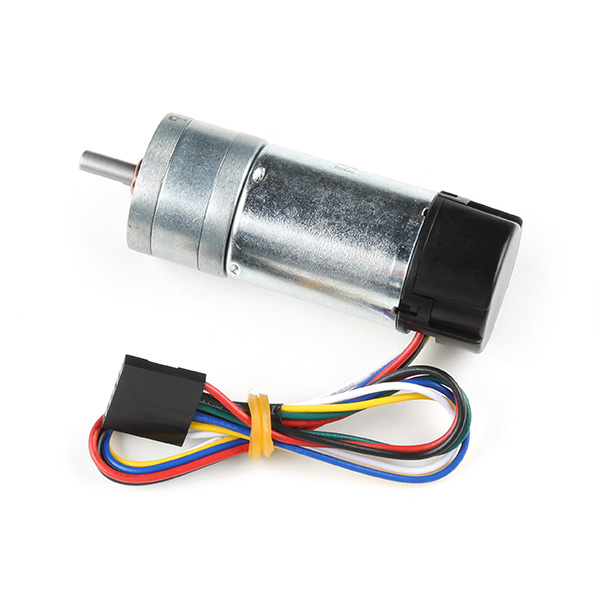
This gearmotor consists of a low-power 12 V brushed DC motor combined with a 9.68:1 metal spur gearbox and it has an integrated 48 CPR quadrature encoder on the motor shaft which provides 464.64 counts per revolution of the gearbox s output shaft. The gearmotor is cylindrical with a diameter just under 25 mm and the D-shaped output shaft is 4 mm in diameter and extends 12.5 mm from the face plate of the gearbox. A two-channel Hall effect encoder is used to sense the rotation of a magnetic disk on a rear protrusion of the motor shaft. The quadrature encoder provides a resolution of 48 counts per revolution of the motor shaft when counting both edges of both channels. To compute the counts per revolution of the gearbox output multiply the gear ratio by 48. The motor/encoder has six color-coded 8 (20 cm) leads terminated by a 1 6 female header with a 0.1 pitch. The Hall sensor requires an input voltage Vcc between 3.5 and 20 V and draws a maximum of 10 mA. The A and B outputs are square waves from 0 V to Vcc approximately 90 out of phase. The frequency of the transitions tells you the speed of the motor and the order of the transitions tells you the direction. Note: The listed stall torques and currents are theoretical extrapolations; units will typically stall well before these points as the motors heat up. Stalling or overloading gearmotors can greatly decrease their lifetimes and even result in immediate damage. The recommended upper limit for continuously applied loads is 4 kg cm (55 oz in) and the recommended upper limit for intermittently permissible torque is 8 kg cm (110 oz in). Stalls can also result in rapid (potentially on the order of seconds) thermal damage to the motor windings and brushes; a general recommendation for brushed DC motor operation is 25% or less of the stall current.
This gearmotor consists of a low-power 12 V brushed DC motor combined with a 9.68:1 metal spur gearbox and it has an integrated 48 CPR quadrature encoder on the motor shaft which provides 464.64 counts per revolution of the gearbox s output shaft. The gearmotor is cylindrical with a diameter just under 25 mm and the D-shaped output shaft is 4 mm in diameter and extends 12.5 mm from the face plate of the gearbox. A two-channel Hall effect encoder is used to sense the rotation of a magnetic disk on a rear protrusion of the motor shaft. The quadrature encoder provides a resolution of 48 counts per revolution of the motor shaft when counting both edges of both channels. To compute the counts per revolution of the gearbox output multiply the gear ratio by 48. The motor/encoder has six color-coded 8 (20 cm) leads terminated by a 1 6 female header with a 0.1 pitch. The Hall sensor requires an input voltage Vcc between 3.5 and 20 V and draws a maximum of 10 mA. The A and B outputs are square waves from 0 V to Vcc approximately 90 out of phase. The frequency of the transitions tells you the speed of the motor and the order of the transitions tells you the direction. Note: The listed stall torques and currents are theoretical extrapolations; units will typically stall well before these points as the motors heat up. Stalling or overloading gearmotors can greatly decrease their lifetimes and even result in immediate damage. The recommended upper limit for continuously applied loads is 4 kg cm (55 oz in) and the recommended upper limit for intermittently permissible torque is 8 kg cm (110 oz in). Stalls can also result in rapid (potentially on the order of seconds) thermal damage to the motor windings and brushes; a general recommendation for brushed DC motor operation is 25% or less of the stall current.
価格の推移
観測日ごとに平均した、1日あたり1つのデータポイント。
USDでの金額
記録されたすべての販売価格を対象に、UTCの日ごとの平均を算出しています。
RoboSavvy
£95.83
RoboSavvy
£116

RoboSavvy
£74.99
RoboSavvy
£108.08

RoboSavvy
£74.90

RoboSavvy
£66.66

RoboSavvy
£118.42
RoboSavvy
£50.75
RoboSavvy
£121.36
RoboSavvy
£54
RoboSavvy
£49.75
RoboSavvy
£52.75
🍪 クッキーの設定
パフォーマンスを測定するためにクッキーを使用しています。 プライバシーポリシー