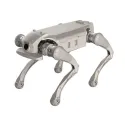
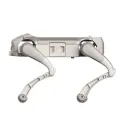
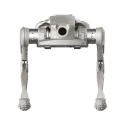
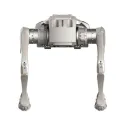
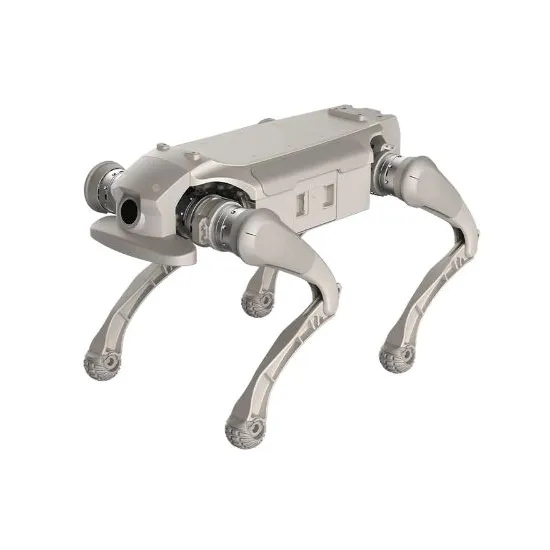
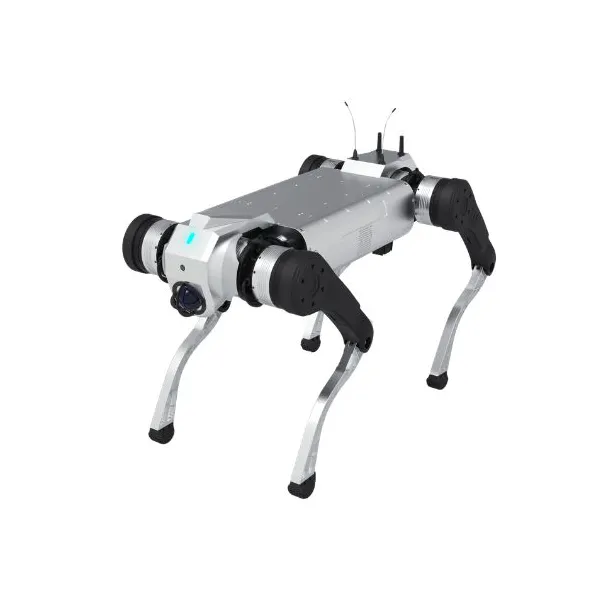
The AgiBot D1 Ultra is a compact quadruped robot designed for research, inspection, and mobile robotics in real-world environments.
| Dimensions in standing position | 630 × 360 × 420 mm |
| Folded dimensions | 670 × 435 × 145 mm |
| Weight | 15 kg |
| Speed | 0 to 3.7 m/s |
| Static payload | ≈ 8 kg |
| Travel range unloaded | 6 km at 1.8 m/s |
| Travel range with payload | 4 km with 5 kg payload |
| Maximum slope | up to 40° |
| Stair climbing | up to 16 cm |
| Jump | up to 35 cm |
| Protection rating | IP54 |
| Max. joint motor torque | approximately 48 N·m |
| Max. machine output power | approximately 3,500 W |
| Joint control mode | Dual encoder |
| Expansion interfaces | Ethernet, USB, 12V/24V power supply, SBUS, UART |
| Compatible modules | LiDAR / 3D radar, depth camera, RTK, 4G/5G module, video transmission, other development modules |
| Secondary development | Yes (Open SDK) |
| Simulation | URDF, Isaac Sim, MuJoCo |
What types of research projects is the AgiBot D1 Ultra suitable for?
The D1 Ultra is well suited for projects involving quadruped locomotion, navigation on complex terrain, robotic inspection, embedded perception, multi-sensor fusion, and payload testing. Its relevance is especially strong when the test environment includes uneven ground, stairs, or outdoor constraints.
Can third-party sensors or modules be added?
Yes. It is compatible with modules such as LiDAR, depth camera, RTK, 4G/5G, or video transmission modules. This makes it an interesting base for projects requiring specific instrumentation.
Is the robot suitable for both indoor and outdoor testing?
Yes, as its product positioning emphasizes all-terrain mobility and IP54 protection. It is presented for environments involving splashes, humidity, mud, or sand, which makes it relevant for mixed testing depending on the safety protocol and project conditions.
Which capabilities are most useful for locomotion research?
The most interesting points are the announced speed up to 3.7 m/s, stair climbing of 16 cm, jump capability up to 35 cm, and slope climbing up to 40°. For a research team, these features make it possible to work on gait robustness and adaptation to varied terrain.
Is the D1 Ultra relevant for higher education?
Yes, especially for courses or projects related to mobile robotics, perception, control, embedded AI, and robotic simulation. URDF support and openness to module integration make it an interesting platform for advanced demonstrations and university-level practical work.
Is simulation part of the development workflow?
It supports URDF models, Isaac Sim, and MuJoCo. This can help prepare behaviors, test a sensor configuration, or validate a control logic before field trials.
Is the robot sold with a complete ready-to-use software environment for all use cases?
The robot integrates an Open SDK, compatibility with simulation environments, and possibilities for secondary development, making it suitable for integration into research or applied robotics projects.
価格の推移
観測日ごとに平均した、1日あたり1つのデータポイント。
USDでの金額
記録されたすべての販売価格を対象に、UTCの日ごとの平均を算出しています。

Agibot
$9,600

Agibot
$11,005

Agibot
12,900 złから

Agibot
$8,285

Agibot
$6,080
Agibot
$3,200
Agibot
3,876 €
Agibot
83,280 €

Agibot
$4,389

Agibot
$66,549

Agibot
$94,409

Genisom
$9,800
🍪 クッキーの設定
パフォーマンスを測定するためにクッキーを使用しています。 プライバシーポリシー