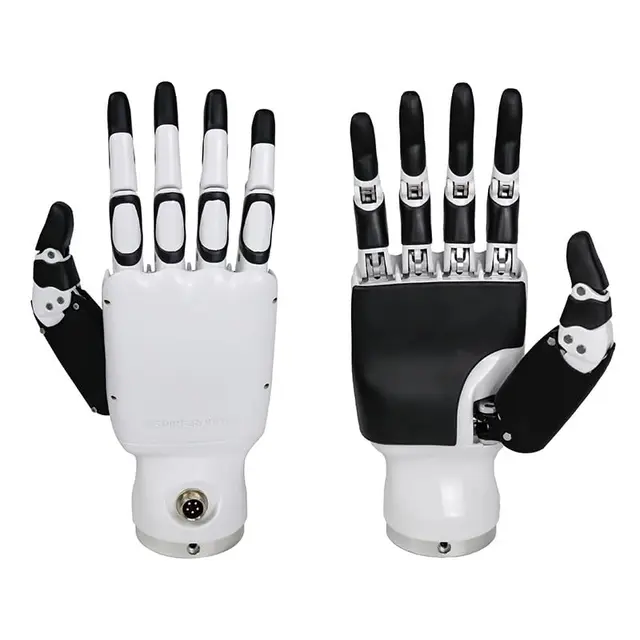
The Linkerbot Linker Hand O7 is a palm-sized dexterous robotic hand with a tactile array built into the hand, for robots that need to feel what they pick up. It combines 7 active joints with 10 passive ones, 17 degrees of freedom in all, in an aluminium-alloy frame of about 700 g, and is made as a left or a right hand.
The 72-cell resistive array (6 × 12) reports where and how hard the hand touches an object at 200 frames per second, so a controller sees contact, pressure distribution and the start of a slip. That makes the O7 a fit for contact-rich manipulation research, imitation-learning data collection and humanoid robots that handle objects of varying shape. The passive joints help as well: they let the fingers settle around an object whose pose or friction is uncertain.
The fingers run on Linkerbot's own joint modules through a linkage drive and repeat to ±0.20 mm. The thumb swings through 95°, the fingers flex through 90°, thumb and fingers pinch with 12 N, and the hand carries up to 5 kg. It connects over CAN or RS-485, works with Linkerbot's ROS 2 SDK and URDF model, and protects itself against overload and overheating.
Next to it in the range, the Linker Hand O6 is lighter at 360 g with six active joints and optional fingertip sensors, and the Linker Hand L10 Standard adds side-to-side finger movement with ten active joints. Compare them with the rest of our dexterous robotic hands.
Key Capabilities
-
72-cell tactile array built in: A 6 × 12 resistive array maps contact location and pressure at 200 frames per second, with no add-on sensor kit.
-
7 active, 10 passive joints: Seven driven joints set the grasp, and ten passive joints let the fingers settle around an object whose position or shape is uncertain.
-
95° thumb yaw: The thumb swings through 95° and the fingers flex through 90°, enough for opposed pinches as well as wrap grasps.
-
12 N pinch, 5 kg payload: Thumb and fingers pinch with 12 N, and the hand carries up to 5 kg.
-
±0.20 mm repeatability: Linkage fingers on Linkerbot's own joint modules return to the same position within ±0.20 mm, in an aluminium-alloy frame of about 700 g.
-
ROS 2 and URDF: The O7 talks CAN or RS-485, Linkerbot's ROS 2 SDK drives it, and a URDF model covers simulation.
-
Overload and thermal protection: The hand protects itself against overload and overheating during jams and long data-collection runs.
Buying through Robotix Market
This unit is sourced new through established distribution channels and ships worldwide with the manufacturer warranty. Technical support is coordinated with the manufacturer's own service network. Deployment scope, configuration, and commissioning responsibilities are agreed as part of the quotation — on-site installation is not included in the product price.