Computer vision is easy to teach on a laptop webcam and much harder on a robot that walks, turns and shakes its camera. The Rover X1 Explorer Vision, the middle edition of Dobot's Explorer education quadruped, puts that problem in front of students: a 40 TOPS NVIDIA Orin Nano runs detection, tracking and segmentation models on board, so they deploy their own networks and watch them steer the robot without a tether to a PC.
Perception comes from three sources at once: front and rear 1080p RGB cameras, two built-in depth cameras and an Intel RealSense D435i, whose built-in IMU suits visual odometry and 3D mapping experiments. The enhanced camera SDK opens the RealSense and depth streams for a class's own perception pipeline, and the C++ and Python SDK reaches from high-level speed and gait commands down to joint position, velocity and torque, with ROS support and Isaac Gym for training locomotion in simulation.
Against the Entry Level edition, the Vision adds the Orin Nano, the RealSense D435i, the enhanced camera SDK, dual-language AI voice interaction and an 8000 mAh battery that runs about 2.5 hours; it weighs 18.5 kg. It has no LiDAR, which is what the Explorer Sentinel adds for mapping and autonomous navigation. The Explorer line is the education version of the Rover X1 and is sold separately from the Rover X1 Quadruped Robot Dog for home use.
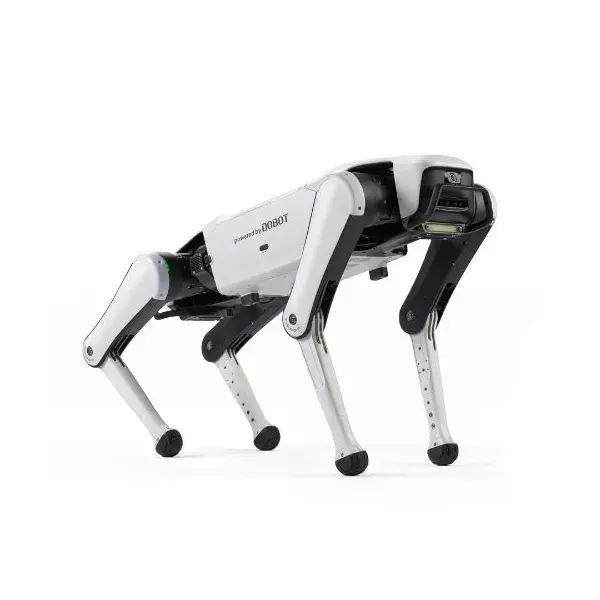
The package holds the Explorer Vision robot, four default leg modules, a Bluetooth remote controller, a charging dock, the 8000 mAh high-capacity battery pack, the Intel RealSense D435i and the enhanced camera SDK. The photo shows the X1 body that all three Explorer editions share.
Key Capabilities
-
40 TOPS on Board: An NVIDIA Orin Nano module runs detection, tracking and segmentation models on the robot itself in real time.
-
Three Kinds of Vision: Front and rear 1080p cameras, two built-in depth cameras and an Intel RealSense D435i deliver color, depth and motion data together.
-
Open Camera SDK: The enhanced camera SDK gives direct access to the RealSense and depth streams for custom perception pipelines.
-
Legged Mobility: The robot walks at up to 1.8 m/s, climbs 30 to 35° slopes, steps over 16 cm obstacles and carries 3 to 7 kg.
-
Ready-Made Behaviors: Active following, obstacle avoidance and dual-language AI voice interaction work from the first lesson.
-
Simulation to Joints: High-level and low-level C++ and Python APIs, ROS and Isaac Gym take students from simulation to the real legs.
-
About 2.5 Hours per Charge: The 8000 mAh high-capacity battery doubles the capacity of the Entry Level pack.
The price covers the Explorer Vision package described above. Classroom sets and optional accessories are quoted separately.
Buying through Robotix Market
This unit is sourced new through established distribution channels and ships worldwide with the manufacturer warranty. Technical support is coordinated with the manufacturer's own service network. Deployment scope and configuration are agreed before dispatch, and on-site installation is not included in the product price.