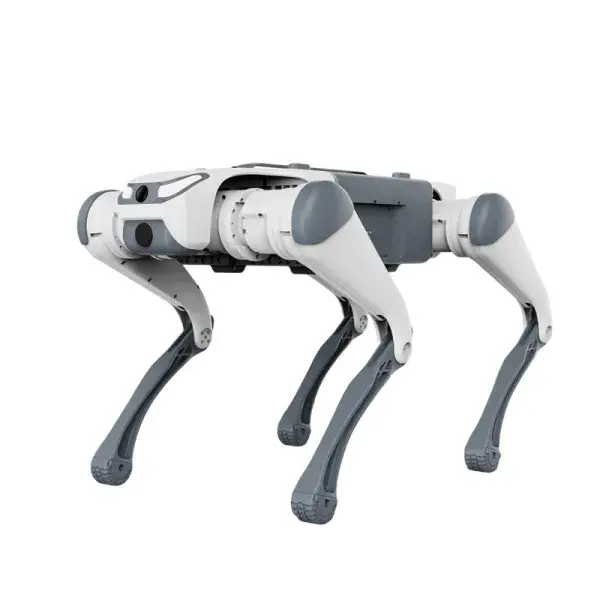
The LYNX S10 is the operator-driven model of DEEP Robotics' compact wheeled-legged range. Each of its four legs has four joints and ends in a powered 6.5 in tyre, so it rolls quickly over flat ground and walks over steps, kerbs and debris where wheels alone would stop. With its battery fitted it weighs about 21 kg: one person lifts it out of its transport case by the side handles and sets it down where the job starts.
It suits work where a person should guide every move: reconnaissance ahead of a team, search in collapsed buildings where its small frame slips through narrow gaps, inspection walks with an operator at the controls, surveys of remote outdoor ground, and teaching and research on wheeled-legged motion in universities and labs. The body is sealed to IP66 and works from −20 to 55 °C, so rain, dust and cold do not end the day.
LYNX S10 or LYNX S10 Pro
Both models share the body, joints, wheels, battery, payload and climbing figures. The LYNX S10 carries one 3D LiDAR and one ultra-wide-angle camera at the front and one octa-core industrial processor for motion control. The operator drives it from the remote controller in Normal mode, or in Assist mode, where the sensors stop the robot at obstacles and warn with yellow lights; obstacle avoidance covers every direction. The LYNX S10 Pro adds a rear LiDAR, three more cameras and a second processor for on-board mapping and autonomous navigation, plus two USB 3.0 Type-C ports. Choose the Pro when the robot should run its rounds on its own.
The system
A swappable 72 V, 4.5 Ah battery gives about 3 hours or 14 km without load and about 2 hours or 8 km with a payload. It charges in about 1.5 hours, by cable inside the robot or on its own outside it, and the robot also supports autonomous charging at the optional charging dock. The handheld remote controller has a screen for the live camera view, battery level, remaining range and joint temperatures, and an Android phone app is also available. Gaits for flat ground, stairs, high platforms and slopes are chosen on the controller, together with posture adjustment for body height and pitch. Software updates arrive over the air.
Payloads and development
Equipment mounts on two rails with 12 M4 holes on the back, up to 8 kg and about 30 cm high. Three aviation ports supply power and data: 24 V with 100 Mbit Ethernet, PPS and SBUS; 24 V with Gigabit Ethernet; and a 72 V charge and discharge port, with up to 288 W in total for payloads. Developers reach the robot through a TCP/UDP protocol that is encrypted by default, ROS 2 topics for the IMU, LiDAR point cloud and robot status, and a Motion SDK mode for joint-level control at up to 200 Hz. DEEP Robotics publishes a URDF model with reinforcement-learning and deployment code on GitHub, and a STEP model of the robot for designing brackets.
Operating notes from DEEP Robotics
The LYNX S10 works on flat or gently rolling ground, grass, stairs and slopes, at an operating speed of 2 m/s. DEEP Robotics advises keeping it off ice, very slippery floors, sharp or broken ground and drop edges, and keeping 1 m clear around it when it starts. Wipe it dry after rain and do not immerse it. Batteries charge at 0 to 40 °C, and the robot is stored at −20 to 70 °C. Extreme moves such as a two-leg stand are locked at the factory and are unlocked only by DEEP Robotics' after-sales service.
Key Capabilities
-
About 21 kg, carried by one person: It weighs about 21 kg with its battery and lifts out of its transport case by the side handles.
-
Wheels and legs: Sixteen joints and a 6.5 in tyre on each foot let it roll over flat ground at an operating speed of 2 m/s and walk over steps and debris.
-
Stairs, platforms and slopes: It climbs stairs with steps up to 20 cm, single steps and platforms up to 50 cm and slopes up to 40°, depending on the surface.
-
Driven by an operator, assisted by sensors: A front 3D LiDAR and a front ultra-wide-angle camera send live video to the remote controller, and in Assist mode the robot stops at obstacles and warns with yellow lights.
-
IP66 from −20 to 55 °C: The body is sealed against dust and powerful water jets for work in rain, dust and cold.
-
Swappable 72 V battery: It runs about 3 hours or 14 km per charge without load, recharges in about 1.5 hours and supports autonomous charging at the optional dock.
-
Open to developers: Two payload rails with 72 V and 24 V power, Ethernet ports, ROS 2 topics and a Motion SDK mode for joint-level control make it a research platform.
Options such as the charging dock and the smart charging hub for charging batteries outside the robot are quoted separately.
Buying through Robotix Market
This unit is sourced new through established distribution channels and ships worldwide with the manufacturer warranty. Technical support is coordinated with the manufacturer's own service network. Deployment scope and configuration are agreed as part of the quotation, and on-site installation is not included in the product price.