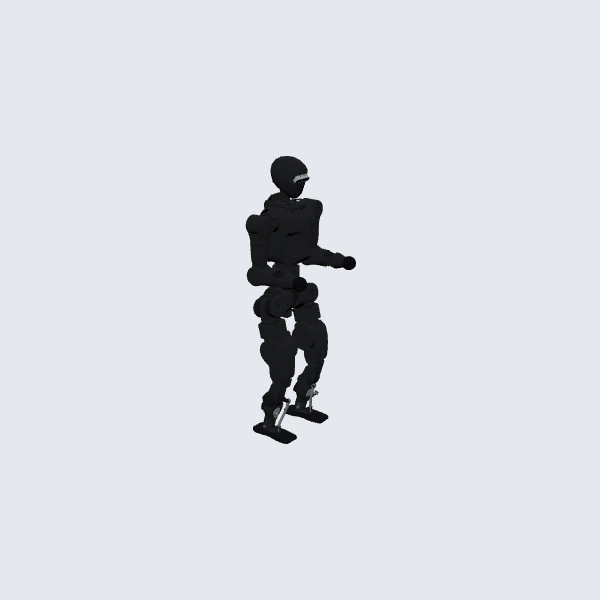
What is the Fourier N1?
A 1.3 m, 38 kg open-source humanoid robot by Fourier (Shanghai) with 23 joints (6 per leg, 1 waist, 5 per arm) driven by Fourier's own FSA actuators, an Intel Core i7 computer in the chest and a 475 Wh battery for about 2 hours; it runs at up to 3.5 m/s. Released in April 2025 with its parts list, drawings and assembly guide.
Specifications
Facts about the Fourier N1 from its project's published documentation, design files and its makers' own figures. A figure marked Estimate is worked out from those files or parts lists rather than stated by the maker.
| Spec | Detail |
|---|---|
| Size | 1,245 × 441 × 202 mm (height × width × depth) with an arm span of 1,240 mm (Fourier's parameter table); 'stands 1.3 meters tall' in Fourier's text. |
| Weight | About 38 kg (Fourier's text and product page); its parameter table says ≈39 kg. Fourier's 3D model adds up to 39.7 kg. |
| Joints | 23: six per leg (hip pitch, roll and yaw, knee, ankle roll and pitch), one at the waist and five per arm (shoulder pitch, roll and yaw, elbow, wrist). The head has no joints and the fists do not move. |
| Joint actuators | 23 of Fourier's own 'FSA 61 cm integrated actuators, one per joint, each taking DC power and an Ethernet cable directly. Fourier's table gives three torque limits: 90 N·m for 4 (hip pitch, knee), 54 N·m for 7 (hip roll and yaw, waist, shoulder pitch) and 30 N·m for 12 (the ankles and the rest of the arms). Each has two encoders (16-bit and 14-bit) and runs on 24–60 V (46 V rated). |
| Actuator models | Fourier does not name the N1's actuators. Its FSA80-29E (rated 32 N·m, peak 96 N·m, 100 rpm) fits the 90 N·m joints and its FSA60-43E (17 N·m, 51 N·m, 59 rpm) is close to the 54 N·m ones; both have two-stage planetary gearboxes (described for a student biped Fourier sponsored). The same biped also uses a smaller FSA45-30E in its lower legs. (Estimate: The model names come from a biped Fourier sponsored, not from the N1; the authors matched them by torque (the 54 N·m limit is a little above the FSA60-43E's 51 N·m peak). If the numbers in Fourier's FSA names are motor diameters in mm (80, 60, 45), they are about 15–22 mm smaller than the housings measured in the N1 model (about 102, 83 and 60 mm), which weakens these matches.) |
| Peak joint torque | Fourier's parameter table gives a 'Peak Joint Torque' of 144 N·m, but its joint table limits no joint above 90 N·m (95 N·m in the URDF). |
| Drive linkages | The two ankle actuators sit in the shin; in Fourier's model the upper one's rod pitches the foot and the lower one's rod rolls the ankle cross. The knee actuator sits in the thigh about 100 mm above the knee pivot, so it turns the knee through a link the 3D file does not draw. (Estimate: The actuators' places and the rods are in Fourier's model (measured); the knee link is the authors' inference from the gap.) |
| Range of motion | Waist ±150°; hip pitch ±150°, hip roll −15° to +90° (outwards), hip yaw ±150°; knee −5° to +135°; ankle ±25° in pitch and roll (±45° in pitch in the URDF); shoulder pitch ±170°, roll −10° to +160°, yaw ±105°; elbow −20° to +95°; wrist ±105° (Fourier's joint table). |
| Speed and terrain | Walks at 2.7 km/h and runs at 10.8 km/h; Fourier measured a top stable running speed of 3.5 m/s. It climbs 15–20° slopes and 20 cm stairs, stands on one leg and pushes itself up off the floor with both hands. |
| Main computer | Intel Core i7-13700H (14 cores: 6 performance and 8 efficient, 20 threads, per Intel; Fourier calls it '8-core high-performance') with 16 GB memory and 512 GB NVMe storage, running Ubuntu 22.04; Wi-Fi 6, wired network at 100/1000/2500 Mbit/s, HDMI, USB-C and USB-A (Fourier). It sits in the chest with the power management module and the network switch. |
| Battery | Lithium-ion, 475 Wh, 39.6 V nominal, charged to at most 46.2 V, 3.2 kg or less, at least 800 cycles to 80% health; about 2 hours of use and about 3.5 hours to charge with the 46 V, 4 A adapter (Fourier). It plugs in at the back (Fourier's launch). Rated power about 460 W. |
| Sensors | A 6-axis IMU (under the pelvis in Fourier's model; Fourier's software reads one USB IMU) and two encoders in every joint. A stereo camera is optional: Fourier's model has a 90 × 25 × 25 mm camera bar across the face, the size of an Intel RealSense D435i. No LiDAR, microphones or speaker are listed. |
| Controls | A battery button, a system power button, a charging port and an emergency-stop button on the robot; it comes with a gamepad (XBOX layout) to start, walk and stop it. Developers program it in Python through Fourier's SDK. |
| Materials | 'Aluminum Alloy - engineering plastics' (Fourier): a lightweight aluminium-alloy and engineering-plastic frame. |
| Open-source package | Fourier published the N1's parts list (BOM), design drawings, assembly manual and base software with the robot, as a Baidu Netdisk download, plus this 3D model on GitHub. The dataset could not read the download (it needs a Baidu account and client). |
| Testing | Over 1,000 hours of outdoor tests on rough ground and a 72-hour continuous run before release (Fourier, at the launch). |
| Price | Fourier has published no price ('pricing remains flexible', April 2025). A US reseller lists the N1 at US$40,000.00, in stock (14 Oct 2026). The dataset uses that price for the N1 everywhere. |
| Availability | Released on 11 April 2025. Fourier calls it an open-source test platform rather than a commercial product and sells it through its sales team and resellers; it may charge for custom builds or extra modules. |
| Made in | China (Shanghai), estimated: Fourier is based in Shanghai and develops its joint motors itself; it does not say where the N1 is assembled. (Estimate: This is the maker's home city; Fourier does not say where each robot is built.) |
| Parts cost | About ¥39,050 (US$5,835): the dataset's estimate of what Fourier pays, line by line from the teardown costs for the G1, matched to the N1's actuator sizes, battery and frame (range ~$3,474–9,623). Fourier's own BOM was not read. (Estimate: Every line is matched to another robot; the actuators, about 68% of the total, are the biggest guess.) |
| Pose shown | Fourier's ready stance: hips −0.2468 rad and knees 0.5181 rad, with the ankles at −0.28 rad so the soles lie flat (Fourier's −0.2408 would tip the toes 2.2° down with the pelvis level); waist and arms at 0, so the forearms point forward. |
3D model
The interactive 3D model on this page is converted from the project's published design: Fourier N1 by Fourier (Fourier Intelligence), github.com/FFTAI/Wiki-GRx-Models (branch FourierN1, N1/urdf/N1_raw.urdf). Apache License 2.0: commercial use allowed, with the licence and a note of the dataset's changes (web/public/models/LICENSE-fourier-n1.md).
Sources
- Project repository: github.com/FFTAI/Wiki-GRx-Models