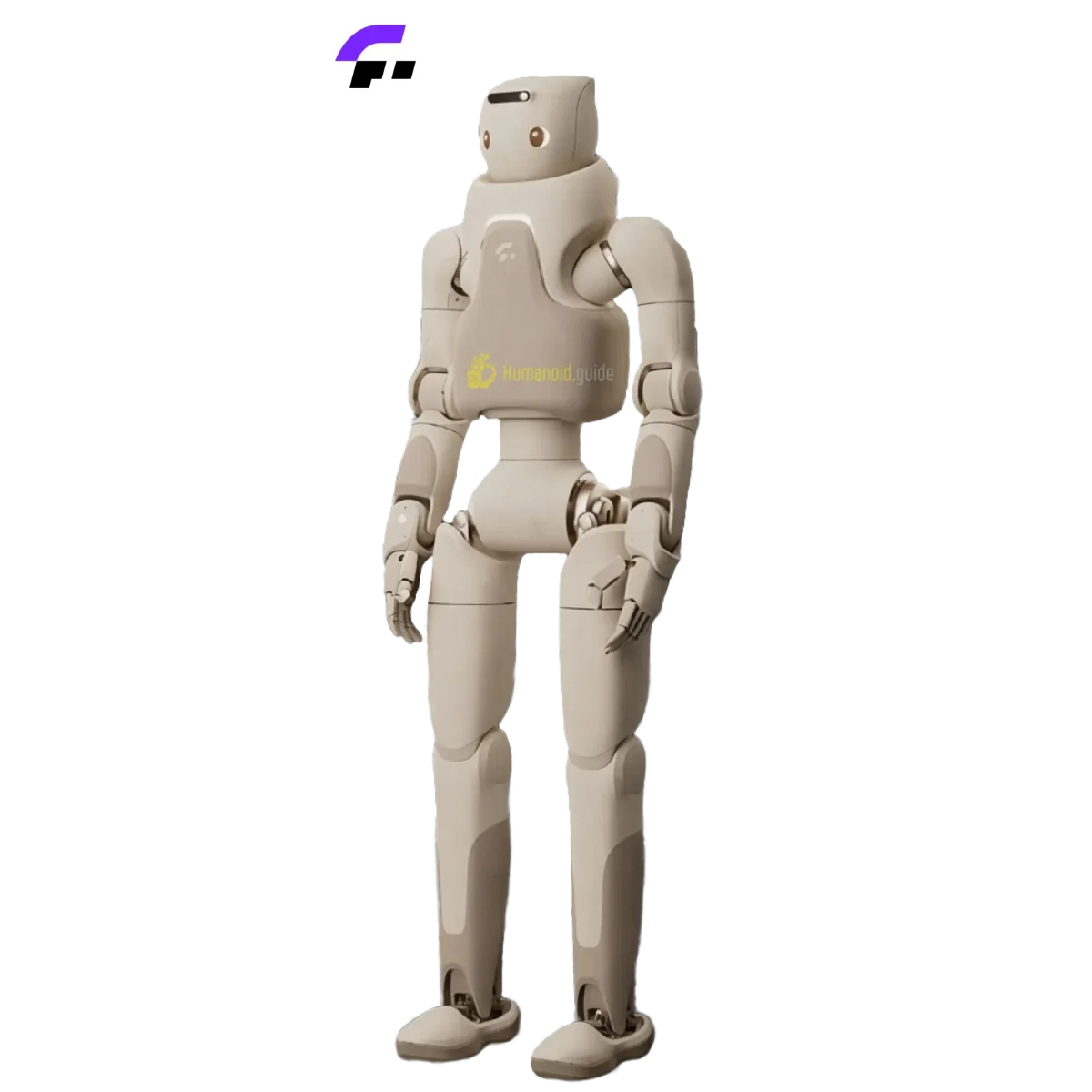
İnsansı Robot

Fourier GR-3 — Özellikler, Fiyat ve Nereden Satın Alınır (2026)

The Fourier GR-3 is a general-purpose humanoid robot designed by Fourier Intelligence in Shanghai, China. The new price is $80,000 as a pre-order. It features 55 degrees of freedom, a 3-hour battery life, and a top walking speed of 6.5 km/h. Units are expected to start shipping in 2025–2026, and a used market may emerge shortly after initial deliveries.

💰Fiyat
$80.000
📅İlk üretim
2026
🌍Menşei
CN
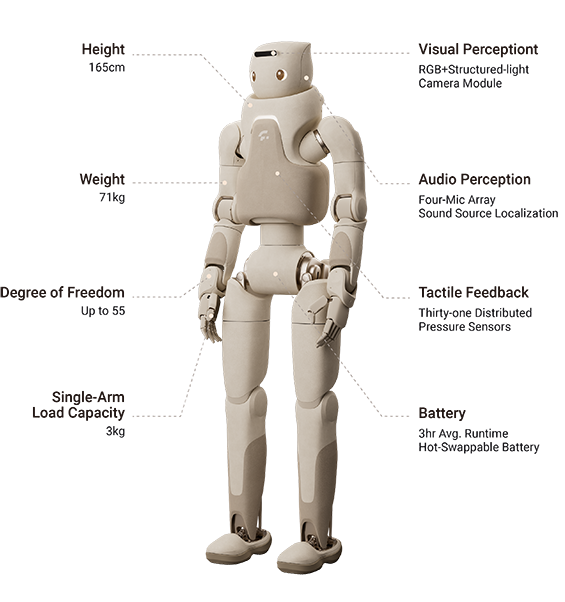
📏Yükseklik
168 cm
⚖️Ağırlık
60 kg
🦾Serbestlik derecesi
55
🏃Azami hız
6.5 km/h
📦Taşıma kapasitesi
15 kg
🔋Pil
3 hours
🛒Bulunabilirlik
Ön sipariş

What is the Fourier Gr3?

The Fourier GR-3 is a full‑sized humanoid robot developed by Fourier Intelligence, a Shanghai‑based robotics company founded in 2015. It builds on the GR-1 platform with a significant increase in degrees of freedom (55 total, 12 per hand), a faster bipedal gait (up to 6.5 km/h), and added dexterous manipulation capabilities. The GR-3 is designed for research, light industrial tasks, and healthcare assistance—targeting environments where safe human‑robot interaction is required. Its soft polymer shell and padded upholstery give it a companion‑like appearance, while the underlying electric actuator system enables dynamic movement and a 3‑hour runtime per charge. First demonstrated in 2025, the GR-3 is currently available for pre‑order through Fourier’s partner network at a price of $80,000.

Specifications

Here are the full technical specifications.

SpecValue
Height168 cm
Weight60 kg
Degrees of freedom55 (12 per hand)
Battery life3 hours
Max speed6.5 km/h
Payload15 kg (standing)
Price (new)$80,000
Price (used range)N/A (pre‑order)

Price & Value

New MSRP: $80,000

Used range: N/A

At $80,000 the GR-3 positions itself as a mid‑range humanoid, undercutting the Unitree H1 ($90,000) while offering comparable bipedal speed and battery life. The price reflects the step up from the earlier GR-1 and includes dexterous hands rarely seen at this cost. Depreciation is hard to gauge as the robot is still in pre‑order; early adopters may see little used supply for the first year. Total cost of ownership will depend on maintenance contracts and spare part availability, which Fourier has not yet detailed. For labs and light industry, the GR-3 provides a high‑DOF platform without the enterprise price tag of Agility Digit or the indefinite wait of Tesla Optimus. Buyers should confirm lead times and software support before committing.

Who Is It For?

Best for: - University robotics research labs (55‑DOF body + 12‑DOF hands enable full‑body manipulation studies) - Light manufacturing tasks that require safe physical collaboration (soft outer shell, 6.5 km/h walking speed) - Healthcare rehabilitation and assisted living pilots (the padded, companion‑like design suits patient‑facing roles)

Not for: - Heavy industrial payload handling (the standing payload is only 15 kg, with arm payload not yet published) - Continuous 24/7 operations (3‑hour battery means frequent recharging; swap‑able battery status unclear) - Budget‑constrained education programs (the $80k price and anticipated service costs are high for a teaching tool)

Alternatives & Comparison

The pre‑order humanoid market around $80,000—$90,000 is heating up. Below we compare the Fourier GR-3 with three direct competitors a buyer might evaluate.

ModelPriceAvailableKey Difference
Unitree H1$90,000yesThe H1 is shipping now with known reliability; the GR-3 offers higher dexterity with 12‑DOF hands vs the H1’s simpler grippers.
Figure 02UndisclosedpreorderFigure 02 focuses on dexterous manipulation and AI, but its price is unknown and availability is limited to early partners, making the GR-3 a more transparent pre-order.
Agility DigitUndisclosedenterprise-onlyDigit is purpose‑built for logistics with a unique leg design; the GR-3 is a general‑purpose humanoid suited for broader tasks.

Verdict: If you need a robot today, the Unitree H1 is the only production‑ready option. For research labs that prize 12‑DOF hands and a soft human‑friendly appearance, the GR-3’s $80k pre‑order is a compelling choice—once units start shipping. Wait for Agility Digit if your use case is strictly warehouse logistics; otherwise, the GR-3’s balanced spec sheet makes it the most versatile humanoid in this price bracket until Tesla Optimus reaches the open market.

Use Cases & Capabilities

Academic Robotics Research

With 55 degrees of freedom and 12‑DOF hands, the GR-3 enables whole‑body motion planning, dual‑arm manipulation, and embodied AI experiments. The RGB + structured‑light camera module provides perception data that integrates easily with ROS‑based stacks. Its soft exterior lowers the risk of injury during human‑subject studies, making it safer for university labs than industrial robots. Researchers can focus on algorithms rather than mechanical integration, as the platform comes ready with a low‑latency real‑time control stack.

Light Manufacturing & Assembly

The GR-3’s combination of 6.5 km/h walking speed and 12‑DOF hands makes it suitable for moving small parts and performing simple assembly tasks across a factory floor. Its 3‑hour runtime fits typical shift patterns with scheduled charging breaks. The robot’s padded shell is intended to permit collaborative work alongside human workers without requiring full physical barriers. Early adopters can evaluate it for tasks like kitting, inspection, or machine tending, though heavy lifting (payload 15 kg) limits its scope.

Healthcare Assistance & Rehabilitation

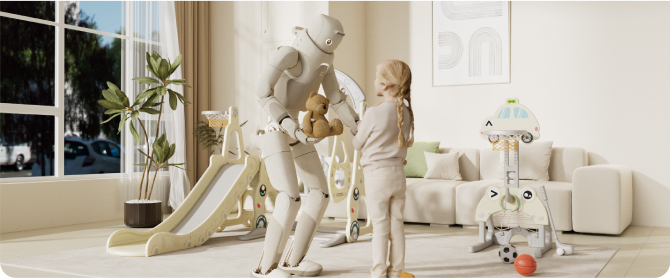
Fourier Intelligence originally focused on rehabilitation robotics, and the GR-3 inherits a companion‑like, approachable design. It can assist therapists by demonstrating exercises, fetching light equipment, or providing encouragement to patients during rehabilitation sessions. The 12‑DOF hands allow it to gently support a patient’s arm or deliver objects with precision. Its speed is sufficient to move around a clinic floor safely, and the soft exterior is less intimidating to elderly or vulnerable patients.

Public Service & Hospitality Pilots

The GR-3’s non‑threatening appearance makes it a candidate for information desks, museum guides, or hotel reception pilots. Its 55 DOF let it gesture naturally, and the 6.5 km/h top speed lets it escort guests at a brisk walking pace. The 3‑hour battery may require periodic recharging, which limits continuous use, but a well‑planned schedule can accommodate this. Developers can integrate LLM‑based conversation through the robot’s low‑latency glass‑to‑action interface.

History & Background

Fourier Intelligence was founded in 2015 in Shanghai, initially focused on rehabilitation robotics. The company’s first full‑sized humanoid, GR-1, appeared in 2023 with 40 degrees of freedom and a walking speed around 1.6 m/s. The GR-3 was unveiled in early 2025 as a major evolution, increasing DOF to 55 (12 per hand), raising top speed to 6.5 km/h, and adding a more refined soft‑shell exterior. The GR-3 targets a wider commercial audience, from research labs to light industry, and is offered for pre‑order at $80,000. As of 2026, units are still pre‑production with no public demonstrations of mass‑manufactured models, though the company expects to begin deliveries by late 2026. Fourier remains an independent Chinese robotics firm with no known acquisitions or external ownership changes.

Buying Used — What to Check

Verify payload rating and battery health Payload and runtime are the most critical specs for any used humanoid; ensure the 15 kg standing payload and 3‑hour battery are still accurate.

Confirm software version and updates Pre‑production robots may have immature software stacks; ask for the exact ROS‑compatible version and whether future updates are included.

Inspect hand dexterity and actuator wear The 12‑DOF hands are complex; any used unit should be tested for full finger range and actuator noise.
Sıkça Sorulan Sorular

The GR-3 carries a pre‑order price of $80,000 (USD). No official list price has been published beyond this figure, which aligns with listings on partner resellers like MERA Robotics. Buyers should contact Fourier Intelligence directly for volume discounts or payment terms.
The GR-3 is a 55‑DOF humanoid capable of walking at 6.5 km/h, carrying standing loads up to 15 kg, and manipulating objects with 12‑DOF hands. It packs an RGB + structured‑light camera module, supports LLM integration, and runs on a Linux‑based ROS‑compatible stack, making it suitable for research, light material handling, and healthcare assistance.
As of 2026, the GR-3 is available for pre‑order. Orders are placed through Fourier’s distribution network; expected delivery lead times have not been publicly confirmed but are anticipated within 2026. Contact Fourier Intelligence or authorized resellers for a quote and delivery estimate.
The GR-3 costs $80,000 vs the H1’s $90,000. It offers 55 DOF (including 12‑DOF hands) compared to the H1’s 28 DOF, giving it far superior dexterity. The H1 is currently shipping, while the GR-3 is in pre‑order. Both have similar battery life (3 h) and speed, but the GR-3’s soft shell and companion aesthetic target safer human interaction.
Height: 168 cm. Weight: 60 kg. Degrees of freedom: 55 (12 per hand). Battery life: 3 hours. Max walking speed: 6.5 km/h. Payload: 15 kg standing. Sensors: RGB + structured‑light camera module. Control: Linux‑based ROS‑compatible stack with low‑latency real‑time response.
Fourier Intelligence, an independent robotics company founded in 2015 and headquartered in Shanghai, China. Fourier originally specialized in rehabilitation robots and has since expanded to full‑sized humanoids with the GR series.
The GR-3 runs for approximately 3 hours on a full charge. Charging time and whether batteries are hot‑swappable have not been disclosed. Users should expect downtime for recharging in continuous operation scenarios.
Target industries include academic robotics research, light manufacturing and assembly, healthcare rehabilitation, and public service or hospitality pilots. Its soft, approachable exterior makes it a candidate for environments where human‑robot interaction is frequent and safety is paramount.

Fourier GR-3 in 3D

Loading the 3D model…
Drag to rotate · click the model, then scroll or pinch to zoom · click a part to inspectSwipe sideways to turn · pinch to zoom · tap a part to inspect3D model credit and licence

Fourier GR-3 supply chain

Point at or select a step to light up its chain: bright lines are its direct links, softer lines the rest of the path from raw material to robot.

Swipe sideways to follow the whole chain.

ExtractionRefiningMaterialsComponentsModulesRobotsCompaniesFourier's own actuators ('Fourier's high-performance actuators').Fourier's own 'Bionic Five-Finger Dexterous Hand', which it also sells on its own.Lithium compounds (carbonate, chloride, hydroxide) are produced from mined lithium.Lithium is produced from brine and mineral operations.Mined copper is smelted and refined.Primary aluminium from smelters.Bauxite is refined to alumina for aluminium.6061 aluminium contains 0.8–1.2% magnesium.6061 aluminium contains 0.40–0.8% silicon.A lithium-ion cell has a cathode (positive electrode), typically a metal oxide or phosphate. IEA tracks the 2025 mix of LFP and nickel-based cathodes in electric-car batteries.Silicon metal is made from silica in natural forms such as quartzite (USGS).Chips are made on wafers: thin slices of semiconductor such as crystalline silicon (Wikipedia). Silicon metal can be refined further into ultra-high-purity semiconductor-grade silicon, called polysilicon (USGS).Silicon metal can be refined further into ultra-high-purity semiconductor-grade silicon, called polysilicon (USGS). Chips are made on wafers: thin slices of crystalline silicon (Wikipedia).Magnesium is recovered from dolomite, serpentine, magnesium-bearing evaporite minerals and brines (USGS).In wire-bond packaging, fine gold or copper wire connects each die to its leadframe or substrate. ASE is gradually replacing gold wire with copper to cut material cost, though gold wire is still one of its main materials.Bosch makes its MEMS sensors in its own fabs in Reutlingen and Dresden; a MEMS sensor is a MEMS element plus an evaluation chip (ASIC).A MEMS sensor is packed in a semiconductor housing, such as an LGA package (Bosch).Mined cobalt is refined further into chemicals or metal (Cobalt Institute). In 2025 DR Congo's export restrictions left refiners short of cobalt hydroxide feed and forced some to limit production, though world refined output still rose 5% to 240 kt (Cobalt Institute).Cobalt sulphate, the largest refined cobalt product, is typically used in NCM (NMC) batteries, and cobalt tetroxide often in LCO batteries (Cobalt Institute). Cobalt-free substitutes that use iron and phosphorus (LFP) held a significant market share in China (USGS).Mined nickel ore and concentrate go to smelters and refineries. In Indonesia, laterite ore is processed into nickel pig iron and ferronickel for stainless steel, or into battery intermediates such as mixed hydroxide precipitate (IEA); the US Eagle Mine's concentrate is exported to smelters (USGS).Battery cathodes need nickel sulphate, made from Class I nickel metal or from intermediates such as mixed hydroxide precipitate and nickel matte (IEA). LFP (lithium iron phosphate) cathodes contain no nickel.Lithium-ion cathodes are lithium compounds, generally a layered oxide (such as lithium cobalt oxide), a phosphate (lithium iron phosphate) or a spinel (lithium manganese oxide). Batteries took an estimated 88% of world lithium in 2025 (USGS).Natural graphite flakes must be made into spherical particles, purified to over 99.95% carbon and coated before they can be used in lithium-ion battery anodes (IEA). Natural graphite is now a small part of anode supply: under 8% of China's 2025 anode shipments (GGII), and about 14% worldwide in 2022 (Rystad).Synthetic graphite is made by calcining and graphitising petroleum coke or needle coke at nearly 3,000 °C (IEA). It was 92.7% of China's 2025 anode shipments (GGII).The negative electrode (anode) of a conventional lithium-ion cell is typically graphite. IEA's 2025 data on electric-car battery anodes show only graphite and silicon-doped graphite.89.8% of the world's plastics in 2024 were made from fossil feedstock (Plastics Europe).Fourier lists GR-3's materials as aluminium alloy, engineering plastic and a soft cover material.Fourier lists engineering plastic among GR-3's materials.Fourier lists a soft cover material among GR-3's materials.Solder is the largest use of tin, 51% of world tin use in 2023 (International Tin Association; in the US solder took 11%, USGS). The common lead-free alloy SAC305 is 96.5% tin (AIM).Tin-lead solder is nearly half lead (PubChem), but the electronics industry has moved toward lead-free solders (USGS): 92% of solder for electronics was lead-free in 2023 (ITA).The lead-free alloy SAC305 contains 3% silver (AIM). In the US, brazing and solder took 3% of silver (USGS).The lead-free alloy SAC305 contains 0.5% copper (AIM).FR-4 laminate is woven fibreglass cloth with an epoxy binder (Wikipedia), and fibreglass is made from silica sand (Covia).A thin layer of copper foil is laminated to one or both sides of an FR-4 panel; these are called copper-clad laminates (Wikipedia; ChinaBaogao).FR-4 epoxy resin systems typically use bromine to resist fire (Wikipedia); a grade of the brominated flame retardant TBBPA is used to make epoxy resins for circuit boards (Wikipedia). Brominated flame retardants are one of bromine's two leading uses (USGS).Barite is used to make barium carbonate, which goes into dielectrics (Wikipedia). Barium titanate, the dielectric ceramic used in capacitors, can be made by heating barium carbonate with titanium dioxide (Wikipedia).Barium titanate, the ceramic in high-capacitance MLCCs, can be made by heating barium carbonate with titanium dioxide (Wikipedia); titanium dioxide comes from ilmenite and rutile (USGS).99% of MLCCs made worldwide use base-metal electrodes of nickel or copper; the industry moved from palladium and silver to cut cost (NASA, 2015). TDK replaced palladium electrodes with nickel in 1993 (Wikipedia).Platinum-group metals are used in multilayer ceramic capacitors (USGS). High-reliability MLCCs use palladium-silver electrodes (NASA, 2015).High-reliability MLCCs use precious-metal electrodes of palladium and silver (NASA, 2015).Indium tin oxide (ITO), which takes most of the world's indium, is the conductive coating in flat-panel displays, most commonly LCDs (USGS).Connector contacts are copper alloys: beryllium copper is called the best copper alloy for contacts, connectors and cables (Wikipedia), and phosphor bronze (copper-tin-phosphorus) can replace it (USGS).Copper-clad laminate is the core material of circuit boards (ChinaBaogao); FR-4 is a common material for printed circuit boards (Wikipedia).Parts are soldered onto bare boards: Adafruit's BNO055 board is a "breakout PCB", and the Raspberry Pi Zero 2 W brief warns against damage to the printed circuit board.SAC305 lead-free solder is made for soldering printed circuits, by wave, hand and SMT reflow soldering (Conro; AIM).MLCCs store and release charge and absorb noise in phones, home appliances and IoT devices (Murata). The Raspberry Pi's RP3A0 package includes the decoupling capacitors that smooth its supply voltage (Raspberry Pi).Boards carry connectors: the Raspberry Pi Zero 2 W brief speaks of the board and its connectors, and Waveshare's servo adapter has a USB-C connector and a power connector.Brass is copper and zinc: CW614N free-cutting brass is about 39% zinc. In the US, brass and bronze are the second use of zinc after galvanized steel.Brass is mostly copper: 57–59% in CW614N free-cutting brass.Free-cutting brass such as CW614N holds 2.5–3.5% lead so it machines cleanly; lead-free brasses exist.XT30 battery plugs (G1 harness, Open Duck Mini) have gold-plated brass contacts.Antimony is used in circuit boards to cut flammability further. A review lists two studies of scrap PC boards, parts and solder still on, with 0.45% and 1.97% antimony, so the share in the laminate alone is not known.The RK3588 is made on an 8 nm process (Rockchip).MEMS microphones are silicon chips: the diaphragm is etched into a silicon wafer (Wikipedia). Pollen's HAT uses a MEMS microphone.Magnet wire is drawn from rod of pure electrolytic copper: Elektrisola starts from 8 mm rod with at least 99.90% copper, and most magnet wire is fully annealed, electrolytically refined copper (Elektrisola; Wikipedia).Small DC and brushless motors' coils are wound from magnet wire, usually copper (Wikipedia); maxon says its coreless windings are enamelled copper wire, a copper core with lacquer insulation (maxon). Nidec does not say what wire its coils use.Each Fourier actuator takes DC power and an Ethernet cable directly, so its driver board is built in, with two encoders.Fourier: 'built-in 6 linear actuators and control circuits'; drive type 'Coreless motor'.Fourier: the hand has its own control circuits and talks over 100 Mbps Ethernet.Fourier: 'Lithium-ion battery'.Fourier GR-3 docs: processor 'AMD Ryzen 7 8845HS'.Fourier: 'GR3 head uses RK3588 main chip'.ASML's EUV machines print the most critical layers of the most advanced chips. DUV machines, which ASML also makes, print most of the layers in microchips (ASML annual report 2025).ASML's DUV machines, 'the workhorses of the industry', print the majority of layers in chips, older-generation chips included (ASML annual report 2025).Fourier (Fourier Intelligence) makes this robot.Fourier lists a 6-axis IMU that senses acceleration and turning speed; its 3D model puts it under the pelvis.The frame, shells and covers that make up the Fourier GR-3's body.The torso holds the main computer, a power management board, a communication board and the hot-swappable battery packs (Fourier); the chest light strip and the back control panel probably have small boards of their own (not published).Every actuator is wired for power and Ethernet ('all actuator IPs are pingable'), and Fourier names the external power port's connector (02.FGG.0B.002.CA42ZN); their makers are not published.Fourier's brochure: 'Equipped with Fourier's high-performance actuators'; one per body joint, 31 in all (Fourier's joint table).Fourier: 'Under standard configuration, equipped with 6-DOF dexterous hands'; the hand's meshes are in Fourier's GR-3 model folder.Fourier: two lithium-ion packs, 702 Wh + 234 Wh, one hot-swappable from the back.Fourier: AMD Ryzen 7 8845HS main computer in the chest.Fourier: 'GR3 head uses RK3588 main chip, supports Android12'.Fourier's brochure: 'OAK Camera'; its docs: 'Monocular camera' in the head.Fourier: a four-mic array with 360° pickup and sound-source location.Fourier: a speaker of up to 15 W.Fourier: 31 distributed pressure sensors, 16 on the head and 15 on the torso.Fourier: two eye display screens (an SPI screen shows the eyes).Quartz and silica sandQuartz and silica sandMagnesium ores and brinesMagnesium ores and brinesOil, gas and coal(plastics feedstock)Oil, gas and coal (plastics feedstock)Lithography machines (chipprinting)Lithography machines (chip printing)Mature-node chipfabrication (28 nm and…Mature-node chip fabrication (28 nm and older; analog and sensor chips)Aluminium alloysAluminium alloysBattery-grade lithiumcompoundsBattery-grade lithium compoundsLithium chemicalconversionLithium chemical conversionCopper smelting andrefiningCopper smelting and refiningAlumina refining andaluminium smeltingAlumina refining and aluminium smeltingLithium miningLithium miningCopper miningCopper miningBauxite miningBauxite miningMagnesium smeltingMagnesium smeltingSilicon metal smeltingSilicon metal smeltingLeading-edge chipfabrication (under 10 nm)Leading-edge chip fabrication (under 10 nm)Chip packaging and test(OSAT)Chip packaging and test (OSAT)Small precision motors (DCand BLDC)Small precision motors (DC and BLDC)Processors (CPUs and SoCs)Processors (CPUs and SoCs)IMUs (motion sensors)IMUs (motion sensors)Tactile sensorsTactile sensorsLithium-ion cellsLithium-ion cellsFourier GR-3Fourier GR-3FourierFourierCobalt miningCobalt miningCobalt refining (chemicalsand metal)Cobalt refining (chemicals and metal)Nickel miningNickel miningNickel smelting andrefiningNickel smelting and refiningNatural graphite miningNatural graphite miningBattery anode graphite(spherical natural and…Battery anode graphite (spherical natural and synthetic)Cathode active material(NMC, NCA, LCO, LFP)Cathode active material (NMC, NCA, LCO, LFP)Titanium minerals(ilmenite and rutile)Titanium minerals (ilmenite and rutile)Engineering plastics (ABS,PC, nylon, PEEK)Engineering plastics (ABS, PC, nylon, PEEK)Soft covers (textiles,foams, soft polymer skins)Soft covers (textiles, foams, soft polymer skins)Tin miningTin miningLead miningLead miningSilver miningSilver miningPalladium mining(platinum-group metals)Palladium mining (platinum-group metals)Antimony miningAntimony miningBromine (from brines)Bromine (from brines)Barite mining (barium)Barite mining (barium)Indium refining (zincby-product)Indium refining (zinc by-product)Solder (tin alloys:lead-free SAC and…Solder (tin alloys: lead-free SAC and tin-lead)Copper-clad laminate (FR-4glass-fibre epoxy board…Copper-clad laminate (FR-4 glass-fibre epoxy board material)Printed circuit boards(bare boards)Printed circuit boards (bare boards)Multilayer ceramiccapacitors (MLCC)Multilayer ceramic capacitors (MLCC)Connectors and wiringharnessesConnectors and wiring harnessesDisplays (LCD and OLEDscreens)Displays (LCD and OLED screens)Electronics assembly(circuit boards with part…Electronics assembly (circuit boards with parts soldered on)Structure: Fourier GR-3Structure: Fourier GR-3Zinc miningZinc miningBrass (copper-zinc alloy)Brass (copper-zinc alloy)Copper magnet wire(enamelled)Copper magnet wire (enamelled)Rockchip RK3588 SoCRockchip RK3588 SoCMicrophonesMicrophonesSmall speakersSmall speakersFourier actuators (GR-3:31 in seven sizes)Fourier actuators (GR-3: 31 in seven sizes)Fourier FDH-6 dexteroushand (6 DoF)Fourier FDH-6 dexterous hand (6 DoF)GR-3 batteries (702 Wh +234 Wh, 46.8 V;…GR-3 batteries (702 Wh + 234 Wh, 46.8 V; hot-swappable)GR-3 main computer (AMDRyzen 7 8845HS)GR-3 main computer (AMD Ryzen 7 8845HS)GR-3 head board (RockchipRK3588, Android 12)GR-3 head board (Rockchip RK3588, Android 12)GR-3 OAK camera (Luxonis)GR-3 OAK camera (Luxonis)

Görseller4

Fourier GR-3 photo 1
Fourier GR-3 photo 2
Fourier GR-3 photo 3
Fourier GR-3 photo 4