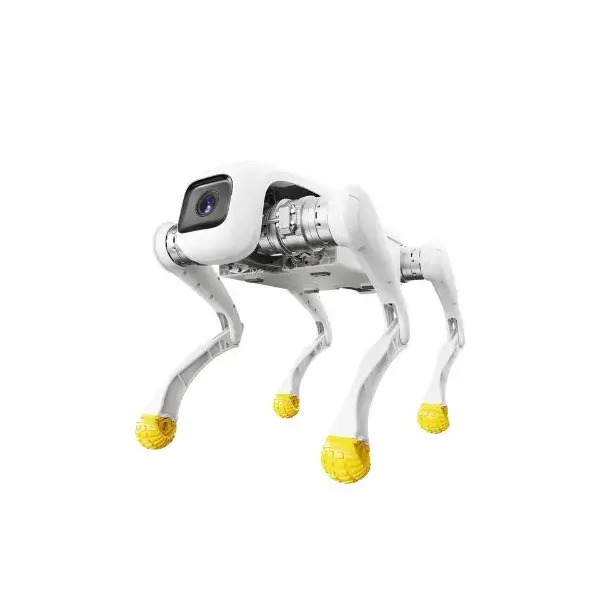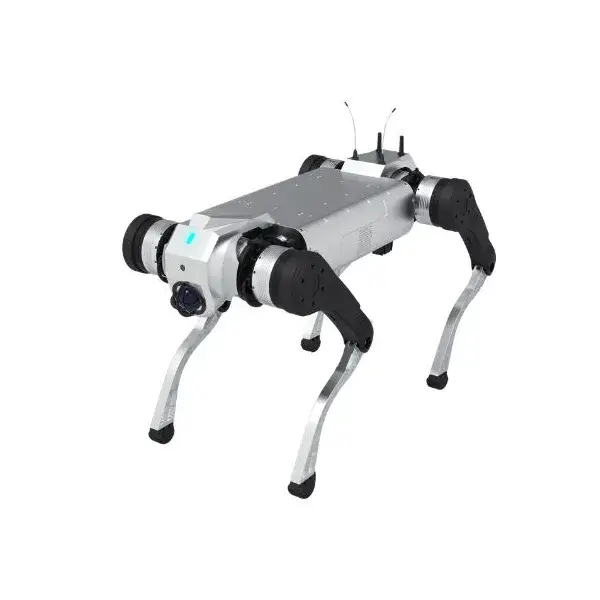
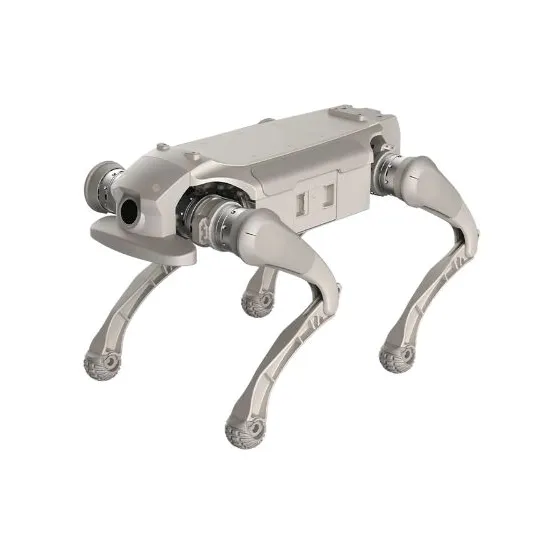
AgiBot D1 Ultra Quadruped Robot

AgiBot D1 Ultra Quadruped Robot

AgiBot D1 Ultra Quadruped Robot
Agibot | A-000000-08145
€9,300.00 VAT incl. €7,750.00 VAT excl.

The AgiBot D1 Ultra is a compact quadruped robot designed for research, inspection, and mobile robotics in real-world environments.
Quantity
Delivery within 2 to 4 weeks

Create a cart and turn it into a quote instantly!
Payment methods (see T&C)
Debit card
PayPal
Payment by invoice
Wire transfer

AgiBot D1 Ultra quadruped robot: key points

  • Compact industrial-grade quadruped robot, designed for multi-scenario applications in real-world environments.
  • All-terrain locomotion: walking control based on reinforcement learning (RL), with self-balancing, anti-tip, and disturbance rejection capabilities.
  • Advanced mobility: speed up to 3.7 m/s, jump height up to 35 cm, continuous stair climbing up to 16 cm, and maximum slope up to 40°.
  • Static payload: approximately 8 kg.
  • Compact form factor: 630 × 360 × 420 mm in standing position, for easier integration in mixed indoor / outdoor environments.
  • IP54 protection: design intended for dusty, humid, muddy, or sandy environments.
  • Secondary development: Open SDK, Ethernet, USB, SBUS, UART interfaces, and 12V/24V power supply for integrating sensors and external modules.
  • Sensor / module compatibility: LiDAR, depth camera, RTK, 4G/5G module, video transmission, and other payloads.
  • Simulation: support for URDF models and compatibility with Isaac Sim and MuJoCo.
  • Actuation: peak joint motor torque of around 48 N·m and dual-encoder control, with no zero calibration required at startup.
  • Travel range: up to 6 km unloaded (at 1.8 m/s) and 4 km with a 5 kg payload.
  • Applications: research and education, inspection, security, emergency response, and advanced robotics experimentation.

Applications and project types (locomotion, perception, inspection, navigation, sensor integration)

The AgiBot D1 Ultra quadruped robot is intended for research laboratories, universities, and robotics professionals looking for a compact, mobile quadruped platform open to the integration of additional modules.

It is particularly relevant for projects involving locomotion on complex terrain, walking control, navigation in unstructured environments, robotic inspection, sensor fusion, and validation of algorithms in simulation before deployment on the real robot.

Practical examples: research on robust quadruped locomotion, SLAM experimentation with LiDAR or depth camera, inspection of technical sites, security robotics, emergency response scenarios, higher education in mobile robotics, and the development of demonstrators for R&D projects.

The AgiBot D1 Ultra is a relevant robotic platform for developing POCs, validating software building blocks, and testing onboard payloads before a possible industrialization phase.

Why choose the AgiBot D1 Ultra for a research or applied robotics project?

  • Its compact size makes it easier to work in corridors, laboratories, technical platforms, or mixed test areas.
  • Its quadruped mobility is valuable whenever terrain, stairs, uneven surfaces, or outdoor constraints limit the use of a wheeled platform.
  • Its development ecosystem is designed for adding sensors, communication modules, and payloads intended for experimentation.
  • Support for simulation via URDF facilitates workflows such as simulation → validation → field deployment.
  • The robot is positioned for both academic and professional uses, making it an interesting platform for applied research projects.

Software ecosystem and development (SDK, interfaces, simulation)

The robot features an Open SDK for secondary development, as well as a set of standardized interfaces enabling the integration of external modules and various payloads. It also supports URDF models and can be used in simulation environments such as Isaac Sim and MuJoCo.

This approach is particularly useful for teams wishing to build a workflow combining modeling, simulation, locomotion testing, sensor integration, and validation on the real robot.

What information should I prepare for a quote request?

To qualify a project around the AgiBot D1 Ultra, it is useful to specify: your estimated budget, the project timeline, your delivery address, the intended operating environment (indoor, outdoor, mixed), the sensors or modules you wish to integrate, as well as a short description of your use case (inspection, locomotion, research, education, navigation, data collection, etc.).

Pre-shipment check

Before each shipment, our team performs a complete, step-by-step check (battery, start-up, remote control, movement, controls).

Details are listed on our Support page.

Technical specifications of the AgiBot D1 Ultra quadruped robot

Dimensions in standing position630 × 360 × 420 mm
Folded dimensions670 × 435 × 145 mm
Weight15 kg
Speed0 to 3.7 m/s
Static payload≈ 8 kg
Travel range unloaded6 km at 1.8 m/s
Travel range with payload4 km with 5 kg payload
Maximum slopeup to 40°
Stair climbingup to 16 cm
Jumpup to 35 cm
Protection ratingIP54
Max. joint motor torqueapproximately 48 N·m
Max. machine output powerapproximately 3,500 W
Joint control modeDual encoder
Expansion interfacesEthernet, USB, 12V/24V power supply, SBUS, UART
Compatible modulesLiDAR / 3D radar, depth camera, RTK, 4G/5G module, video transmission, other development modules
Secondary developmentYes (Open SDK)
SimulationURDF, Isaac Sim, MuJoCo

Resources for the AgiBot D1 Ultra quadruped robot

FAQ – AgiBot D1 Ultra quadruped robot

What types of research projects is the AgiBot D1 Ultra suitable for?

The D1 Ultra is well suited for projects involving quadruped locomotion, navigation on complex terrain, robotic inspection, embedded perception, multi-sensor fusion, and payload testing. Its relevance is especially strong when the test environment includes uneven ground, stairs, or outdoor constraints.

Can third-party sensors or modules be added?

Yes. It is compatible with modules such as LiDAR, depth camera, RTK, 4G/5G, or video transmission modules. This makes it an interesting base for projects requiring specific instrumentation.

Is the robot suitable for both indoor and outdoor testing?

Yes, as its product positioning emphasizes all-terrain mobility and IP54 protection. It is presented for environments involving splashes, humidity, mud, or sand, which makes it relevant for mixed testing depending on the safety protocol and project conditions.

Which capabilities are most useful for locomotion research?

The most interesting points are the announced speed up to 3.7 m/s, stair climbing of 16 cm, jump capability up to 35 cm, and slope climbing up to 40°. For a research team, these features make it possible to work on gait robustness and adaptation to varied terrain.

Is the D1 Ultra relevant for higher education?

Yes, especially for courses or projects related to mobile robotics, perception, control, embedded AI, and robotic simulation. URDF support and openness to module integration make it an interesting platform for advanced demonstrations and university-level practical work.

Is simulation part of the development workflow?

It supports URDF models, Isaac Sim, and MuJoCo. This can help prepare behaviors, test a sensor configuration, or validate a control logic before field trials.

Is the robot sold with a complete ready-to-use software environment for all use cases?

The robot integrates an Open SDK, compatibility with simulation environments, and possibilities for secondary development, making it suitable for integration into research or applied robotics projects.

Kasaysayan ng presyo

Kasaysayan ng karaniwang presyo

Isang punto ng datos bawat araw, na kinuwenta ang average ayon sa petsa ng obserbasyon.

Karaniwang presyo bawat araw

Mga halaga sa USD

$10,208.56
Tsart ng kasaysayan ng karaniwang presyo sa USDGrapikong linya ng 61 obserbasyon mula Okt 2, 2026 hanggang Nob 22, 2026.$10,208.59$10,208.58$10,208.57$10,208.56$10,208.55Okt 2Okt 14Okt 27Nob 9Nob 22Okt 2, 2026: $10,208.56 ang karaniwang presyoOkt 3, 2026: $10,208.56 ang karaniwang presyoOkt 4, 2026: $10,208.56 ang karaniwang presyoOkt 5, 2026: $10,208.56 ang karaniwang presyoOkt 6, 2026: $10,208.56 ang karaniwang presyoOkt 7, 2026: $10,208.56 ang karaniwang presyoOkt 8, 2026: $10,208.56 ang karaniwang presyoOkt 9, 2026: $10,208.56 ang karaniwang presyoOkt 10, 2026: $10,208.56 ang karaniwang presyoOkt 11, 2026: $10,208.56 ang karaniwang presyoOkt 12, 2026: $10,208.56 ang karaniwang presyoOkt 13, 2026: $10,208.56 ang karaniwang presyoOkt 14, 2026: $10,208.56 ang karaniwang presyoOkt 15, 2026: $10,208.56 ang karaniwang presyoOkt 16, 2026: $10,208.56 ang karaniwang presyoOkt 17, 2026: $10,208.56 ang karaniwang presyoOkt 18, 2026: $10,208.56 ang karaniwang presyoOkt 19, 2026: $10,208.56 ang karaniwang presyoOkt 20, 2026: $10,208.56 ang karaniwang presyoOkt 21, 2026: $10,208.56 ang karaniwang presyoOkt 22, 2026: $10,208.56 ang karaniwang presyoOkt 23, 2026: $10,208.56 ang karaniwang presyoOkt 24, 2026: $10,208.56 ang karaniwang presyoOkt 25, 2026: $10,208.56 ang karaniwang presyoOkt 26, 2026: $10,208.56 ang karaniwang presyoOkt 27, 2026: $10,208.56 ang karaniwang presyoOkt 28, 2026: $10,208.56 ang karaniwang presyoOkt 29, 2026: $10,208.56 ang karaniwang presyoOkt 30, 2026: $10,208.56 ang karaniwang presyoOkt 31, 2026: $10,208.56 ang karaniwang presyoNob 1, 2026: $10,208.56 ang karaniwang presyoNob 2, 2026: $10,208.56 ang karaniwang presyoNob 3, 2026: $10,208.56 ang karaniwang presyoNob 4, 2026: $10,208.56 ang karaniwang presyoNob 5, 2026: $10,208.56 ang karaniwang presyoNob 6, 2026: $10,208.56 ang karaniwang presyoNob 7, 2026: $10,208.56 ang karaniwang presyoNob 8, 2026: $10,208.56 ang karaniwang presyoNob 9, 2026: $10,208.56 ang karaniwang presyoNob 10, 2026: $10,208.56 ang karaniwang presyoNob 11, 2026: $10,208.56 ang karaniwang presyoNob 12, 2026: $10,208.56 ang karaniwang presyoNob 13, 2026: $10,208.56 ang karaniwang presyoNob 14, 2026: $10,208.56 ang karaniwang presyoNob 15, 2026: $10,208.56 ang karaniwang presyoNob 16, 2026: $10,208.56 ang karaniwang presyoNob 17, 2026: $10,208.56 ang karaniwang presyoNob 18, 2026: $10,208.56 ang karaniwang presyoNob 19, 2026: $10,208.56 ang karaniwang presyoNob 20, 2026: $10,208.56 ang karaniwang presyoNob 21, 2026: $10,208.56 ang karaniwang presyoNob 22, 2026: $10,208.56 ang karaniwang presyo

Kinakalkula ang mga average bawat araw ng UTC mula sa lahat ng naitalang presyo ng alok.