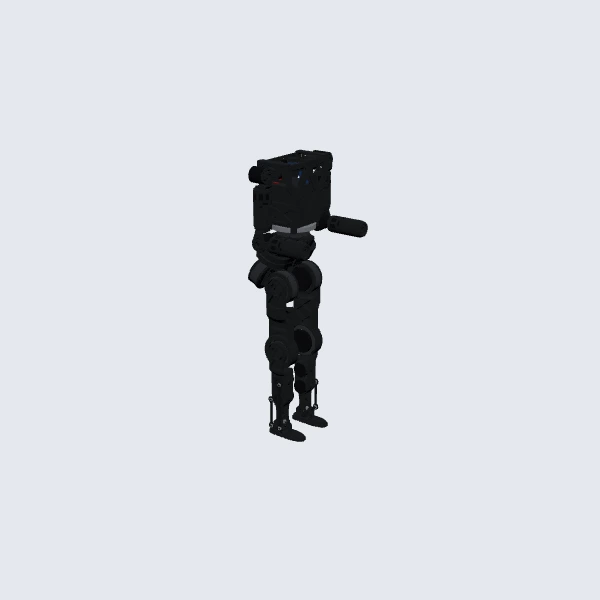
หุ่นยนต์คล้ายมนุษย์

RoboParty Roboto Origin — สเปก ราคา และแหล่งจำหน่าย (2026)

A 1.25 m, 34 kg open-source humanoid robot by RoboParty, built from a kit of machined aluminium parts and 23 bought-in Damiao motors (6 per leg, 5 per arm, 1 at the waist), with a 48 V battery and a small AI computer in the chest. It can run at 3 m/s.

🌍แหล่งกำเนิด
CN
📏ความสูง
1.25 m
⚖️น้ำหนัก
34 kg
🦾องศาอิสระ
23
🏃ความเร็วสูงสุด
3 m/s
🔋แบตเตอรี่
2+ hours
🛒สถานะการวางจำหน่าย
—

What is the RoboParty Roboto Origin?

A 1.25 m, 34 kg open-source humanoid robot by RoboParty, built from a kit of machined aluminium parts and 23 bought-in Damiao motors (6 per leg, 5 per arm, 1 at the waist), with a 48 V battery and a small AI computer in the chest. It can run at 3 m/s.

Specifications

Facts about the RoboParty Roboto Origin from its project's published documentation, design files and its makers' own figures. A figure marked Estimate is worked out from those files or parts lists rather than stated by the maker.

SpecDetail
Size1.25 m tall (RoboParty's figure; its pictures show a display head, which the 3D model lacks); thigh 250 mm, shank 300 mm, each arm 440 mm. The 3D model, without a head, is 1.06 m from sole to shoulder top.
Weight34 kg (RoboParty). Its 3D model's link masses add up to 33.76 kg.
Joints23 joint motors: 6 per leg (hip yaw, roll and pitch, knee, and two for the ankle's pitch and roll), 5 per arm (shoulder pitch, roll and yaw, elbow, wrist roll) and 1 at the waist. No hands.
Joint motorsBought-in Damiao motors with built-in driver and two encoders: 9 DM-J10010L (120 N·m peak, 10:1, 1,375 g) at the waist, hips and knees, and 14 DM-J4340P (27 N·m peak, 40:1, 375 g) in the arms and shins. The two shin motors of each leg move the ankle through steel rods.
Range of motionHip pitch −120° to +45°, knee −11° to +143°, hip roll and hip yaw 69° each (−11° to +57°, mirrored left and right), ankle pitch ±34° and roll ±29°, shoulder pitch −180° to +90°, waist ±180° (RoboParty's URDF limits; the V2 waist also has a mechanical limit switch).
Main computerTwo boards are documented. The parts list and the official kit name a D-Robotics RDK X5 with 8 GB (8 Cortex-A55 cores at 1.5 GHz, 10 TOPS AI accelerator). RoboParty's own wiring guide and 3D file use an Orange Pi 5 Plus (Rockchip RK3588, 6 TOPS): the guide plugs the power board's USB-to-CAN, the IMU and the gamepad receiver into it. RoboParty's software is verified on both.
Battery48 V, 15 Ah lithium-ion pack (about 720 Wh, 140 × 140 × 115 mm), for more than 2 hours (RoboParty). It is charged through a 3-pin aviation plug.
Power and wiringRoboParty's own RBE board (80 × 60 mm) turns 48 V into 5 V (8 A) for the computer, shares the 48 V among four XT30 outputs and has four USB-to-CAN channels. 23 harnesses with XT30 plugs chain the motors; the cables run inside the frame.
SensorsA HiPNUC HI14M0 IMU in the chest. An Intel RealSense D435i depth camera and a 3D LiDAR are optional (RoboParty; a reseller names an E1R LiDAR).
SpeedRuns at up to 3 m/s (RoboParty), with its open-source reinforcement-learning gait.
Emergency stopA red emergency stop button on the back of the chest (Lanbo, metal head), and a latching power switch with a green ring light for the computer.
Frame26 machined parts: 6061 aluminium, with 7075 for the waist support and battery bottom cover, all sandblasted and black anodised; the ankle rods, cranks and foot links are 45 steel with a black-oxide finish. RoboParty's README says the robot can be built from Taobao parts and JLC (Jialichuang) prototypes.
Screws1,168 fasteners in the parts list: socket-head screws from M2.5 to M6 in 12.9-grade alloy steel (200 of them M4 × 8), 60 steel dowel pins, 10 standoffs and 4 eye bolts.
PriceKit at a reseller: $12,450 for the official full kit without battery; $11,800 for Kit 1 (frame, battery and motors); $5,000 for the 23 motors (AIFITLAB, 14 Oct 2026). RoboParty's own January 2026 parts list totals about $7,429 (¥49,713).
Where it comes fromDesigned by RoboParty (Shanghai RoboParty Technology, founded 21 Feb 2025, Zhangjiang Robot Valley, Shanghai). By May 2026 its first several hundred robots were being delivered, assembled by their users; the next product is RP1. The motors are made by Damiao in Shenzhen, the IMU by HiPNUC in Beijing.
Pose shownAll joint angles at zero (the zero pose): standing straight, upper arms down, forearms pointing forward.

3D model

The interactive 3D model on this page is converted from the project's published design: Roboto Origin V2 (RPO) by RoboParty (github.com/Roboparty/roboto_origin, commit c71fd92, modules/rpo_description). 3D model © 2025–2026 RoboParty, CERN-OHL-W-2.0; this converted model is shared under the same licence, with its source location and changes in the notice. RoboParty does not endorse this model.

Sources

RoboParty Roboto Origin in 3D

Loading the 3D model…
Drag to rotate · click the model, then scroll or pinch to zoom · click a part to inspectSwipe sideways to turn · pinch to zoom · tap a part to inspect3D model credit and licence

RoboParty Roboto Origin supply chain

Point at or select a step to light up its chain: bright lines are its direct links, softer lines the rest of the path from raw material to robot.

Swipe sideways to follow the whole chain.

ExtractionRefiningMaterialsComponentsModulesRobotsCompaniesPLA filament is made of polylactic acid.Lactic acid feeds PLA polymer production.PLA is plant-based.Lithium compounds (carbonate, chloride, hydroxide) are produced from mined lithium.Lithium is produced from brine and mineral operations.Mined copper is smelted and refined.Primary aluminium from smelters.Bauxite is refined to alumina for aluminium.6061 aluminium contains 0.8–1.2% magnesium.6061 aluminium contains 0.40–0.8% silicon.A lithium-ion cell has a cathode (positive electrode), typically a metal oxide or phosphate. IEA tracks the 2025 mix of LFP and nickel-based cathodes in electric-car batteries.Silicon metal is made from silica in natural forms such as quartzite (USGS).Chips are made on wafers: thin slices of semiconductor such as crystalline silicon (Wikipedia). Silicon metal can be refined further into ultra-high-purity semiconductor-grade silicon, called polysilicon (USGS).Memory is made on silicon wafers (Micron lists silicon wafers among its key materials); wafer silicon is refined from silicon metal (USGS).Magnesium is recovered from dolomite, serpentine, magnesium-bearing evaporite minerals and brines (USGS).In wire-bond packaging, fine gold or copper wire connects each die to its leadframe or substrate. ASE is gradually replacing gold wire with copper to cut material cost, though gold wire is still one of its main materials.Steel is made from iron ore: US mines shipped 98% of their usable iron ore to the steel industry (USGS).Precision bearing rings are made of through-hardened chromium bearing steel 100Cr6 (SAE 52100) (GMN).Micron makes its memory in its own fabs; most of its 2026 DRAM output came from Taiwan. SIA/BCG: DRAM capacity is highly concentrated in South Korea.Micron's manufacturing runs from wafer fabrication through assembly and test, with subcontractors for some steps.Mined cobalt is refined further into chemicals or metal (Cobalt Institute). In 2025 DR Congo's export restrictions left refiners short of cobalt hydroxide feed and forced some to limit production, though world refined output still rose 5% to 240 kt (Cobalt Institute).Cobalt sulphate, the largest refined cobalt product, is typically used in NCM (NMC) batteries, and cobalt tetroxide often in LCO batteries (Cobalt Institute). Cobalt-free substitutes that use iron and phosphorus (LFP) held a significant market share in China (USGS).Mined nickel ore and concentrate go to smelters and refineries. In Indonesia, laterite ore is processed into nickel pig iron and ferronickel for stainless steel, or into battery intermediates such as mixed hydroxide precipitate (IEA); the US Eagle Mine's concentrate is exported to smelters (USGS).Battery cathodes need nickel sulphate, made from Class I nickel metal or from intermediates such as mixed hydroxide precipitate and nickel matte (IEA). LFP (lithium iron phosphate) cathodes contain no nickel.Stainless steel is the biggest use of nickel, 66% of demand in 2025 (Cobalt Institute). In the US, stainless and alloy steels and nickel alloys take more than 85% of nickel use (USGS). The world made 64.2 Mt of stainless steel in 2025 (worldstainless), against about 1,900 Mt of raw steel (USGS).Lithium-ion cathodes are lithium compounds, generally a layered oxide (such as lithium cobalt oxide), a phosphate (lithium iron phosphate) or a spinel (lithium manganese oxide). Batteries took an estimated 88% of world lithium in 2025 (USGS).Natural graphite flakes must be made into spherical particles, purified to over 99.95% carbon and coated before they can be used in lithium-ion battery anodes (IEA). Natural graphite is now a small part of anode supply: under 8% of China's 2025 anode shipments (GGII), and about 14% worldwide in 2022 (Rystad).Synthetic graphite is made by calcining and graphitising petroleum coke or needle coke at nearly 3,000 °C (IEA). It was 92.7% of China's 2025 anode shipments (GGII).The negative electrode (anode) of a conventional lithium-ion cell is typically graphite. IEA's 2025 data on electric-car battery anodes show only graphite and silicon-doped graphite.Solder is the largest use of tin, 51% of world tin use in 2023 (International Tin Association; in the US solder took 11%, USGS). The common lead-free alloy SAC305 is 96.5% tin (AIM).Tin-lead solder is nearly half lead (PubChem), but the electronics industry has moved toward lead-free solders (USGS): 92% of solder for electronics was lead-free in 2023 (ITA).The lead-free alloy SAC305 contains 3% silver (AIM). In the US, brazing and solder took 3% of silver (USGS).The lead-free alloy SAC305 contains 0.5% copper (AIM).FR-4 laminate is woven fibreglass cloth with an epoxy binder (Wikipedia), and fibreglass is made from silica sand (Covia).A thin layer of copper foil is laminated to one or both sides of an FR-4 panel; these are called copper-clad laminates (Wikipedia; ChinaBaogao).FR-4 epoxy resin systems typically use bromine to resist fire (Wikipedia); a grade of the brominated flame retardant TBBPA is used to make epoxy resins for circuit boards (Wikipedia). Brominated flame retardants are one of bromine's two leading uses (USGS).Barite is used to make barium carbonate, which goes into dielectrics (Wikipedia). Barium titanate, the dielectric ceramic used in capacitors, can be made by heating barium carbonate with titanium dioxide (Wikipedia).Barium titanate, the ceramic in high-capacitance MLCCs, can be made by heating barium carbonate with titanium dioxide (Wikipedia); titanium dioxide comes from ilmenite and rutile (USGS).99% of MLCCs made worldwide use base-metal electrodes of nickel or copper; the industry moved from palladium and silver to cut cost (NASA, 2015). TDK replaced palladium electrodes with nickel in 1993 (Wikipedia).Platinum-group metals are used in multilayer ceramic capacitors (USGS). High-reliability MLCCs use palladium-silver electrodes (NASA, 2015).High-reliability MLCCs use precious-metal electrodes of palladium and silver (NASA, 2015).Connector contacts are copper alloys: beryllium copper is called the best copper alloy for contacts, connectors and cables (Wikipedia), and phosphor bronze (copper-tin-phosphorus) can replace it (USGS).Copper-clad laminate is the core material of circuit boards (ChinaBaogao); FR-4 is a common material for printed circuit boards (Wikipedia).Parts are soldered onto bare boards: Adafruit's BNO055 board is a "breakout PCB", and the Raspberry Pi Zero 2 W brief warns against damage to the printed circuit board.SAC305 lead-free solder is made for soldering printed circuits, by wave, hand and SMT reflow soldering (Conro; AIM).MLCCs store and release charge and absorb noise in phones, home appliances and IoT devices (Murata). The Raspberry Pi's RP3A0 package includes the decoupling capacitors that smooth its supply voltage (Raspberry Pi).Boards carry connectors: the Raspberry Pi Zero 2 W brief speaks of the board and its connectors, and Waveshare's servo adapter has a USB-C connector and a power connector.Brass is copper and zinc: CW614N free-cutting brass is about 39% zinc. In the US, brass and bronze are the second use of zinc after galvanized steel.Brass is mostly copper: 57–59% in CW614N free-cutting brass.Free-cutting brass such as CW614N holds 2.5–3.5% lead so it machines cleanly; lead-free brasses exist.XT30 battery plugs (G1 harness, Open Duck Mini) have gold-plated brass contacts.Antimony is used in circuit boards to cut flammability further. A review lists two studies of scrap PC boards, parts and solder still on, with 0.45% and 1.97% antimony, so the share in the laminate alone is not known.22 of the 26 machined parts are aluminium: 6061, and 7075 for the waist support and the battery bottom cover, all sandblasted and black anodised (RoboParty's parts list).The ankle rods, the cranks on the ankle motors and the foot links are 45 steel with a black-oxide finish (RoboParty's parts list).The board adapter plates and the calibration pieces are printed in black PLA (RoboParty's printed-parts list).The Orange Pi 5 Plus is built around the Rockchip RK3588.The RK3588 is made on an 8 nm process (Rockchip).The RDK X5's processor is the Sunrise 5 chip (8 Cortex-A55 cores at 1.5 GHz and a 10 TOPS AI accelerator).4 or 8 GB of LPDDR4 memory.A 48 V, 15 Ah lithium-ion pack is built from many lithium-ion cells; the cell type, arrangement and maker are not stated.Each motor carries its own driver board on its back (Damiao's photo).Each motor has its driver built in (Damiao).Heat sinks are often aluminium: the Go2's main board has two fans blowing over an aluminium heat sink (Simplexity).In the Unitree G1, the heat pipe and heat spreaders that teardowns show are copper: a copper heat pipe presses against a motor (a published teardown), and copper heat-spreader plates cool its knees (China Post Securities).ASML's EUV machines print the most critical layers of the most advanced chips. DUV machines, which ASML also makes, print most of the layers in microchips (ASML annual report 2025).DUV machines, which ASML also makes, print most of the layers in microchips, and ASML's EUV machines (the NXE:3800E) are being adopted by advanced DRAM makers (ASML annual report 2025).RoboParty designs the Roboto Origin and sells it as a kit; its users assemble it (first several hundred delivered by May 2026).The machined frame, steel ankle rods, rubber foot pads and printed parts that make up the Roboto Origin's body.Nine DM-J10010L motors: the waist, the three hip joints and the knee of each leg.Fourteen DM-J4340P motors: five in each arm and two in each shin, which drive the ankle.One 48 V, 15 Ah lithium-ion pack.Main computer in the parts list and the official kit: an RDK X5 with 8 GB.The main computer in RoboParty's own wiring guide (text and photo) and 3D file: its software is verified on the Orange Pi 5 Plus, and it prints an adapter plate for it.The IMU: a HiPNUC HI14M0 with USB, in the chest.RoboParty's own RBE board (48 V to 5 V, power distribution and four USB-to-CAN channels, built from LCSC parts), plus the driver board in each motor.23 harnesses with XT30 plugs carry 48 V and the CAN bus from motor to motor, and an XT60 plug connects the battery (RoboParty's wiring guide and board README).Bearings in the parts list: one 130 × 165 × 18 mm deep-groove ball bearing, nine AXK6085 thrust needle bearings, two 16 × 40 mm universal-joint crosses and eight size-8 spherical plain bearings. The list does not say where each sits; the big ring probably turns the waist.A cooling kit (散热套装), listed in the electronics group of RoboParty's parts list with the RDK X5 computer; its contents are not itemised.Quartz and silica sandQuartz and silica sandMagnesium ores and brinesMagnesium ores and brinesOil, gas and coal(plastics feedstock)Oil, gas and coal (plastics feedstock)Steel (gear, bearing andstainless grades)Steel (gear, bearing and stainless grades)Lithography machines (chipprinting)Lithography machines (chip printing)Memory chip fabrication(DRAM)Memory chip fabrication (DRAM)PLA filamentPLA filamentAluminium alloysAluminium alloysPLA resinPLA resinBattery-grade lithiumcompoundsBattery-grade lithium compoundsLithium chemicalconversionLithium chemical conversionCopper smelting andrefiningCopper smelting and refiningAlumina refining andaluminium smeltingAlumina refining and aluminium smeltingLactic acid fermentationLactic acid fermentationLithium miningLithium miningCopper miningCopper miningBauxite miningBauxite miningPlant feedstockPlant feedstockIron ore miningIron ore miningMagnesium smeltingMagnesium smeltingSilicon metal smeltingSilicon metal smeltingLeading-edge chipfabrication (under 10 nm)Leading-edge chip fabrication (under 10 nm)Chip packaging and test(OSAT)Chip packaging and test (OSAT)Precision bearingsPrecision bearingsProcessors (CPUs and SoCs)Processors (CPUs and SoCs)Memory chips (DRAM /LPDDR)Memory chips (DRAM / LPDDR)Lithium-ion cellsLithium-ion cellsCobalt miningCobalt miningCobalt refining (chemicalsand metal)Cobalt refining (chemicals and metal)Nickel miningNickel miningNickel smelting andrefiningNickel smelting and refiningNatural graphite miningNatural graphite miningBattery anode graphite(spherical natural and…Battery anode graphite (spherical natural and synthetic)Cathode active material(NMC, NCA, LCO, LFP)Cathode active material (NMC, NCA, LCO, LFP)Titanium minerals(ilmenite and rutile)Titanium minerals (ilmenite and rutile)Tin miningTin miningLead miningLead miningSilver miningSilver miningPalladium mining(platinum-group metals)Palladium mining (platinum-group metals)Antimony miningAntimony miningBromine (from brines)Bromine (from brines)Barite mining (barium)Barite mining (barium)Solder (tin alloys:lead-free SAC and…Solder (tin alloys: lead-free SAC and tin-lead)Copper-clad laminate (FR-4glass-fibre epoxy board…Copper-clad laminate (FR-4 glass-fibre epoxy board material)Printed circuit boards(bare boards)Printed circuit boards (bare boards)Multilayer ceramiccapacitors (MLCC)Multilayer ceramic capacitors (MLCC)Connectors and wiringharnessesConnectors and wiring harnessesElectronics assembly(circuit boards with part…Electronics assembly (circuit boards with parts soldered on)Zinc miningZinc miningBrass (copper-zinc alloy)Brass (copper-zinc alloy)RoboParty Roboto OriginRoboParty Roboto OriginStructure: RoboPartyRoboto OriginStructure: RoboParty Roboto OriginDamiao DM-J10010L jointmotorDamiao DM-J10010L joint motorDamiao DM-J4340P jointmotorDamiao DM-J4340P joint motorRoboto Origin battery pack(48 V, 15 Ah)Roboto Origin battery pack (48 V, 15 Ah)D-Robotics RDK X5 (8 GB)D-Robotics RDK X5 (8 GB)Orange Pi 5 Plus (RK3588)Orange Pi 5 Plus (RK3588)Rockchip RK3588 SoCRockchip RK3588 SoCHiPNUC HI14 IMUHiPNUC HI14 IMURoboPartyRoboPartyCooling fans and heatsinksCooling fans and heat sinks