umanojdi

Unitree G1 — Speċifikazzjonijiet, Prezz u Fejn Tixtri (2026)

Unitree G1 is a humanoid robot by Unitree Robotics, Hangzhou, China. Price: $13,500–$73,900 depending on configuration. Key specs: 23–43 DOF, 127–132 cm height, 35 kg weight, max speed 7.2 km/h, 2-hour battery. Three variants: Base, EDU, Ultimate. Currently in production and available.

💰Prezz
$13,500 – $73,900
📅Mibni l-ewwel
2024
🌍Oriġini
CN
📏Għoli
127–132 cm
⚖️Piż
35 kg
🦾Gradi ta' libertà
23 – 43
🏃Veloċità massima
7.2 km/h
📦Tagħbija
3 kg
🔋Batterija
2 hours
🛒Disponibbiltà
Disponibbli

What is the Unitree G1?

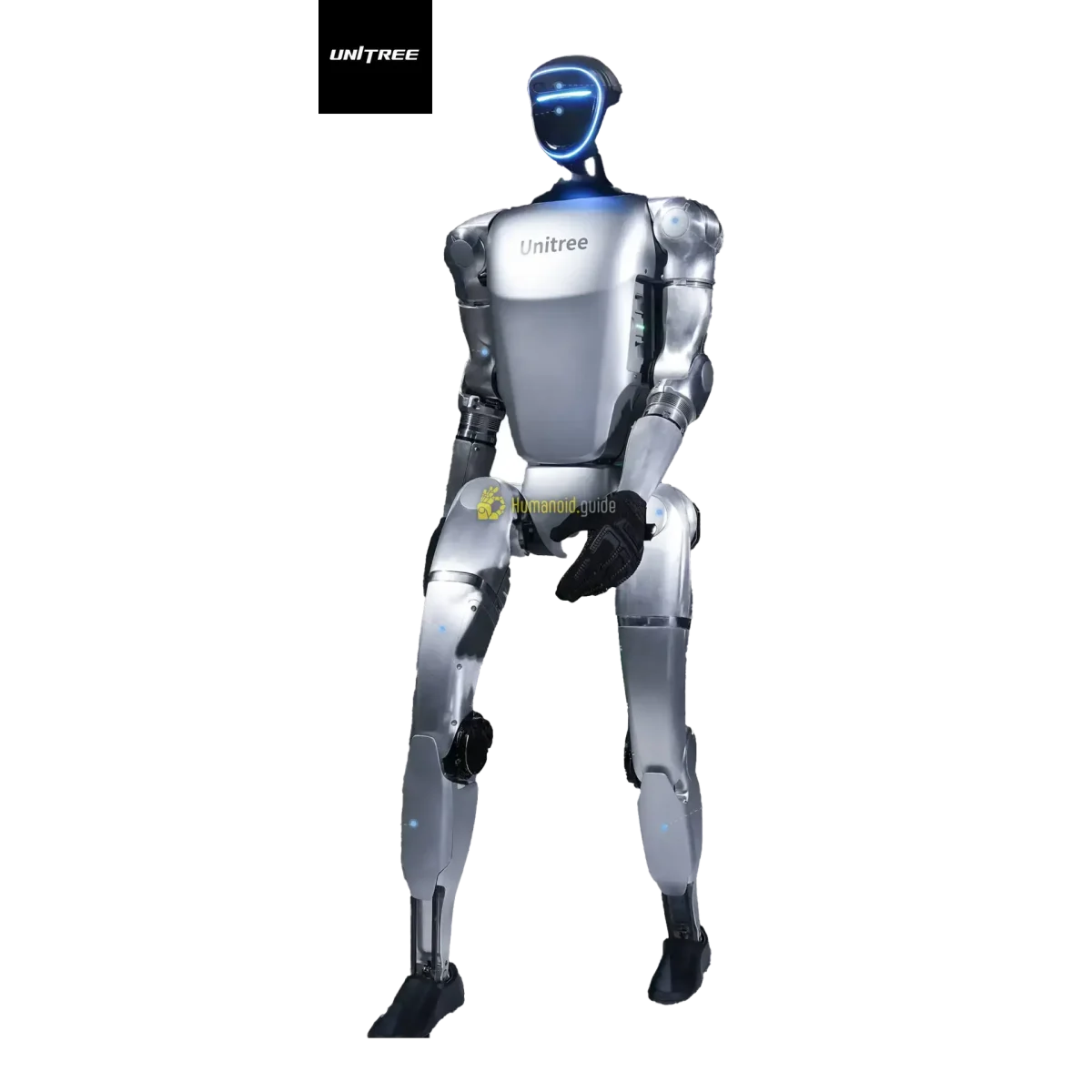
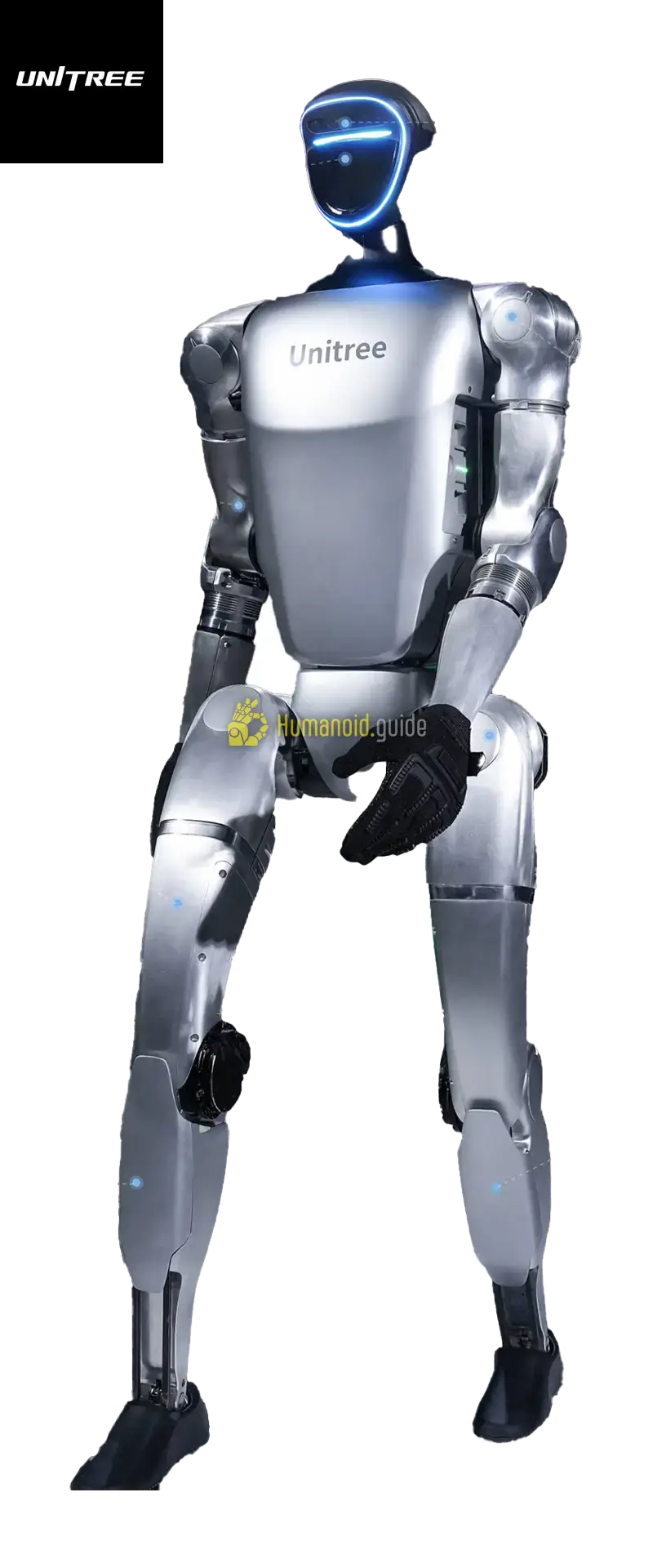
The Unitree G1 is a compact humanoid robot developed by Unitree Robotics, founded in 2016 and headquartered in Hangzhou, China. It stands 127–132 cm tall, weighs 35 kg, and offers 23–43 degrees of freedom depending on the configuration. Three variants cater to different needs: the Base model for research and education, the EDU with 29 DOF and 40 TOPS compute, and the Ultimate with 43 DOF and 100 TOPS. It can walk at up to 7.2 km/h, climb obstacles, and run. Built on an open platform for secondary development, the G1 is popular in entertainment demonstrations and academic labs. Its low entry price makes it one of the cheapest commercially available humanoids.

Specifications

Here are the full technical specifications.

SpecValue
Height127–132 cm
Weight35 kg
Degrees of freedom23–43 (config dependent)
Battery life2 hours
Max speed7.2 km/h (walking 4.5 km/h)
Payload3 kg (arm), 12 kg (standing)
Price (new)$13,500–$73,900
Price (used range)~$10,000–$60,000 (estimated)

Price & Value

New MSRP: $13,500–$73,900

Used range: ~$10,000–$60,000 (estimated)

At $13,500, the Unitree G1 is the cheapest humanoid robot on the market, offering an accessible entry point for research and education. The price scales significantly with added compute and dexterity in the EDU and Ultimate configurations, but remains competitive with alternatives like the Fourier GR-1 ($150,000) and Unitree’s own H1 ($90,000). Depreciation on used units is likely moderate given the high demand for affordable humanoids, but buyers should verify hardware conditions carefully. The G1 delivers strong value for labs that don’t need heavy industrial payloads.

Who Is It For?

Best for: - University robotics labs seeking an affordable, open-development humanoid platform (23–43 DOF enables dexterous manipulation and locomotion research) - Entertainment and demonstration teams needing a compact, fast, 7.2 km/h humanoid that can perform acrobatic movements - Educational institutions wanting a sub-$20,000 robot for teaching AI, control systems, and robotics concepts

Not for: - Heavy industrial manipulation tasks (arm payload limited to 3 kg) - Continuous 24/7 operation (2-hour battery runtime) - Buyers requiring CE/FDA certifications — G1 lacks disclosed compliance certifications

Alternatives & Comparison

The Unitree G1 competes in the budget humanoid segment, undercutting most rivals while offering competitive basic mobility. Here’s how it stacks up against two alternatives.

ModelPriceAvailableKey Difference
Unitree H1$90,000yesLarger (180 cm), higher payload (~20 kg), but 5x price
Fourier GR-1~$150,000 (est.)yes171 cm, 55 kg, stronger payload for industrial use, significantly more expensive

Verdict: The G1 is the clear winner for budget-conscious labs and educational programs; its $13,500 entry price is unmatched. The H1 is better for bipedal load-carrying research, and the GR-1 suits light industrial tasks, but both cost over 6x the G1’s base price. For most non-industrial humanoid applications, the G1 offers the best value.

Use Cases & Capabilities

Research & Development

The G1’s open platform with OTA updates and secondary development support (EDU variants with Jetson Orin) makes it ideal for locomotion algorithms, vision-based navigation, and manipulation studies. Its 23–43 DOF enable testing of balance, whole-body control, and hand dexterity. The onboard depth camera and LiDAR provide rich sensor data for SLAM and obstacle avoidance research.

Education Platform

Affordable enough for classroom use, the G1 allows students to program humanoid kinematics with real hardware. The EDU version’s 40 TOPS compute can run simulated neural networks, making it suitable for AI and robotics courses. The platform supports ROS and custom code, reducing setup time for lab exercises.

Entertainment Demonstrations

With a top speed of 7.2 km/h and obstacle-climbing capability, the G1 can perform choreographed dances, promotional tasks, and interactive exhibits. Its small size and safe 35 kg weight make it suitable for close-quarters demos. The robot’s ability to recover from falls and run adds visual excitement for audiences.

History & Background

Unitree Robotics was founded in 2016 by Wang Xingxing, initially achieving fame with quadruped robots like Laikago. The company launched its first full-size humanoid, the H1, in 2023, targeting industrial and research markets. The G1 debuted in 2024 as a smaller, more affordable humanoid, leveraging Unitree’s high-torque actuator expertise. With three configurations—Base, EDU, and Ultimate—it became the cheapest commercially available humanoid, starting at $13,500. As of 2026, it is Unitree’s latest humanoid and continues in production.

Buying Used — What to Check

Verify DOF configuration Used units may be Base, EDU, or Ultimate with different capabilities; exact DOF and compute affect value significantly.

Check battery health The 2-hour battery degrades over time; replacement packs cost extra.

Inspect actuator wear Frequent high-speed running can stress leg actuators; look for noise or reduced performance.
Unitree G1 Basic in 3D

Loading the 3D model…
Drag to rotate · click the model, then scroll or pinch to zoom · click a part to inspectSwipe sideways to turn · pinch to zoom · tap a part to inspect3D model credit and licence

Unitree G1 Basic supply chain

Point at or select a step to light up its chain: bright lines are its direct links, softer lines the rest of the path from raw material to robot.

Swipe sideways to follow the whole chain.

ExtractionRefiningMaterialsComponentsModulesRobotsCompaniesUnitree designs its joint motors and gearboxes and assembles them itself from custom-made parts. It also designs the encoder and driver boards, buys their parts and has outside firms solder them. It says it buys no finished motors.Unitree designs its joint motors and gearboxes and assembles them itself from custom-made parts. It also designs the encoder and driver boards, buys their parts and has outside firms solder them. It says it buys no finished motors.Unitree designs its reducers and assembles them itself from custom-made parts it buys.Unitree designs its battery packs and their BMS, buys the housings and cells, and assembles the packs itself (said for its robots in general).Lithium compounds (carbonate, chloride, hydroxide) are produced from mined lithium.Lithium is produced from brine and mineral operations.Mined copper is smelted and refined.Primary aluminium from smelters.Bauxite is refined to alumina for aluminium.6061 aluminium contains 0.8–1.2% magnesium.6061 aluminium contains 0.40–0.8% silicon.A lithium-ion cell has a cathode (positive electrode), typically a metal oxide or phosphate. IEA tracks the 2025 mix of LFP and nickel-based cathodes in electric-car batteries.Silicon metal is made from silica in natural forms such as quartzite (USGS).Chips are made on wafers: thin slices of semiconductor such as crystalline silicon (Wikipedia). Silicon metal can be refined further into ultra-high-purity semiconductor-grade silicon, called polysilicon (USGS).Silicon metal can be refined further into ultra-high-purity semiconductor-grade silicon, called polysilicon (USGS). Chips are made on wafers: thin slices of crystalline silicon (Wikipedia).Magnesium is recovered from dolomite, serpentine, magnesium-bearing evaporite minerals and brines (USGS).In wire-bond packaging, fine gold or copper wire connects each die to its leadframe or substrate. ASE is gradually replacing gold wire with copper to cut material cost, though gold wire is still one of its main materials.Steel is made from iron ore: US mines shipped 98% of their usable iron ore to the steel industry (USGS).Precision bearing rings are made of through-hardened chromium bearing steel 100Cr6 (SAE 52100) (GMN).Sony makes its CMOS image sensors in its own production facilities in Japan (Nagasaki, Kumamoto). SIA/BCG count optoelectronics and sensors in one fab group with discrete and analog chips (DAO), apart from logic.Bosch makes its MEMS sensors in its own fabs in Reutlingen and Dresden; a MEMS sensor is a MEMS element plus an evaluation chip (ASIC).A MEMS sensor is packed in a semiconductor housing, such as an LGA package (Bosch).Mined cobalt is refined further into chemicals or metal (Cobalt Institute). In 2025 DR Congo's export restrictions left refiners short of cobalt hydroxide feed and forced some to limit production, though world refined output still rose 5% to 240 kt (Cobalt Institute).Cobalt sulphate, the largest refined cobalt product, is typically used in NCM (NMC) batteries, and cobalt tetroxide often in LCO batteries (Cobalt Institute). Cobalt-free substitutes that use iron and phosphorus (LFP) held a significant market share in China (USGS).Mined nickel ore and concentrate go to smelters and refineries. In Indonesia, laterite ore is processed into nickel pig iron and ferronickel for stainless steel, or into battery intermediates such as mixed hydroxide precipitate (IEA); the US Eagle Mine's concentrate is exported to smelters (USGS).Battery cathodes need nickel sulphate, made from Class I nickel metal or from intermediates such as mixed hydroxide precipitate and nickel matte (IEA). LFP (lithium iron phosphate) cathodes contain no nickel.Stainless steel is the biggest use of nickel, 66% of demand in 2025 (Cobalt Institute). In the US, stainless and alloy steels and nickel alloys take more than 85% of nickel use (USGS). The world made 64.2 Mt of stainless steel in 2025 (worldstainless), against about 1,900 Mt of raw steel (USGS).Lithium-ion cathodes are lithium compounds, generally a layered oxide (such as lithium cobalt oxide), a phosphate (lithium iron phosphate) or a spinel (lithium manganese oxide). Batteries took an estimated 88% of world lithium in 2025 (USGS).Natural graphite flakes must be made into spherical particles, purified to over 99.95% carbon and coated before they can be used in lithium-ion battery anodes (IEA). Natural graphite is now a small part of anode supply: under 8% of China's 2025 anode shipments (GGII), and about 14% worldwide in 2022 (Rystad).Synthetic graphite is made by calcining and graphitising petroleum coke or needle coke at nearly 3,000 °C (IEA). It was 92.7% of China's 2025 anode shipments (GGII).The negative electrode (anode) of a conventional lithium-ion cell is typically graphite. IEA's 2025 data on electric-car battery anodes show only graphite and silicon-doped graphite.Carbon fibre is spun from PAN, made from acrylonitrile, which is made from propylene, a product of cracking oil and gas (Wikipedia; ChinaBaogao).89.8% of the world's plastics in 2024 were made from fossil feedstock (Plastics Europe).A 2026 teardown found the G1's structural parts are mostly aluminium alloy and engineering plastic, with aluminium limbs (China Post Securities).The same teardown found the ankle drive rods are the only steel structural parts; steel also appears inside the joints (gears, bearings, output flanges).Robots Guide, and a reseller quoting Unitree's user manual, list carbon-fibre parts next to the aluminium.The torso is almost all plastic: engineering plastics (ABS and nylon) with soft silicone parts (China Post Securities teardown).Soft silicone parts cushion the limbs and the plastic shell (China Post Securities teardown).Solder is the largest use of tin, 51% of world tin use in 2023 (International Tin Association; in the US solder took 11%, USGS). The common lead-free alloy SAC305 is 96.5% tin (AIM).Tin-lead solder is nearly half lead (PubChem), but the electronics industry has moved toward lead-free solders (USGS): 92% of solder for electronics was lead-free in 2023 (ITA).The lead-free alloy SAC305 contains 3% silver (AIM). In the US, brazing and solder took 3% of silver (USGS).The lead-free alloy SAC305 contains 0.5% copper (AIM).FR-4 laminate is woven fibreglass cloth with an epoxy binder (Wikipedia), and fibreglass is made from silica sand (Covia).A thin layer of copper foil is laminated to one or both sides of an FR-4 panel; these are called copper-clad laminates (Wikipedia; ChinaBaogao).FR-4 epoxy resin systems typically use bromine to resist fire (Wikipedia); a grade of the brominated flame retardant TBBPA is used to make epoxy resins for circuit boards (Wikipedia). Brominated flame retardants are one of bromine's two leading uses (USGS).Barite is used to make barium carbonate, which goes into dielectrics (Wikipedia). Barium titanate, the dielectric ceramic used in capacitors, can be made by heating barium carbonate with titanium dioxide (Wikipedia).Barium titanate, the ceramic in high-capacitance MLCCs, can be made by heating barium carbonate with titanium dioxide (Wikipedia); titanium dioxide comes from ilmenite and rutile (USGS).99% of MLCCs made worldwide use base-metal electrodes of nickel or copper; the industry moved from palladium and silver to cut cost (NASA, 2015). TDK replaced palladium electrodes with nickel in 1993 (Wikipedia).Platinum-group metals are used in multilayer ceramic capacitors (USGS). High-reliability MLCCs use palladium-silver electrodes (NASA, 2015).High-reliability MLCCs use precious-metal electrodes of palladium and silver (NASA, 2015).Connector contacts are copper alloys: beryllium copper is called the best copper alloy for contacts, connectors and cables (Wikipedia), and phosphor bronze (copper-tin-phosphorus) can replace it (USGS).Copper-clad laminate is the core material of circuit boards (ChinaBaogao); FR-4 is a common material for printed circuit boards (Wikipedia).Parts are soldered onto bare boards: Adafruit's BNO055 board is a "breakout PCB", and the Raspberry Pi Zero 2 W brief warns against damage to the printed circuit board.SAC305 lead-free solder is made for soldering printed circuits, by wave, hand and SMT reflow soldering (Conro; AIM).MLCCs store and release charge and absorb noise in phones, home appliances and IoT devices (Murata). The Raspberry Pi's RP3A0 package includes the decoupling capacitors that smooth its supply voltage (Raspberry Pi).Boards carry connectors: the Raspberry Pi Zero 2 W brief speaks of the board and its connectors, and Waveshare's servo adapter has a USB-C connector and a power connector.Two planetary gear stages; a knee teardown found a 22.5:1 two-stage gearbox.Two planetary gear stages; the teardown counted the gear teeth of a calf joint.The teardown found Luoyang Baina's CRBT355A thin crossed roller bearing in a calf joint.Unitree says its joints use industrial-grade crossed roller bearings at the output. A teardown names Luoyang Baina as the G1's crossed-roller-bearing supplier, from a bearing found in a small calf joint; the report shows only that small joint taken apart, not the large one.Unitree says its joints use industrial-grade crossed roller bearings at the output; in the small joint the teardown names the maker (Luoyang Baina).The joint motors are permanent-magnet synchronous motors, and Unitree buys the magnets as a raw material. The magnet type is not stated.A calf joint's motor rotor carries 42.9 g of permanent magnets; Unitree buys the magnets as a raw material. The magnet type is not stated.Unitree's co-founder says the joint motors' only outside suppliers sell raw materials, such as copper wire and magnets.In a teardown, a calf joint's motor stator (listed as 'copper wire + coating') weighs 94.3 g; Unitree buys copper wire as a raw material.Aluminium housings clamp around the joint motors (a published teardown). China Post Securities lists a joint's housing and end caps as aluminium, and Unitree's leg patent holds the hip and knee motors in hoop clamps.A calf joint's shell (79.3 g) and two end caps (23.7 g) are aluminium.In a calf joint the sun gears, planet gears and ring gears are steel (teardown parts table).The teardown weighs the second gear stage together with the crossed roller bearing (74 g) and lists it as steel, apart from one aluminium carrier part.Each joint has its own round driver board. Unitree designs its driver and encoder boards, buys the parts and has the boards assembled (soldered) by outside firms.Each joint has its own round driver board (12.8 g in a calf joint). Unitree designs its driver and encoder boards, buys the parts and has the boards assembled (soldered) by outside firms.39 cylindrical lithium cells, 13 in series, some marked MURATA (Nikkei xTECH teardown). Unitree buys its cells.The main board is a circuit board with the processor, memory and storage chips soldered on; Unitree says it buys the core boards of its computing modules.Main processor: Rockchip RK3588S, 8 nm (teardown).Working memory: two BIWIN chips, 8 GB in all (teardown).Storage: one FORESEE (Longsys) 64 GB chip (teardown).Rockchip states an 8 nm process for the RK3588 (it designs the chip and does not name its foundry), and the teardown gives 8 nm for the RK3588S; SIA/BCG count logic under 10 nm as the most advanced class.Built-in IMU, model ICM40609 (Livox).Two OmniVision OV9282 image sensors in the D430 depth module and an OmniVision OV2740 colour sensor (datasheet).Built-in IMU: a BMI055 or, in a later version, a BMI085 (datasheet).Brass is copper and zinc: CW614N free-cutting brass is about 39% zinc. In the US, brass and bronze are the second use of zinc after galvanized steel.Brass is mostly copper: 57–59% in CW614N free-cutting brass.Free-cutting brass such as CW614N holds 2.5–3.5% lead so it machines cleanly; lead-free brasses exist.XT30 battery plugs (G1 harness, Open Duck Mini) have gold-plated brass contacts.Antimony is used in circuit boards to cut flammability further. A review lists two studies of scrap PC boards, parts and solder still on, with 0.45% and 1.97% antimony, so the share in the laminate alone is not known.MEMS microphones are silicon chips: the diaphragm is etched into a silicon wafer (Wikipedia). Pollen's HAT uses a MEMS microphone.Unitree lists a 4-microphone array on the G1 and the G1 EDU.Unitree lists a 5 W speaker on the G1 and the G1 EDU.Heat sinks are often aluminium: the Go2's main board has two fans blowing over an aluminium heat sink (Simplexity).In the Unitree G1, the heat pipe and heat spreaders that teardowns show are copper: a copper heat pipe presses against a motor (a published teardown), and copper heat-spreader plates cool its knees (China Post Securities).Magnet wire is drawn from rod of pure electrolytic copper: Elektrisola starts from 8 mm rod with at least 99.90% copper, and most magnet wire is fully annealed, electrolytically refined copper (Elektrisola; Wikipedia).ASML's EUV machines print the most critical layers of the most advanced chips. DUV machines, which ASML also makes, print most of the layers in microchips (ASML annual report 2025).ASML's DUV machines, 'the workhorses of the industry', print the majority of layers in chips, older-generation chips included (ASML annual report 2025).Unitree Robotics makes the G1.IMU: integrator docs say the G1 driver publishes IMU data; model not published.A teardown of the G1 found a main control board, a power distribution unit (PDU), a DC-DC converter and a battery management system (BMS) with temperature sensors (China Post Securities).The G1 links its joints with standard CAN bus wiring and XT30 power connectors; the teardown lists XT30 harnesses and harness terminals (China Post Securities).Nine large joints: five N7520-14.3 (both hip pitch, both hip yaw, waist) and four N7520-22.5 (both hip roll, both knees).Fourteen small joints: ten in the arms and four in the calves, which drive the ankles.One quick-release battery pack: 13 cells in series, 9,000 mAh.Main computer board with a Rockchip RK3588S (teardown); Unitree lists an 8-core CPU.3D LiDAR in the head: a Livox Mid-360. Unitree's 3D model has a 'mid360_link', and the teardown and an integrator manual name it.Depth camera in the head: a RealSense D435i. Unitree's 3D model has a 'd435_link', the teardown names it, and Nikkei found an Intel camera.The frame, shells and covers that make up the Unitree G1's body.The G1 has a 4-microphone array (Unitree).The G1 has a 5 W speaker (Unitree).'Local air cooling' (Unitree): fans cool the main board, which is partly covered by heat-sink fins, and the hip joints, while the knees pass their heat through copper heat-spreader plates into the frame (China Post Securities teardown). Unitree's leg patent allows a fan or fins around the waist and puts a heat-conducting part against the knee motor; a published teardown found two centrifugal fans in the hip area.Quartz and silica sandQuartz and silica sandMagnesium ores and brinesMagnesium ores and brinesOil, gas and coal(plastics feedstock)Oil, gas and coal (plastics feedstock)Steel (gear, bearing andstainless grades)Steel (gear, bearing and stainless grades)Lithography machines (chipprinting)Lithography machines (chip printing)Mature-node chipfabrication (28 nm and…Mature-node chip fabrication (28 nm and older; analog and sensor chips)Aluminium alloysAluminium alloysBattery-grade lithiumcompoundsBattery-grade lithium compoundsPermanent magnets (typeundisclosed)Permanent magnets (type undisclosed)Lithium chemicalconversionLithium chemical conversionCopper smelting andrefiningCopper smelting and refiningAlumina refining andaluminium smeltingAlumina refining and aluminium smeltingLithium miningLithium miningCopper miningCopper miningBauxite miningBauxite miningIron ore miningIron ore miningMagnesium smeltingMagnesium smeltingSilicon metal smeltingSilicon metal smeltingLeading-edge chipfabrication (under 10 nm)Leading-edge chip fabrication (under 10 nm)Chip packaging and test(OSAT)Chip packaging and test (OSAT)Precision bearingsPrecision bearingsImage sensorsImage sensorsIMUs (motion sensors)IMUs (motion sensors)Lithium-ion cellsLithium-ion cellsUnitreeUnitreeUnitree G1 BasicUnitree G1 BasicCobalt miningCobalt miningCobalt refining (chemicalsand metal)Cobalt refining (chemicals and metal)Nickel miningNickel miningNickel smelting andrefiningNickel smelting and refiningNatural graphite miningNatural graphite miningBattery anode graphite(spherical natural and…Battery anode graphite (spherical natural and synthetic)Cathode active material(NMC, NCA, LCO, LFP)Cathode active material (NMC, NCA, LCO, LFP)Titanium minerals(ilmenite and rutile)Titanium minerals (ilmenite and rutile)Carbon-fibre composite(CFRP)Carbon-fibre composite (CFRP)Engineering plastics (ABS,PC, nylon, PEEK)Engineering plastics (ABS, PC, nylon, PEEK)Soft covers (textiles,foams, soft polymer skins)Soft covers (textiles, foams, soft polymer skins)Tin miningTin miningLead miningLead miningSilver miningSilver miningPalladium mining(platinum-group metals)Palladium mining (platinum-group metals)Antimony miningAntimony miningBromine (from brines)Bromine (from brines)Barite mining (barium)Barite mining (barium)Solder (tin alloys:lead-free SAC and…Solder (tin alloys: lead-free SAC and tin-lead)Copper-clad laminate (FR-4glass-fibre epoxy board…Copper-clad laminate (FR-4 glass-fibre epoxy board material)Printed circuit boards(bare boards)Printed circuit boards (bare boards)Multilayer ceramiccapacitors (MLCC)Multilayer ceramic capacitors (MLCC)Connectors and wiringharnessesConnectors and wiring harnessesElectronics assembly(circuit boards with part…Electronics assembly (circuit boards with parts soldered on)Unitree N7520 joint module(large)Unitree N7520 joint module (large)Unitree N5020 joint module(small)Unitree N5020 joint module (small)Two-stage planetarygearboxes (G1 joints)Two-stage planetary gearboxes (G1 joints)Baina CRBT355A thincrossed roller bearingBaina CRBT355A thin crossed roller bearingG1 battery pack (13S, 9Ah)G1 battery pack (13S, 9 Ah)G1 main computer boardG1 main computer boardRockchip RK3588S SoCRockchip RK3588S SoCBIWIN RAM chips (2 × 4 GB)BIWIN RAM chips (2 × 4 GB)FORESEE 64 GB storage chip(Longsys)FORESEE 64 GB storage chip (Longsys)Livox Mid-360 3D LiDARLivox Mid-360 3D LiDARRealSense D435i depthcameraRealSense D435i depth cameraStructure: Unitree G1BasicStructure: Unitree G1 BasicZinc miningZinc miningBrass (copper-zinc alloy)Brass (copper-zinc alloy)Copper magnet wire(enamelled)Copper magnet wire (enamelled)MicrophonesMicrophonesSmall speakersSmall speakersCooling fans and heatsinksCooling fans and heat sinksG1 microphone array (4microphones)G1 microphone array (4 microphones)G1 speaker (5 W)G1 speaker (5 W)

Ritratti2

Unitree G1 photo 1
Unitree G1 photo 2