robot humanoid

Fourier N1 — Spesifikasi, Harga & Tempat Membeli (2026)

A 1.3 m, 38 kg open-source humanoid robot by Fourier (Shanghai) with 23 joints (6 per leg, 1 waist, 5 per arm) driven by Fourier's own FSA actuators, an Intel Core i7 computer in the chest and a 475 Wh battery for about 2 hours; it runs at up to 3.5 m/s. Released in April 2025 with its parts list, drawings and assembly guide.

📅Dibina pertama kali
2025
🌍Asal
CN
📏Ketinggian
1.245 m
⚖️Berat
38 kg
🦾Darjah kebebasan
23
🏃Kelajuan maksimum
3.5 m/s
🔋Bateri
2 hours
🛒Ketersediaan
—

What is the Fourier N1?

A 1.3 m, 38 kg open-source humanoid robot by Fourier (Shanghai) with 23 joints (6 per leg, 1 waist, 5 per arm) driven by Fourier's own FSA actuators, an Intel Core i7 computer in the chest and a 475 Wh battery for about 2 hours; it runs at up to 3.5 m/s. Released in April 2025 with its parts list, drawings and assembly guide.

Specifications

Facts about the Fourier N1 from its project's published documentation, design files and its makers' own figures. A figure marked Estimate is worked out from those files or parts lists rather than stated by the maker.

SpecDetail
Size1,245 × 441 × 202 mm (height × width × depth) with an arm span of 1,240 mm (Fourier's parameter table); 'stands 1.3 meters tall' in Fourier's text.
WeightAbout 38 kg (Fourier's text and product page); its parameter table says ≈39 kg. Fourier's 3D model adds up to 39.7 kg.
Joints23: six per leg (hip pitch, roll and yaw, knee, ankle roll and pitch), one at the waist and five per arm (shoulder pitch, roll and yaw, elbow, wrist). The head has no joints and the fists do not move.
Joint actuators23 of Fourier's own 'FSA 61 cm integrated actuators, one per joint, each taking DC power and an Ethernet cable directly. Fourier's table gives three torque limits: 90 N·m for 4 (hip pitch, knee), 54 N·m for 7 (hip roll and yaw, waist, shoulder pitch) and 30 N·m for 12 (the ankles and the rest of the arms). Each has two encoders (16-bit and 14-bit) and runs on 24–60 V (46 V rated).
Actuator modelsFourier does not name the N1's actuators. Its FSA80-29E (rated 32 N·m, peak 96 N·m, 100 rpm) fits the 90 N·m joints and its FSA60-43E (17 N·m, 51 N·m, 59 rpm) is close to the 54 N·m ones; both have two-stage planetary gearboxes (described for a student biped Fourier sponsored). The same biped also uses a smaller FSA45-30E in its lower legs. (Estimate: The model names come from a biped Fourier sponsored, not from the N1; the authors matched them by torque (the 54 N·m limit is a little above the FSA60-43E's 51 N·m peak). If the numbers in Fourier's FSA names are motor diameters in mm (80, 60, 45), they are about 15–22 mm smaller than the housings measured in the N1 model (about 102, 83 and 60 mm), which weakens these matches.)
Peak joint torqueFourier's parameter table gives a 'Peak Joint Torque' of 144 N·m, but its joint table limits no joint above 90 N·m (95 N·m in the URDF).
Drive linkagesThe two ankle actuators sit in the shin; in Fourier's model the upper one's rod pitches the foot and the lower one's rod rolls the ankle cross. The knee actuator sits in the thigh about 100 mm above the knee pivot, so it turns the knee through a link the 3D file does not draw. (Estimate: The actuators' places and the rods are in Fourier's model (measured); the knee link is the authors' inference from the gap.)
Range of motionWaist ±150°; hip pitch ±150°, hip roll −15° to +90° (outwards), hip yaw ±150°; knee −5° to +135°; ankle ±25° in pitch and roll (±45° in pitch in the URDF); shoulder pitch ±170°, roll −10° to +160°, yaw ±105°; elbow −20° to +95°; wrist ±105° (Fourier's joint table).
Speed and terrainWalks at 2.7 km/h and runs at 10.8 km/h; Fourier measured a top stable running speed of 3.5 m/s. It climbs 15–20° slopes and 20 cm stairs, stands on one leg and pushes itself up off the floor with both hands.
Main computerIntel Core i7-13700H (14 cores: 6 performance and 8 efficient, 20 threads, per Intel; Fourier calls it '8-core high-performance') with 16 GB memory and 512 GB NVMe storage, running Ubuntu 22.04; Wi-Fi 6, wired network at 100/1000/2500 Mbit/s, HDMI, USB-C and USB-A (Fourier). It sits in the chest with the power management module and the network switch.
BatteryLithium-ion, 475 Wh, 39.6 V nominal, charged to at most 46.2 V, 3.2 kg or less, at least 800 cycles to 80% health; about 2 hours of use and about 3.5 hours to charge with the 46 V, 4 A adapter (Fourier). It plugs in at the back (Fourier's launch). Rated power about 460 W.
SensorsA 6-axis IMU (under the pelvis in Fourier's model; Fourier's software reads one USB IMU) and two encoders in every joint. A stereo camera is optional: Fourier's model has a 90 × 25 × 25 mm camera bar across the face, the size of an Intel RealSense D435i. No LiDAR, microphones or speaker are listed.
ControlsA battery button, a system power button, a charging port and an emergency-stop button on the robot; it comes with a gamepad (XBOX layout) to start, walk and stop it. Developers program it in Python through Fourier's SDK.
Materials'Aluminum Alloy - engineering plastics' (Fourier): a lightweight aluminium-alloy and engineering-plastic frame.
Open-source packageFourier published the N1's parts list (BOM), design drawings, assembly manual and base software with the robot, as a Baidu Netdisk download, plus this 3D model on GitHub. The dataset could not read the download (it needs a Baidu account and client).
TestingOver 1,000 hours of outdoor tests on rough ground and a 72-hour continuous run before release (Fourier, at the launch).
PriceFourier has published no price ('pricing remains flexible', April 2025). A US reseller lists the N1 at US$40,000.00, in stock (14 Oct 2026). The dataset uses that price for the N1 everywhere.
AvailabilityReleased on 11 April 2025. Fourier calls it an open-source test platform rather than a commercial product and sells it through its sales team and resellers; it may charge for custom builds or extra modules.
Made inChina (Shanghai), estimated: Fourier is based in Shanghai and develops its joint motors itself; it does not say where the N1 is assembled. (Estimate: This is the maker's home city; Fourier does not say where each robot is built.)
Parts costAbout ¥39,050 (US$5,835): the dataset's estimate of what Fourier pays, line by line from the teardown costs for the G1, matched to the N1's actuator sizes, battery and frame (range ~$3,474–9,623). Fourier's own BOM was not read. (Estimate: Every line is matched to another robot; the actuators, about 68% of the total, are the biggest guess.)
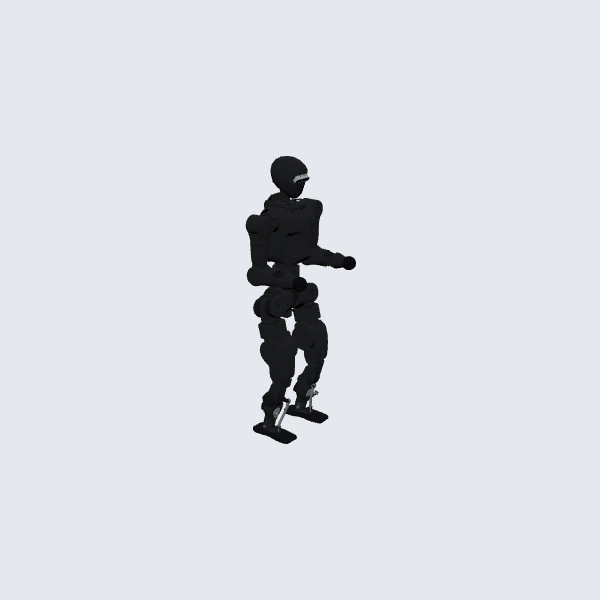
Pose shownFourier's ready stance: hips −0.2468 rad and knees 0.5181 rad, with the ankles at −0.28 rad so the soles lie flat (Fourier's −0.2408 would tip the toes 2.2° down with the pelvis level); waist and arms at 0, so the forearms point forward.

3D model

The interactive 3D model on this page is converted from the project's published design: Fourier N1 by Fourier (Fourier Intelligence), github.com/FFTAI/Wiki-GRx-Models (branch FourierN1, N1/urdf/N1_raw.urdf). Apache License 2.0: commercial use allowed, with the licence and a note of the dataset's changes (web/public/models/LICENSE-fourier-n1.md).

Sources

Fourier N1 in 3D

Loading the 3D model…
Drag to rotate · click the model, then scroll or pinch to zoom · click a part to inspectSwipe sideways to turn · pinch to zoom · tap a part to inspect3D model credit and licence

Fourier N1 supply chain

Point at or select a step to light up its chain: bright lines are its direct links, softer lines the rest of the path from raw material to robot.

Swipe sideways to follow the whole chain.

ExtractionRefiningMaterialsComponentsModulesRobotsCompaniesFourier develops its joint motors itself ('FSA 2.0' integrated actuators, self-developed).Fourier develops its joint motors itself ('FSA 2.0' integrated actuators, self-developed).Fourier develops its joint motors itself ('FSA 2.0' integrated actuators, self-developed).Lithium compounds (carbonate, chloride, hydroxide) are produced from mined lithium.Lithium is produced from brine and mineral operations.Mined copper is smelted and refined.Primary aluminium from smelters.Bauxite is refined to alumina for aluminium.6061 aluminium contains 0.8–1.2% magnesium.6061 aluminium contains 0.40–0.8% silicon.A lithium-ion cell has a cathode (positive electrode), typically a metal oxide or phosphate. IEA tracks the 2025 mix of LFP and nickel-based cathodes in electric-car batteries.Camera units are built around image sensors (CMOS image sensors from makers such as Sony and OmniVision).Silicon metal is made from silica in natural forms such as quartzite (USGS).Silicon metal can be refined further into ultra-high-purity semiconductor-grade silicon, called polysilicon (USGS). Chips are made on wafers: thin slices of crystalline silicon (Wikipedia).Memory is made on silicon wafers (Micron lists silicon wafers among its key materials); wafer silicon is refined from silicon metal (USGS).Magnesium is recovered from dolomite, serpentine, magnesium-bearing evaporite minerals and brines (USGS).In wire-bond packaging, fine gold or copper wire connects each die to its leadframe or substrate. ASE is gradually replacing gold wire with copper to cut material cost, though gold wire is still one of its main materials.Sony makes its CMOS image sensors in its own production facilities in Japan (Nagasaki, Kumamoto). SIA/BCG count optoelectronics and sensors in one fab group with discrete and analog chips (DAO), apart from logic.Bosch makes its MEMS sensors in its own fabs in Reutlingen and Dresden; a MEMS sensor is a MEMS element plus an evaluation chip (ASIC).A MEMS sensor is packed in a semiconductor housing, such as an LGA package (Bosch).Micron makes its memory in its own fabs; most of its 2026 DRAM output came from Taiwan. SIA/BCG: DRAM capacity is highly concentrated in South Korea.Micron's manufacturing runs from wafer fabrication through assembly and test, with subcontractors for some steps.Mined cobalt is refined further into chemicals or metal (Cobalt Institute). In 2025 DR Congo's export restrictions left refiners short of cobalt hydroxide feed and forced some to limit production, though world refined output still rose 5% to 240 kt (Cobalt Institute).Cobalt sulphate, the largest refined cobalt product, is typically used in NCM (NMC) batteries, and cobalt tetroxide often in LCO batteries (Cobalt Institute). Cobalt-free substitutes that use iron and phosphorus (LFP) held a significant market share in China (USGS).Mined nickel ore and concentrate go to smelters and refineries. In Indonesia, laterite ore is processed into nickel pig iron and ferronickel for stainless steel, or into battery intermediates such as mixed hydroxide precipitate (IEA); the US Eagle Mine's concentrate is exported to smelters (USGS).Battery cathodes need nickel sulphate, made from Class I nickel metal or from intermediates such as mixed hydroxide precipitate and nickel matte (IEA). LFP (lithium iron phosphate) cathodes contain no nickel.Lithium-ion cathodes are lithium compounds, generally a layered oxide (such as lithium cobalt oxide), a phosphate (lithium iron phosphate) or a spinel (lithium manganese oxide). Batteries took an estimated 88% of world lithium in 2025 (USGS).Natural graphite flakes must be made into spherical particles, purified to over 99.95% carbon and coated before they can be used in lithium-ion battery anodes (IEA). Natural graphite is now a small part of anode supply: under 8% of China's 2025 anode shipments (GGII), and about 14% worldwide in 2022 (Rystad).Synthetic graphite is made by calcining and graphitising petroleum coke or needle coke at nearly 3,000 °C (IEA). It was 92.7% of China's 2025 anode shipments (GGII).The negative electrode (anode) of a conventional lithium-ion cell is typically graphite. IEA's 2025 data on electric-car battery anodes show only graphite and silicon-doped graphite.89.8% of the world's plastics in 2024 were made from fossil feedstock (Plastics Europe).Solder is the largest use of tin, 51% of world tin use in 2023 (International Tin Association; in the US solder took 11%, USGS). The common lead-free alloy SAC305 is 96.5% tin (AIM).Tin-lead solder is nearly half lead (PubChem), but the electronics industry has moved toward lead-free solders (USGS): 92% of solder for electronics was lead-free in 2023 (ITA).The lead-free alloy SAC305 contains 3% silver (AIM). In the US, brazing and solder took 3% of silver (USGS).The lead-free alloy SAC305 contains 0.5% copper (AIM).FR-4 laminate is woven fibreglass cloth with an epoxy binder (Wikipedia), and fibreglass is made from silica sand (Covia).A thin layer of copper foil is laminated to one or both sides of an FR-4 panel; these are called copper-clad laminates (Wikipedia; ChinaBaogao).FR-4 epoxy resin systems typically use bromine to resist fire (Wikipedia); a grade of the brominated flame retardant TBBPA is used to make epoxy resins for circuit boards (Wikipedia). Brominated flame retardants are one of bromine's two leading uses (USGS).Barite is used to make barium carbonate, which goes into dielectrics (Wikipedia). Barium titanate, the dielectric ceramic used in capacitors, can be made by heating barium carbonate with titanium dioxide (Wikipedia).Barium titanate, the ceramic in high-capacitance MLCCs, can be made by heating barium carbonate with titanium dioxide (Wikipedia); titanium dioxide comes from ilmenite and rutile (USGS).99% of MLCCs made worldwide use base-metal electrodes of nickel or copper; the industry moved from palladium and silver to cut cost (NASA, 2015). TDK replaced palladium electrodes with nickel in 1993 (Wikipedia).Platinum-group metals are used in multilayer ceramic capacitors (USGS). High-reliability MLCCs use palladium-silver electrodes (NASA, 2015).High-reliability MLCCs use precious-metal electrodes of palladium and silver (NASA, 2015).Connector contacts are copper alloys: beryllium copper is called the best copper alloy for contacts, connectors and cables (Wikipedia), and phosphor bronze (copper-tin-phosphorus) can replace it (USGS).Copper-clad laminate is the core material of circuit boards (ChinaBaogao); FR-4 is a common material for printed circuit boards (Wikipedia).Parts are soldered onto bare boards: Adafruit's BNO055 board is a "breakout PCB", and the Raspberry Pi Zero 2 W brief warns against damage to the printed circuit board.SAC305 lead-free solder is made for soldering printed circuits, by wave, hand and SMT reflow soldering (Conro; AIM).MLCCs store and release charge and absorb noise in phones, home appliances and IoT devices (Murata). The Raspberry Pi's RP3A0 package includes the decoupling capacitors that smooth its supply voltage (Raspberry Pi).Boards carry connectors: the Raspberry Pi Zero 2 W brief speaks of the board and its connectors, and Waveshare's servo adapter has a USB-C connector and a power connector.Brass is copper and zinc: CW614N free-cutting brass is about 39% zinc. In the US, brass and bronze are the second use of zinc after galvanized steel.Brass is mostly copper: 57–59% in CW614N free-cutting brass.Free-cutting brass such as CW614N holds 2.5–3.5% lead so it machines cleanly; lead-free brasses exist.XT30 battery plugs (G1 harness, Open Duck Mini) have gold-plated brass contacts.Antimony is used in circuit boards to cut flammability further. A review lists two studies of scrap PC boards, parts and solder still on, with 0.45% and 1.97% antimony, so the share in the laminate alone is not known.Fourier lists the N1's materials as aluminium alloy and engineering plastics.Fourier lists engineering plastics among the N1's materials.Fourier lists a lithium-ion battery; the cell maker is not stated.Fourier's N1 table: processing unit 'Intel® Core™ i7-13700H'.Fourier's N1 table: 16 GB memory.Each FSA has its driver built in: it takes DC power and an Ethernet cable directly.Each FSA has its driver built in: it takes DC power and an Ethernet cable directly.Each FSA has its driver built in: it takes DC power and an Ethernet cable directly.DUV machines, which ASML also makes, print most of the layers in microchips, and ASML's EUV machines (the NXE:3800E) are being adopted by advanced DRAM makers (ASML annual report 2025).ASML's DUV machines, 'the workhorses of the industry', print the majority of layers in chips, older-generation chips included (ASML annual report 2025).Fourier (Fourier Intelligence) makes this robot.The frame, shells and covers that make up the Fourier N1's body.One lithium-ion battery: 475 Wh, 39.6 V (Fourier).Main computer: Intel Core i7-13700H, 16 GB, 512 GB NVMe (Fourier).Fourier lists a 6-axis IMU; its software reads one USB IMU.A stereo camera is optional (Fourier); the 3D model has a camera bar across the face.Fourier: the torso holds the power management module and the network switch (circuit boards).4 joints of this torque limit: hip pitch and knee (Fourier's table).7 joints of this torque limit: hip roll and yaw, waist and shoulder pitch (Fourier's table).12 joints of this torque limit: ankles, shoulder roll and yaw, elbows and wrists (Fourier's table).Quartz and silica sandQuartz and silica sandMagnesium ores and brinesMagnesium ores and brinesOil, gas and coal(plastics feedstock)Oil, gas and coal (plastics feedstock)Lithography machines (chipprinting)Lithography machines (chip printing)Mature-node chipfabrication (28 nm and…Mature-node chip fabrication (28 nm and older; analog and sensor chips)Memory chip fabrication(DRAM)Memory chip fabrication (DRAM)Aluminium alloysAluminium alloysBattery-grade lithiumcompoundsBattery-grade lithium compoundsLithium chemicalconversionLithium chemical conversionCopper smelting andrefiningCopper smelting and refiningAlumina refining andaluminium smeltingAlumina refining and aluminium smeltingLithium miningLithium miningCopper miningCopper miningBauxite miningBauxite miningMagnesium smeltingMagnesium smeltingSilicon metal smeltingSilicon metal smeltingChip packaging and test(OSAT)Chip packaging and test (OSAT)Processors (CPUs and SoCs)Processors (CPUs and SoCs)Memory chips (DRAM /LPDDR)Memory chips (DRAM / LPDDR)Image sensorsImage sensorsIMUs (motion sensors)IMUs (motion sensors)Lithium-ion cellsLithium-ion cellsCameras and depth camerasCameras and depth camerasFourierFourierCobalt miningCobalt miningCobalt refining (chemicalsand metal)Cobalt refining (chemicals and metal)Nickel miningNickel miningNickel smelting andrefiningNickel smelting and refiningNatural graphite miningNatural graphite miningBattery anode graphite(spherical natural and…Battery anode graphite (spherical natural and synthetic)Cathode active material(NMC, NCA, LCO, LFP)Cathode active material (NMC, NCA, LCO, LFP)Titanium minerals(ilmenite and rutile)Titanium minerals (ilmenite and rutile)Engineering plastics (ABS,PC, nylon, PEEK)Engineering plastics (ABS, PC, nylon, PEEK)Tin miningTin miningLead miningLead miningSilver miningSilver miningPalladium mining(platinum-group metals)Palladium mining (platinum-group metals)Antimony miningAntimony miningBromine (from brines)Bromine (from brines)Barite mining (barium)Barite mining (barium)Solder (tin alloys:lead-free SAC and…Solder (tin alloys: lead-free SAC and tin-lead)Copper-clad laminate (FR-4glass-fibre epoxy board…Copper-clad laminate (FR-4 glass-fibre epoxy board material)Printed circuit boards(bare boards)Printed circuit boards (bare boards)Multilayer ceramiccapacitors (MLCC)Multilayer ceramic capacitors (MLCC)Connectors and wiringharnessesConnectors and wiring harnessesElectronics assembly(circuit boards with part…Electronics assembly (circuit boards with parts soldered on)Zinc miningZinc miningBrass (copper-zinc alloy)Brass (copper-zinc alloy)Fourier N1Fourier N1Structure: Fourier N1Structure: Fourier N1Fourier FSA actuator, 90N·m class (N1)Fourier FSA actuator, 90 N·m class (N1)Fourier FSA actuator, 54N·m class (N1)Fourier FSA actuator, 54 N·m class (N1)Fourier FSA actuator, 30N·m class (N1)Fourier FSA actuator, 30 N·m class (N1)N1 battery pack (475 Wh,39.6 V)N1 battery pack (475 Wh, 39.6 V)N1 main computer (IntelCore i7-13700H)N1 main computer (Intel Core i7-13700H)