

The humanoid robot market is splitting into two distinct philosophies: full‑body dexterity vs pure athletic mobility. On one side, the Fourier GR-3 packs 55 degrees of freedom, a 15 kg payload, and a 3‑hour battery into an $80,000 package aimed at dexterous labor. On the other, the Unitree H1 redefines speed with a world‑record 3.3 m/s sprint, dynamic acrobatics, and a 2‑hour runtime starting at $90,000. This head‑to‑head comparison unpacks every specification, software ecosystem, and real‑world deployment detail so you can decide which general‑purpose humanoid fits your lab, factory, or field deployment in 2026.
Fourier GR-3 vs Unitree H1: Specs Compared
The side-by-side table reveals the stark trade‑off: the GR-3 gives you twice the payload, triple the degrees of freedom, and an extra hour of runtime, but the H1 is nearly twice as fast and lighter. If your tasks center on picking, placing, and assembling, the GR-3’s numbers dominate; if they involve covering ground quickly, H1 is the clear numeric winner.
| Specification | Fourier GR-3 | Unitree H1 |
|---|---|---|
| Price (base) | $80,000 | $90,000 |
| Price (configured) | $80,000 (single configuration) | $90,000 – $150,000 |
| Height | 168 cm | 180 cm |
| Weight | 60 kg | 47 kg |
| Payload | 15 kg | 7 kg |
| Max speed | 6.5 km/h | 11.9 km/h (3.3 m/s) |
| Battery life | 3 hours | 2 hours |
| Degrees of freedom (DOF) | 55 | 19 (27 on H1‑2 variant) |
| IP rating | Not published | Not published |
| Onboard compute | Not published | Not published |
| Sensors | Not published | Depth cameras, LiDAR (confirmed on H1‑2) |
| SDK languages | Not published | Not published |
| ROS2 support | Not published | Not published |
| Autonomy/fleet software | Not published | Not published |
| Safety certifications | Not published | Not published |
| Availability | Pre‑order; shipping estimated 2025–2026 | Available now |
| Warranty | Not published | Not published |
Fourier GR-3: The Dexterous Generalist
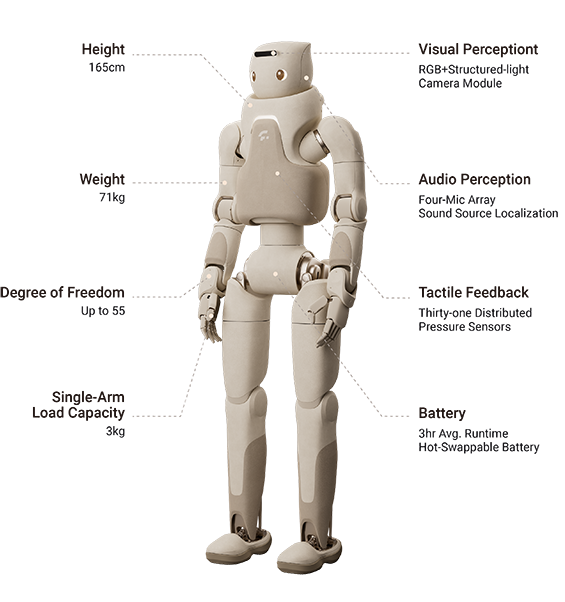
Launched by Fourier Intelligence (Shanghai, China) with pre‑orders opening in 2026, the GR-3 is a 168 cm, 60 kg humanoid that prioritizes fine motor control. Its 55 DOF — far above most commercial humanoids — split across arms, hands, torso, and legs, making it suited for delicate assembly, lab tool handling, and multi‑step manipulation. With a 15 kg payload, it can lift heavier tools than many peers, and the 3‑hour battery lets it work through half a shift without a swap. The sole published configuration is $80,000, inclusive of the standard suite. Because units are still primarily in pre‑order, real‑world fleet data is scant, but the design philosophy points squarely at precision‑driven industry and research.
Unitree H1: The Speed Athlete
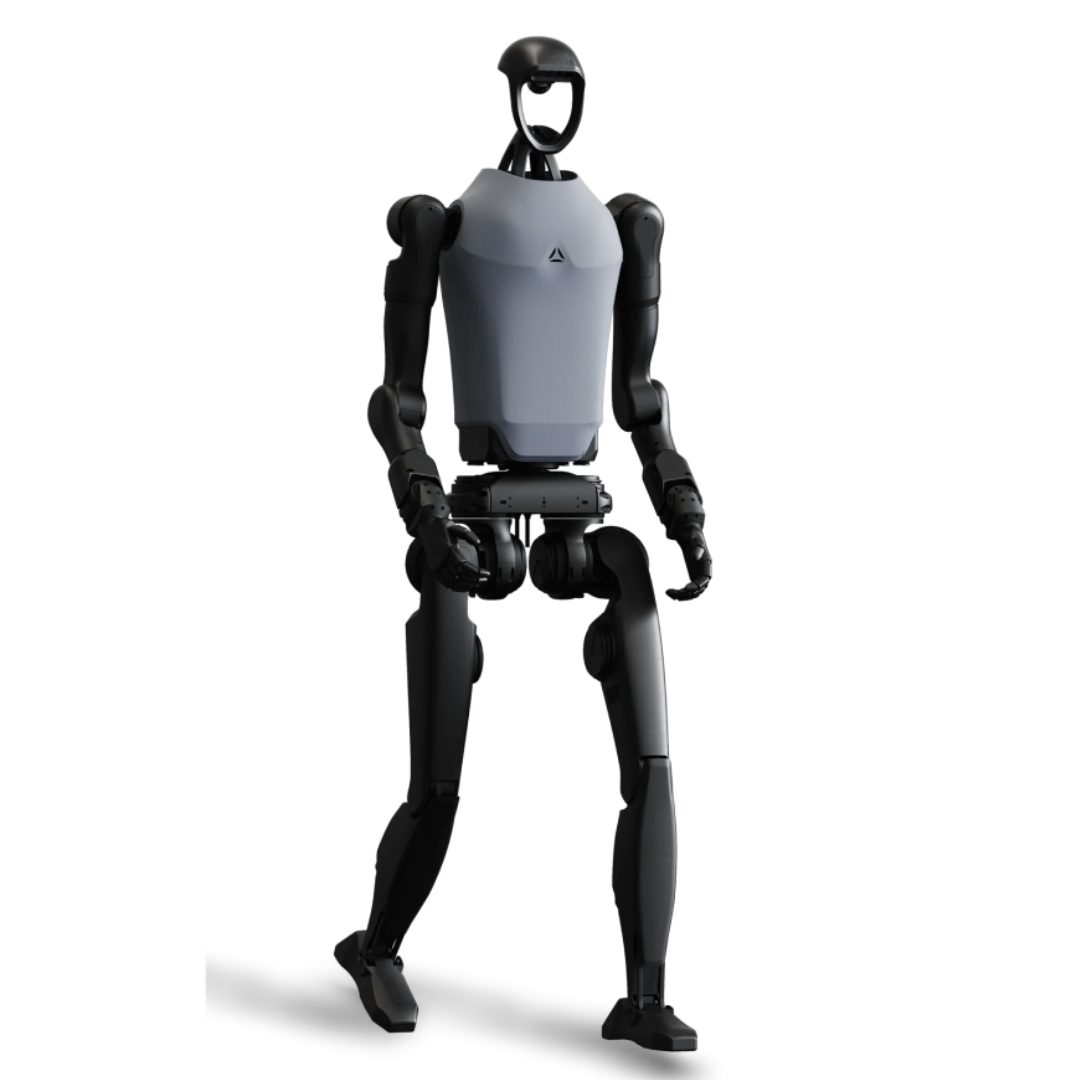
Unitree Robotics (Hangzhou, China) released the H1 in 2023, and it immediately set a humanoid speed record of 11.9 km/h. Standing 180 cm tall but weighing only 47 kg, the H1 is a lightweight, powerful runner capable of backflips and dynamic stair climbing. The base 19‑DOF version starts at $90,000, with the upgraded H1‑2 (27 DOF, additional sensors, $150,000) giving it more dexterity and perception. The hot‑swappable 864 Wh battery delivers 2 hours of strenuous action. The H1 is currently in production and buyable through Unitree and select resellers, with used units appearing between $64,000 and $120,000 — a significant availability advantage.
Head‑to‑Head by Dimension
Price & Configurations
The GR-3’s single $80,000 pre‑order price includes the full 55‑DOF hardware; no upper‑tier configs are published. The H1 starts at $90,000 for the 19‑DOF model, scaling to $150,000 for the H1‑2 with 27 DOF and richer sensing. On a per‑DOF basis, the GR-3 costs roughly $1,455/DOF vs $4,737/DOF for the base H1 — a stark efficiency advantage if dexterity is your primary metric. Winner: Fourier GR-3 for cost‑per‑capability; H1 for flexible, field‑upgradable tiers.
Performance & Specs
Payload
GR-3’s 15 kg payload doubles the H1’s 7 kg. That extra capacity allows the GR-3 to handle heavier tooling, larger workpieces, and more substantial safety‑overload margins in industrial settings. The H1’s lower payload is sufficient for sensor suites or light pick‑and‑place, but not for heavy assembly. Winner: Fourier GR-3.
Speed
The H1’s 11.9 km/h is nearly twice the GR-3’s 6.5 km/h. In warehouse or field scenarios where rapid relocation between stations is critical, the H1 covers ground vastly faster, cutting dead time. The GR-3 is a brisk walker, but no match for the H1’s running capability. Winner: Unitree H1.
Battery Life
The GR-3 runs 3 hours on a charge vs the H1’s 2 hours. While hot‑swapping helps the H1 recover quickly, the GR‑3’s longer continuous uptime reduces interventions and battery inventory costs in a shift‑based operation. Winner: Fourier GR-3.
Degrees of Freedom
With 55 DOF, the GR-3 offers far more articulation — hands, wrists, full torso — enabling complex bi‑manual tasks. The H1’s base 19 DOF (27 on H1‑2) is adequate for locomotion and simple manipulation but cannot match the GR‑3’s fine control. Winner: Fourier GR-3.
Software & SDK Ecosystem
Both manufacturers are tight‑lipped on SDKs and ROS2 support as of mid‑2026. Unitree has a track record with its quadrupeds (Go2/B2) that use a custom SDK and ROS2 nodes; it is plausible the H1 inherits some of that ecosystem. Fourier’s prior rehab robots used a proprietary platform; the GR‑3’s software stack remains undisclosed. Until published, neither can claim a decisive ecosystem win. Winner: Unknown — tie until documented.
Autonomy & Sensors
Sensor details are largely unpublished for both platforms. The H1‑2 variant includes depth cameras and LiDAR, implying an autonomy stack for SLAM and obstacle avoidance; the base H1 likely carries a subset. The GR‑3 has no public sensor specification, making it impossible to evaluate perception quality. For autonomy, the H1’s proven dynamic locomotion and the H1‑2’s sensor suite suggest a more mature, if still evolving, navigation stack. Winner: Unitree H1 (by inference from H1‑2 variant and locomotion demonstrations).
Build Quality & Durability
Neither robot publishes IP ratings or operating temperature ranges. The H1’s lightweight frame and acrobatic track record indicate robust mechanical design for dynamic loads. The GR‑3’s heavier 60 kg chassis suggests a sturdy build, but no long‑term field data exists yet. On immediate evidence, the H1’s ability to withstand backflips and high‑speed impacts gives it an edge in proven resilience. Winner: Unitree H1 (demonstrated durability).
Price & Total Cost of Ownership
At face value, the GR-3’s $80,000 pre‑order price undercuts the H1’s $90,000 entry. However, a full 3‑year TCO paints a more nuanced picture:
- Hardware: GR‑3 $80,000 (single config); H1 $90,000–150,000 depending on version needed to match some GR‑3 capabilities.
- Software/support: No subscription publicly announced for either. If Unitree bundles fleet management with the H1‑2 at a premium, TCO rises.
- Batteries & spares: GR‑3’s longer runtime reduces the number of swappable packs needed; H1 might require 50% more packs for continuous shift coverage, adding ~$3,000–5,000 over 3 years.
- Availability premium: The H1 is available now; the GR‑3 requires an indefinite pre‑order wait, which can carry opportunity cost in deployment timelines.
- Residual value: A used H1 market already exists ($64K–120K), providing partial asset recovery; the GR‑3 has no used market yet, making total 3‑year cost harder to hedge.
Winner: Fourier GR-3 on sticker price and hardware efficiency; Unitree H1 on immediate availability and residual value.
Which Should You Buy? Fourier GR-3 vs Unitree H1 by Use Case
Choose the Fourier GR-3 if… - Your workflow demands fine manipulation (assembly, lab work, intricate handling) where 55 DOF and 15 kg payload make a measurable difference. - Long continuous operation (3 hours) is more important than top speed, avoiding frequent battery swaps. - You can wait for pre‑order fulfillment and value full‑body dexterity over proven shipping timelines.
Choose the Unitree H1 if… - High‑speed locomotion is central — covering large factory floors, outdoor patrol, or research into dynamic walking/running. - You need a robot that you can buy and deploy immediately, with a healthy used market to manage costs. - Acrobatic capability (backflips, stair running) is either a showcase requirement or a proxy for robust balance control.
Choose neither if… - You need a robot with a fully open, documented SDK and ROS2 ecosystem right now — both are unproven on that front. - Your task requires heavy outdoor weather sealing (neither publishes IP ratings).
Real‑World Deployments & Track Record
The Fourier GR-3 is still in pre‑order phase; as of mid‑2026, no named commercial deployments have been publicly confirmed. Its track record is limited to manufacturer demos.
The Unitree H1 has a more established presence: it achieved the world’s fastest humanoid run (3.3 m/s) in a 2024 demonstration, and multiple units have been showcased at international robotics conferences. Anecdotal reports place H1 units in research labs in China and Europe, though Unitree has not published cumulative operating hours or fleet size. The H1‑2 variant, with enhanced sensors, appeared in public demos in late 2025. While not yet deployed in production manufacturing, the H1’s physical feats and availability in the field give it a clear experiential lead over the unreleased GR-3.
SDK, Software & Developer Ecosystem
Neither Fourier nor Unitree have released detailed SDK documentation for these humanoid platforms as of June 2026. Unitree’s quadruped line (Go2, B2) supports Python/C++ SDKs and ROS2 through open‑source packages; a similar stack is expected but unconfirmed for the H1. Fourier’s SDK philosophy is unknown. Developers planning long‑term integration should seek direct confirmation from sales teams before committing. This dimension currently gives no party a verifiable advantage.
Support, Warranty & Availability
Unitree H1 is in active production, with spare parts and support channels established through Unitree and its global reseller network. Used units are regularly listed on secondary markets. Warranty terms are unpublished but typical for Unitree quadrupeds include a one‑year limited warranty; enterprise SLAs may be negotiable.
Fourier GR-3 is available for pre‑order only. Shipping timelines, warranty coverage, and support infrastructure have not yet been publicly detailed. Early adopters should anticipate potential lead‑time variability and nascent after‑sales support.
Winner: Unitree H1 (proven availability and support ecosystem).
FAQ: Fourier GR-3 vs Unitree H1
What is the main difference between the Fourier GR-3 and the Unitree H1?
The GR-3 emphasizes dexterity with 55 DOF, 15 kg payload, and 3‑hour battery life, while the H1 prioritizes speed (11.9 km/h, backflips) in a lighter, quicker frame with 19 DOF.
Is the Fourier GR-3 available to buy now?
The GR-3 is available for pre‑order only. Fourier has not confirmed a firm shipping date, though units are expected to reach customers in 2025–2026.
Can the Unitree H1 be purchased immediately?
Yes. The H1 is in production and purchasable through Unitree and select robotics resellers. Used units are also available on platforms like Robot Overflow.
Which robot is better for industrial assembly tasks?
The Fourier GR-3, thanks to its 55 DOF and 15 kg payload, is better suited for fine manipulation and heavier tooling. The H1’s lower payload and fewer degrees of freedom limit its assembly utility.
Which robot is better for research involving dynamic locomotion?
The Unitree H1, with its record‑setting speed and acrobatic ability, provides a superior platform for locomotion research. Its proven dynamic capabilities offer immediate experimental value.
How much does each robot cost?
Fourier GR-3: $80,000 (single configuration). Unitree H1: $90,000 to $150,000 depending on the DOF and sensor configuration.
Bottom Line: Fourier GR-3 vs Unitree H1
If your deployment demands advanced manipulation, high payload, and long shifts, the Fourier GR-3 at $80,000 is the more capable and cost‑efficient choice — once it ships. If speed, dynamic performance, and immediate availability matter most, the Unitree H1 is the buy‑today workhorse with a track record of athleticism. Both represent the next frontier of general‑purpose humanoids, but their strengths pull in opposite directions: pick the one that matches the task, not the spec sheet.
Comments