humanoid

Primo Humanoid — Specs, Price & Where to Buy (2026)

An open-source humanoid designed by Alessio Pagliai (River Family) and published on 19 Sep 2026: about 1.40 m and 45 kg when finished, with 30 RobStride joint motors, a 3D-printed carbon-fibre nylon body, an NVIDIA Jetson AGX Thor and Inspire dexterous hands. It is still in design: nothing is built yet, and its walking has only been trained in simulation. Its files are public domain (CC0).

📅First Built
2026
🦾Degrees of freedom
30
🛒Availability
—

What is the Primo Humanoid?

An open-source humanoid designed by Alessio Pagliai (River Family) and published on 19 Sep 2026: about 1.40 m and 45 kg when finished, with 30 RobStride joint motors, a 3D-printed carbon-fibre nylon body, an NVIDIA Jetson AGX Thor and Inspire dexterous hands. It is still in design: nothing is built yet, and its walking has only been trained in simulation. Its files are public domain (CC0).

Specifications

Facts about the Primo Humanoid from its project's published documentation, design files and its makers' own figures. A figure marked Estimate is worked out from those files or parts lists rather than stated by the maker.

SpecDetail
StatusIn design, not built yet (state of 21 Sep 2026, still the latest on 16 Oct 2026). The first step is a bench build of the right arm and hand, one ankle, the battery, the safety chain and the torso on a table (phase 1: €4,009 with VAT); then the legs and walking (€3,998), then the left arm, waist, neck, sound and battery operation (€2,258). The lab already owns the Thor computer and the two hands.
SizeAbout 1.40 m tall when finished (the designer's figure, partly from the two stacked ankle motors in each shin). The published CAD stands 1.25 m from the soles to the top of the head camera (measured in the 3D model).
WeightAbout 45 kg finished (the designer's estimate); the bought parts weigh about 33 kg. The URDF's link masses add up to 32.3 kg, the printed parts 5.5 kg of it.
Joints30: 6 per leg (hip pitch, roll and yaw, knee, ankle pitch and roll), 7 per arm (shoulder pitch, roll and yaw, elbow, wrist roll, pitch and yaw), 2 in the waist (roll and yaw; there is no waist pitch, so the hips bend the torso forward) and 2 in the neck (yaw and pitch).
Joint motors30 RobStride quasi-direct-drive modules, each with its own driver and two encoders: RS04 ×6 (hip pitch and roll, knees: 40 N·m rated, 120 N·m peak), RS03 ×3 (hip yaw, waist roll: 20 / 60 N·m), RS06 ×11 (ankles, waist yaw, shoulder pitch and roll, elbows: 11 / 36 N·m), RS00 ×8 (shoulder yaw, wrists: 5 / 14 N·m), RS05 ×2 (neck: 1.6 / 5.5 N·m); about 20.9 kg of motors.
Hip yaw motorThe CAD, the URDF and so the 3D model have an RS06 at each hip yaw; since 21 Jun 2026 the BOM, the README and the wiring plan buy an RS03 there (60 instead of 36 N·m peak), because a sharp turn at 45 kg could need about 36 N·m. The project will measure the hip-yaw torque while turning in simulation before it orders the leg motors. The dataset follows the BOM: 3 RS03, 11 RS06.
AnklesTwo RS06 motors in each shin work the foot through 47 mm cranks and two adjustable aluminium push rods (140 and 40 mm bodies) with igus rod ends. Turning together they tip the foot up and down (up to 72 N·m); against each other they tilt it (66 N·m). The foot hangs on an offset gimbal with two Ø8 mm shoulder-screw axes, pitch above roll.
Range of motionFrom the URDF: hip pitch −2.88 to 2.53 rad, knee −0.09 to 2.88 rad, ankle pitch −0.52 to 0.87 rad and roll ±0.26 rad, waist yaw ±2.62 rad and roll ±0.52 rad, neck yaw ±1.57 rad and pitch ±0.70 rad, elbow −1.05 to 2.09 rad. The README notes that in the CAD the thigh touches the shin from about 123° of knee bend, below the URDF's 165°.
LoadEstimate: about 1 kg in each hand. The designer sized the shoulder-yaw and elbow motors for 'roughly a 1 kg box' per hand; each Inspire hand pushes 10 N at a fingertip and 15 N at the thumb. (Estimate: A design target from the project's notes, not a tested load.)
ComputerNVIDIA Jetson AGX Thor developer kit (T5000 module), capped at 130 W: perception, the walking policy, state estimation and the 250 Hz motor commands. Two CAN buses from the Thor drive the legs; three USB-to-CAN adapters drive the arms, waist and neck, all at 1 Mbit/s.
BatteryA 48 V lithium-ion pack (13S2P: 26 Molicel P45B 21700 cells): 46.8 V, 9 Ah, 421 Wh, under 2.27 kg (the maker says 'under 2.27 kg'; the parts list uses 2.27 kg), with a 45 A (100 A peak) protection board. A WEHO converter makes the 24 V, 240 W rail for the computer, hands and USB hub. Runtime isn't published.
Safety chainPure hardware at 24 V: a START button latches a relay, precharges the motor bus through a 100 Ω resistor and, after a timer, closes a 100 A contactor; the red e-stop drops it all. The computer, camera and IMU stay on to log the stop. Still open: whether the e-stop should also cut the hands' power.
SensorsA RealSense D436 depth camera with colour and its own IMU on the head, a Phidgets PhidgetSpatial Precision IMU in the pelvis, and two magnetic encoders in every joint motor. The Inspire RH56DFX hands have built-in force sensors; no other force or foot-contact sensors are listed.
HandsTwo Inspire RH56DFX hands (6 actuators and 12 joints each, 540 g, RS485). The project is designing its own five-finger hand with 15 driven joints, to replace them after testing.
SoundA 36 mm, 3 W speaker (PUI AS03604AR) on a USB sound card with a microphone, in the third build phase.
MaterialsThe 20 printed parts (35 files with left and right) are carbon-fibre nylon, PA-CF or PPA-CF, printed on a Bambu Lab H2C: 4,395 cm³, 5.5 kg in the CAD. Everything else is bought: motors, hands, battery, computer, camera, power parts, push rods, rod ends and screws.
ColoursNot decided: nothing is printed yet, and the project shows only CAD renders in Onshape's working colours (light blue, orange, gold, dark blue). The dataset shows the printed parts in a neutral dark grey for black carbon-fibre nylon, and the bought parts in their makers' finishes (black RobStride motors with silver faces).
WalkingOnly in simulation: a walking policy for the 12 leg joints and the waist roll was trained in NVIDIA Isaac Lab on rough ground with stairs of 5–23 cm, for forward speeds up to 1.0 m/s; it lasts about 87% of a 1,000-step episode. No pushes or randomised physics yet, the arms held still, and 'not yet ready for the real robot'.
Parts costAbout €30,490 all new, including 22% Italian VAT: the BOM's €10,265 over its three build phases, plus the computer (the project's reference €3,300 + VAT; already owned) and two hands (€8,099.16 each at Reichelt; already owned). The README rounds it to €30,000, and €10,300 if you already own the Thor and the hands. About $34,166 at the ECB rate of 9 Oct 2026. Not a price: no one sells Primo.
Made byDesigned by Alessio Pagliai with River Family (riverfamily.art, a gallery of open-source 3D-printed designs) and published on GitHub on 19 Sep 2026; the lab plans to build it in Italy (its BOM adds Italian VAT and checks battery shipping to Italy). Nobody makes or sells it.
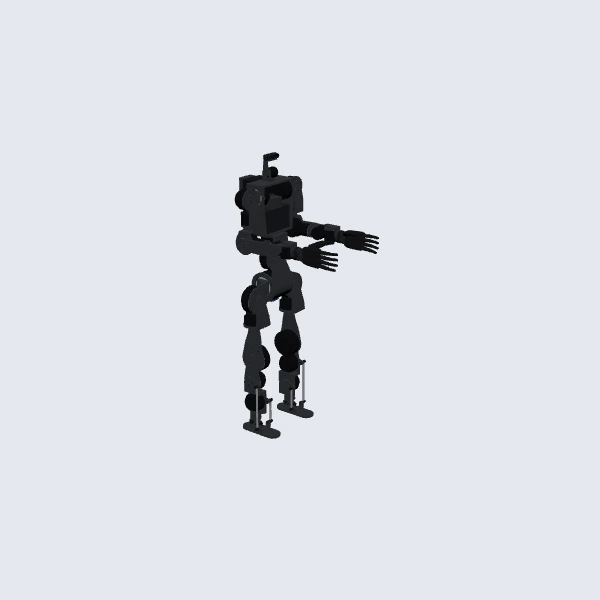
Pose shownAll joint angles at zero (the zero pose): legs straight, upper arms down and forearms straight out in front. The idle animation lowers the forearms and softens the knees, as the project's own simulation stands it.

3D model

The interactive 3D model on this page is converted from the project's published design: Primo by Alessio Pagliai and the River Family contributors (CC0 1.0), github.com/AlessioPagliai/primo; colours, push rods and piece names.

Sources

Primo in 3D

Loading the 3D model…
Drag to rotate · click the model, then scroll or pinch to zoom · click a part to inspectSwipe sideways to turn · pinch to zoom · tap a part to inspect3D model credit and licence

Primo supply chain

Point at or select a step to light up its chain: bright lines are its direct links, softer lines the rest of the path from raw material to robot.

Swipe sideways to follow the whole chain.

ExtractionRefiningMaterialsComponentsModulesRobotsCompaniesLithium compounds (carbonate, chloride, hydroxide) are produced from mined lithium.Lithium is produced from brine and mineral operations.Mined copper is smelted and refined.Primary aluminium from smelters.Bauxite is refined to alumina for aluminium.6061 aluminium contains 0.8–1.2% magnesium.6061 aluminium contains 0.40–0.8% silicon.A lithium-ion cell has a cathode (positive electrode), typically a metal oxide or phosphate. IEA tracks the 2025 mix of LFP and nickel-based cathodes in electric-car batteries.Silicon metal is made from silica in natural forms such as quartzite (USGS).Silicon metal can be refined further into ultra-high-purity semiconductor-grade silicon, called polysilicon (USGS). Chips are made on wafers: thin slices of crystalline silicon (Wikipedia).Magnesium is recovered from dolomite, serpentine, magnesium-bearing evaporite minerals and brines (USGS).In wire-bond packaging, fine gold or copper wire connects each die to its leadframe or substrate. ASE is gradually replacing gold wire with copper to cut material cost, though gold wire is still one of its main materials.Steel is made from iron ore: US mines shipped 98% of their usable iron ore to the steel industry (USGS).Sony makes its CMOS image sensors in its own production facilities in Japan (Nagasaki, Kumamoto). SIA/BCG count optoelectronics and sensors in one fab group with discrete and analog chips (DAO), apart from logic.Bosch makes its MEMS sensors in its own fabs in Reutlingen and Dresden; a MEMS sensor is a MEMS element plus an evaluation chip (ASIC).A MEMS sensor is packed in a semiconductor housing, such as an LGA package (Bosch).Mined cobalt is refined further into chemicals or metal (Cobalt Institute). In 2025 DR Congo's export restrictions left refiners short of cobalt hydroxide feed and forced some to limit production, though world refined output still rose 5% to 240 kt (Cobalt Institute).Cobalt sulphate, the largest refined cobalt product, is typically used in NCM (NMC) batteries, and cobalt tetroxide often in LCO batteries (Cobalt Institute). Cobalt-free substitutes that use iron and phosphorus (LFP) held a significant market share in China (USGS).Mined nickel ore and concentrate go to smelters and refineries. In Indonesia, laterite ore is processed into nickel pig iron and ferronickel for stainless steel, or into battery intermediates such as mixed hydroxide precipitate (IEA); the US Eagle Mine's concentrate is exported to smelters (USGS).Battery cathodes need nickel sulphate, made from Class I nickel metal or from intermediates such as mixed hydroxide precipitate and nickel matte (IEA). LFP (lithium iron phosphate) cathodes contain no nickel.Stainless steel is the biggest use of nickel, 66% of demand in 2025 (Cobalt Institute). In the US, stainless and alloy steels and nickel alloys take more than 85% of nickel use (USGS). The world made 64.2 Mt of stainless steel in 2025 (worldstainless), against about 1,900 Mt of raw steel (USGS).Lithium-ion cathodes are lithium compounds, generally a layered oxide (such as lithium cobalt oxide), a phosphate (lithium iron phosphate) or a spinel (lithium manganese oxide). Batteries took an estimated 88% of world lithium in 2025 (USGS).Natural graphite flakes must be made into spherical particles, purified to over 99.95% carbon and coated before they can be used in lithium-ion battery anodes (IEA). Natural graphite is now a small part of anode supply: under 8% of China's 2025 anode shipments (GGII), and about 14% worldwide in 2022 (Rystad).Synthetic graphite is made by calcining and graphitising petroleum coke or needle coke at nearly 3,000 °C (IEA). It was 92.7% of China's 2025 anode shipments (GGII).The negative electrode (anode) of a conventional lithium-ion cell is typically graphite. IEA's 2025 data on electric-car battery anodes show only graphite and silicon-doped graphite.Carbon fibre is spun from PAN, made from acrylonitrile, which is made from propylene, a product of cracking oil and gas (Wikipedia; ChinaBaogao).89.8% of the world's plastics in 2024 were made from fossil feedstock (Plastics Europe).Solder is the largest use of tin, 51% of world tin use in 2023 (International Tin Association; in the US solder took 11%, USGS). The common lead-free alloy SAC305 is 96.5% tin (AIM).Tin-lead solder is nearly half lead (PubChem), but the electronics industry has moved toward lead-free solders (USGS): 92% of solder for electronics was lead-free in 2023 (ITA).The lead-free alloy SAC305 contains 3% silver (AIM). In the US, brazing and solder took 3% of silver (USGS).The lead-free alloy SAC305 contains 0.5% copper (AIM).FR-4 laminate is woven fibreglass cloth with an epoxy binder (Wikipedia), and fibreglass is made from silica sand (Covia).A thin layer of copper foil is laminated to one or both sides of an FR-4 panel; these are called copper-clad laminates (Wikipedia; ChinaBaogao).FR-4 epoxy resin systems typically use bromine to resist fire (Wikipedia); a grade of the brominated flame retardant TBBPA is used to make epoxy resins for circuit boards (Wikipedia). Brominated flame retardants are one of bromine's two leading uses (USGS).Barite is used to make barium carbonate, which goes into dielectrics (Wikipedia). Barium titanate, the dielectric ceramic used in capacitors, can be made by heating barium carbonate with titanium dioxide (Wikipedia).Barium titanate, the ceramic in high-capacitance MLCCs, can be made by heating barium carbonate with titanium dioxide (Wikipedia); titanium dioxide comes from ilmenite and rutile (USGS).99% of MLCCs made worldwide use base-metal electrodes of nickel or copper; the industry moved from palladium and silver to cut cost (NASA, 2015). TDK replaced palladium electrodes with nickel in 1993 (Wikipedia).Platinum-group metals are used in multilayer ceramic capacitors (USGS). High-reliability MLCCs use palladium-silver electrodes (NASA, 2015).High-reliability MLCCs use precious-metal electrodes of palladium and silver (NASA, 2015).Connector contacts are copper alloys: beryllium copper is called the best copper alloy for contacts, connectors and cables (Wikipedia), and phosphor bronze (copper-tin-phosphorus) can replace it (USGS).Copper-clad laminate is the core material of circuit boards (ChinaBaogao); FR-4 is a common material for printed circuit boards (Wikipedia).Parts are soldered onto bare boards: Adafruit's BNO055 board is a "breakout PCB", and the Raspberry Pi Zero 2 W brief warns against damage to the printed circuit board.SAC305 lead-free solder is made for soldering printed circuits, by wave, hand and SMT reflow soldering (Conro; AIM).MLCCs store and release charge and absorb noise in phones, home appliances and IoT devices (Murata). The Raspberry Pi's RP3A0 package includes the decoupling capacitors that smooth its supply voltage (Raspberry Pi).Boards carry connectors: the Raspberry Pi Zero 2 W brief speaks of the board and its connectors, and Waveshare's servo adapter has a USB-C connector and a power connector.NVIDIA's Jetson Thor modules are 100 × 87 mm and plug in through a 699-pin board-to-board (B2B) connector (NVIDIA).Brass is copper and zinc: CW614N free-cutting brass is about 39% zinc. In the US, brass and bronze are the second use of zinc after galvanized steel.Brass is mostly copper: 57–59% in CW614N free-cutting brass.Free-cutting brass such as CW614N holds 2.5–3.5% lead so it machines cleanly; lead-free brasses exist.XT30 battery plugs (G1 harness, Open Duck Mini) have gold-plated brass contacts.Antimony is used in circuit boards to cut flammability further. A review lists two studies of scrap PC boards, parts and solder still on, with 0.45% and 1.97% antimony, so the share in the laminate alone is not known.Magnet wire is drawn from rod of pure electrolytic copper: Elektrisola starts from 8 mm rod with at least 99.90% copper, and most magnet wire is fully annealed, electrolytically refined copper (Elektrisola; Wikipedia).Small DC and brushless motors' coils are wound from magnet wire, usually copper (Wikipedia); maxon says its coreless windings are enamelled copper wire, a copper core with lacquer insulation (maxon). Nidec does not say what wire its coils use.RobStride: the RS04 has its own FOC driver and two magnetic encoders inside.RobStride: the RS03 has its own FOC driver and two magnetic encoders inside.RobStride: the RS06 has its own FOC driver and two magnetic encoders inside.RobStride: the RS00 has its own FOC driver and two magnetic encoders inside.Seeed, which sells RobStride's modules, says the RS00's planetary reducer uses machined steel gears. Neither Seeed nor RobStride's spec sheet names the bearings' material.RobStride: the RS05 has its own FOC driver and two magnetic encoders inside.All 20 printed parts are PA-CF or PPA-CF; the first ankle gimbal file is set up for Bambu PPA-CF.About 400 steel M3 and M4 socket screws (ISO 4762), plus Ø8 × M6 shoulder screws for the ankle axes and rod-end pivots, M6 nuts and M8 jam nuts.Adjustable aluminium M8 push rods for the ankles (140 and 40 mm).Heat-set brass threaded inserts in the printed parts.The matrix is nylon: PA6 (Nylon 6) in Bambu's PA6-CF. Bambu calls its PPA-CF a fibre-reinforced nylon too, with a higher heat-deflection temperature (196 °C against PA6-CF's 164 °C, at 1.8 MPa).Carbon-fibre reinforcement stiffens and strengthens the nylon, as in Bambu's PA6-CF.26 Molicel INR-21700-P45B cells (4.5 Ah, up to 45 A each).A battery-management board for balancing and protection, 45 A continuous, 100 A peak.An XT90-S anti-spark discharge plug and an XT60 charge lead.The WEHO converter's power board, the timer relay and the CAN power-separation boards.Fuse holders, the distribution block and crimped copper lugs.Six active degrees of freedom (12 joints in all) move the fingers and thumb; Inspire develops and makes its own motors, reducers, planetary roller screws, sensors and servo drivers.Inspire's parameter table lists this model 'without tactile sensors'. Its built-in force sensors give real-time force feedback, with 0.5 N resolution (Inspire).The hand takes commands over RS485 and has built-in absolute position and force sensors (Inspire); its control board is not described.Global-shutter stereo sensors in the D430 depth module and a global-shutter colour sensor.A built-in IMU (BOM: 'depth camera with RGB and IMU').A 3-axis accelerometer, gyroscope and magnetometer on the board.A small board with the sensors and a USB controller.ASML's DUV machines, 'the workhorses of the industry', print the majority of layers in chips, older-generation chips included (ASML annual report 2025).6 × RS04 in Primo's BOM: hips (pitch and roll) and knees.3 × RS03 in Primo's BOM: hip yaw (2) and waist roll.11 × RS06 in Primo's BOM: ankles (4), waist yaw, shoulder pitch and roll (4) and elbows (2).8 × RS00 in Primo's BOM: shoulder yaw (2) and wrists (6).2 × RS05 in Primo's BOM: neck.River Family (Alessio Pagliai) designs Primo and publishes it; nobody makes or sells it yet.The printed carbon-fibre nylon bones, ankle hardware and screws that make up Primo's body.Two Inspire RH56DFX hands (left and right), already owned by the lab.The 48 V, 421 Wh pack powers everything when the robot is off the bench.The fuses, 24 V converter, precharge, contactor and e-stop between the battery and every motor, computer and hand.One NVIDIA Jetson AGX Thor developer kit is the only computer.A RealSense D436 depth camera on the head.A Phidgets PhidgetSpatial Precision IMU (MOT0110) in the pelvis: the robot's base IMU, with an accelerometer, a gyroscope and a magnetometer.Three MKS CANable Pro USB-to-CAN adapters, a Waveshare RS485 adapter for the hands, a powered USB hub and a USB sound card.25, 16 and 6 mm² battery cables with crimped lugs, XT30 (2+2) motor leads carrying power and CAN, shielded CAN pair (Belden 9841NH) and JST and Molex connectors.A 36 mm, 3 W speaker (PUI AS03604AR), in the third build phase.Quartz and silica sandQuartz and silica sandMagnesium ores and brinesMagnesium ores and brinesOil, gas and coal(plastics feedstock)Oil, gas and coal (plastics feedstock)Steel (gear, bearing andstainless grades)Steel (gear, bearing and stainless grades)Lithography machines (chipprinting)Lithography machines (chip printing)Mature-node chipfabrication (28 nm and…Mature-node chip fabrication (28 nm and older; analog and sensor chips)Aluminium alloysAluminium alloysBattery-grade lithiumcompoundsBattery-grade lithium compoundsLithium chemicalconversionLithium chemical conversionCopper smelting andrefiningCopper smelting and refiningAlumina refining andaluminium smeltingAlumina refining and aluminium smeltingLithium miningLithium miningCopper miningCopper miningBauxite miningBauxite miningIron ore miningIron ore miningMagnesium smeltingMagnesium smeltingSilicon metal smeltingSilicon metal smeltingChip packaging and test(OSAT)Chip packaging and test (OSAT)Small precision motors (DCand BLDC)Small precision motors (DC and BLDC)Image sensorsImage sensorsIMUs (motion sensors)IMUs (motion sensors)Tactile sensorsTactile sensorsLithium-ion cellsLithium-ion cellsAI compute modulesAI compute modulesCobalt miningCobalt miningCobalt refining (chemicalsand metal)Cobalt refining (chemicals and metal)Nickel miningNickel miningNickel smelting andrefiningNickel smelting and refiningNatural graphite miningNatural graphite miningBattery anode graphite(spherical natural and…Battery anode graphite (spherical natural and synthetic)Cathode active material(NMC, NCA, LCO, LFP)Cathode active material (NMC, NCA, LCO, LFP)Titanium minerals(ilmenite and rutile)Titanium minerals (ilmenite and rutile)Carbon-fibre composite(CFRP)Carbon-fibre composite (CFRP)Engineering plastics (ABS,PC, nylon, PEEK)Engineering plastics (ABS, PC, nylon, PEEK)Tin miningTin miningLead miningLead miningSilver miningSilver miningPalladium mining(platinum-group metals)Palladium mining (platinum-group metals)Antimony miningAntimony miningBromine (from brines)Bromine (from brines)Barite mining (barium)Barite mining (barium)Solder (tin alloys:lead-free SAC and…Solder (tin alloys: lead-free SAC and tin-lead)Copper-clad laminate (FR-4glass-fibre epoxy board…Copper-clad laminate (FR-4 glass-fibre epoxy board material)Printed circuit boards(bare boards)Printed circuit boards (bare boards)Multilayer ceramiccapacitors (MLCC)Multilayer ceramic capacitors (MLCC)Connectors and wiringharnessesConnectors and wiring harnessesElectronics assembly(circuit boards with part…Electronics assembly (circuit boards with parts soldered on)Zinc miningZinc miningBrass (copper-zinc alloy)Brass (copper-zinc alloy)Copper magnet wire(enamelled)Copper magnet wire (enamelled)Small speakersSmall speakersRobStride RS04 jointmoduleRobStride RS04 joint moduleRobStride RS03 jointmoduleRobStride RS03 joint moduleRobStride RS06 jointmoduleRobStride RS06 joint moduleRobStride RS00 jointmoduleRobStride RS00 joint moduleRobStride RS05 jointmoduleRobStride RS05 joint modulePrimoPrimoStructure: PrimoStructure: PrimoCarbon-fibre nylonfilament (PA-CF, PPA-CF)Carbon-fibre nylon filament (PA-CF, PPA-CF)Inspire RH56DFX dexteroushandInspire RH56DFX dexterous handPrimo battery pack (48 V,13S2P, 421 Wh)Primo battery pack (48 V, 13S2P, 421 Wh)Primo power and safetychain (24 V converter,…Primo power and safety chain (24 V converter, contactor, fuses, e-stop)RealSense D436 depthcameraRealSense D436 depth cameraPhidgets PhidgetSpatialPrecision IMU (MOT0110)Phidgets PhidgetSpatial Precision IMU (MOT0110)River Family (AlessioPagliai)River Family (Alessio Pagliai)