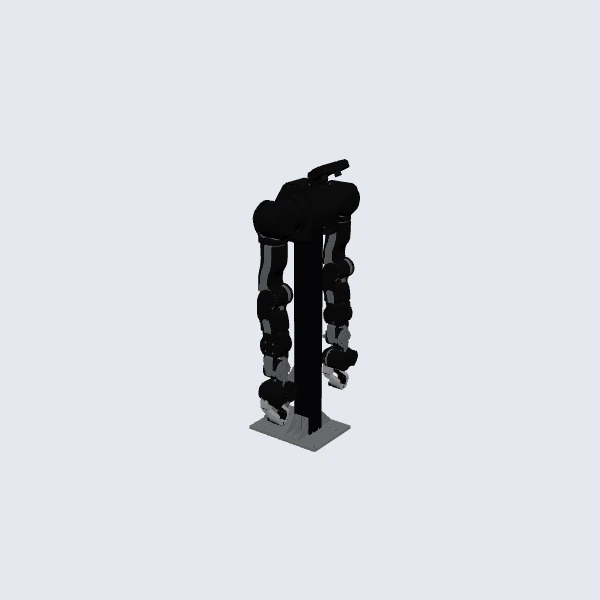
robot arm

Enactic OpenArm 2.0 — Specs, Price & Where to Buy (2026)

An open-source pair of human-sized robot arms on an aluminium pillar, made for physical AI research: you drive them to record demonstrations, with force felt both ways, and train robot models on the data. Enactic designed it in Tokyo; its published parts list for the 1.0 arms adds up to ¥960,438 (about $6,069), and WowRobo sells the 2.0 set assembled for $6,500 online ($6,000 by email order).

🌍Origin
JP
🦾Degrees of freedom
16
🛒Availability
—

What is the Enactic OpenArm 2.0?

An open-source pair of human-sized robot arms on an aluminium pillar, made for physical AI research: you drive them to record demonstrations, with force felt both ways, and train robot models on the data. Enactic designed it in Tokyo; its published parts list for the 1.0 arms adds up to ¥960,438 (about $6,069), and WowRobo sells the 2.0 set assembled for $6,500 online ($6,000 by email order).

Specifications

Facts about the Enactic OpenArm 2.0 from its project's published documentation, design files and its makers' own figures. A figure marked Estimate is worked out from those files or parts lists rather than stated by the maker.

SpecDetail
TypeTwo human-scale robot arms, each with 7 joints and a two-finger gripper, on an aluminium pillar bolted to a table. Made for physical AI research: an operator drives them (teleoperation, with force felt both ways) to record demonstrations, and trained models then run them.
SizeArm reach 606 mm. Measured on the robot description: the shoulders are 0.697 m above the base plate and 305 mm apart, the chest is 0.77 m tall and the head camera sits on top. The base plate is 250 × 190 mm, 8 mm thick, with 48 M6 holes. Enactic scaled the arms for a person 160–165 cm tall.
Mass5.5 kg per arm (WowRobo’s specifications; whether this includes the gripper is not stated). The link masses in the robot description (modelled values) add up to 5.36 kg per arm, 6.13 kg with the gripper, and 16.1 kg for the whole set with the pillar and the camera mount.
Actuated joints16 motors: 7 joints in each arm (J1 to J7) and one gripper motor in each hand (J8). The two fingers of a gripper move together: in the description the second finger copies the first.
ActuatorsDamiao joint motors with their own drivers: DM-J8009P-2EC at the shoulder (J1, J2; 40 N·m peak, 9:1), DM-J4340P-2EC and DM-J4340-2EC in the upper arm and elbow (J3, J4; 27 N·m peak, 40:1), DM-J4310-2EC V1.1 in the wrist and gripper (J5 to J8; 7 N·m peak, 10:1). Each has two 14-bit magnetic encoders and talks CAN.
Payload4.1 kg per arm held for one minute with the arm stretched out (nominal), 6.0 kg moved and held for a second (peak), in both cases including whatever is mounted on the arm.
Control and power1 kHz control over CAN-FD. A computer drives the motors through USB-to-CAN FD adapters (two in Enactic's 1.0 parts list); Enactic's software runs the motors in MIT mode (position and speed gains plus a torque command). The 1.0 list adds two 24 V, 15 A power supplies and an emergency stop. There is no computer in the robot.
SensorsTwo magnetic angle sensors in every motor; a camera in each gripper (Arducam B0495: 1920 × 1200, global shutter, 95° diagonal view); and in the standard 2.0 set a Stereolabs ZED Mini stereo camera above the chest. All three cameras share one USB hub.
GripperA compact two-finger pinching gripper with a 30 N grip force (WowRobo’s figure; the conditions are not stated), its own motor, a camera inside the case and fingers that are easy to swap (2.0; the 1.0 gripper was linkage-driven, without a camera).
StructureMachined 6061 aluminium and SUS304 stainless-steel parts, made to order by MiSUMi's meviy service from Enactic's part numbers; 3D-printed covers and fingers; a 60 × 60 mm aluminium extrusion as the pillar.
Parts cost (Enactic’s list)¥960,438 (about $6,069 at the 9 Oct 2026 rate) for two arms and the pedestal in Enactic's OpenArm 1.0 parts list: motors ¥397,356 (41%), mechanical parts ¥478,518 (50%), electronics ¥84,564 (9%). The README gives $6,500 for a complete bimanual system. 2.0 keeps the arms, motors and electronics and swaps the gripper; its cameras and printed parts are not priced in the public lists.
Price (11 Nov 2026)WowRobo, the manufacturer Enactic certifies, sells OpenArm 2.0 assembled and tested: without the top stereo camera $6,500 online or $6,000 by email order, with it $7,300 or $6,800. Enactic's purchase page gives WowRobo 20–40 days and worldwide shipping. RT Corporation in Tokyo, Enactic's official supplier in Japan, sells it by quotation.
Designed byEnactic, Inc., Tokyo (founded July 2025), which also builds the Ena care robot. OpenArm 01 launched in July 2025 and OpenArm 2.0 in May 2026, adding the in-hand camera gripper, the OpenArm Cell test bench and the KER teaching arm (KER not released yet).

3D model

The interactive 3D model on this page is converted from the project's published design: OpenArm by Enactic, Inc. (github.com/enactic/openarm_description) and contributors; ZED Mini mesh by Stereolabs (github.com/stereolabs/zed-ros2-description). Used under Apache-2.0.

Sources

OpenArm 2.0 in 3D

Loading the 3D model…
Drag to rotate · click the model, then scroll or pinch to zoom · click a part to inspectSwipe sideways to turn · pinch to zoom · tap a part to inspect3D model credit and licence

OpenArm 2.0 supply chain

Point at or select a step to light up its chain: bright lines are its direct links, softer lines the rest of the path from raw material to robot.

Swipe sideways to follow the whole chain.

ExtractionRefiningMaterialsComponentsModulesRobotsMined copper is smelted and refined.Primary aluminium from smelters.Bauxite is refined to alumina for aluminium.6061 aluminium contains 0.8–1.2% magnesium.6061 aluminium contains 0.40–0.8% silicon.Camera units are built around image sensors (CMOS image sensors from makers such as Sony and OmniVision).Silicon metal is made from silica in natural forms such as quartzite (USGS).Silicon metal can be refined further into ultra-high-purity semiconductor-grade silicon, called polysilicon (USGS). Chips are made on wafers: thin slices of crystalline silicon (Wikipedia).Magnesium is recovered from dolomite, serpentine, magnesium-bearing evaporite minerals and brines (USGS).Steel is made from iron ore: US mines shipped 98% of their usable iron ore to the steel industry (USGS).Precision bearing rings are made of through-hardened chromium bearing steel 100Cr6 (SAE 52100) (GMN).Sony makes its CMOS image sensors in its own production facilities in Japan (Nagasaki, Kumamoto). SIA/BCG count optoelectronics and sensors in one fab group with discrete and analog chips (DAO), apart from logic.Mined nickel ore and concentrate go to smelters and refineries. In Indonesia, laterite ore is processed into nickel pig iron and ferronickel for stainless steel, or into battery intermediates such as mixed hydroxide precipitate (IEA); the US Eagle Mine's concentrate is exported to smelters (USGS).Stainless steel is the biggest use of nickel, 66% of demand in 2025 (Cobalt Institute). In the US, stainless and alloy steels and nickel alloys take more than 85% of nickel use (USGS). The world made 64.2 Mt of stainless steel in 2025 (worldstainless), against about 1,900 Mt of raw steel (USGS).Solder is the largest use of tin, 51% of world tin use in 2023 (International Tin Association; in the US solder took 11%, USGS). The common lead-free alloy SAC305 is 96.5% tin (AIM).Tin-lead solder is nearly half lead (PubChem), but the electronics industry has moved toward lead-free solders (USGS): 92% of solder for electronics was lead-free in 2023 (ITA).The lead-free alloy SAC305 contains 3% silver (AIM). In the US, brazing and solder took 3% of silver (USGS).The lead-free alloy SAC305 contains 0.5% copper (AIM).FR-4 laminate is woven fibreglass cloth with an epoxy binder (Wikipedia), and fibreglass is made from silica sand (Covia).A thin layer of copper foil is laminated to one or both sides of an FR-4 panel; these are called copper-clad laminates (Wikipedia; ChinaBaogao).FR-4 epoxy resin systems typically use bromine to resist fire (Wikipedia); a grade of the brominated flame retardant TBBPA is used to make epoxy resins for circuit boards (Wikipedia). Brominated flame retardants are one of bromine's two leading uses (USGS).Barite is used to make barium carbonate, which goes into dielectrics (Wikipedia). Barium titanate, the dielectric ceramic used in capacitors, can be made by heating barium carbonate with titanium dioxide (Wikipedia).Barium titanate, the ceramic in high-capacitance MLCCs, can be made by heating barium carbonate with titanium dioxide (Wikipedia); titanium dioxide comes from ilmenite and rutile (USGS).99% of MLCCs made worldwide use base-metal electrodes of nickel or copper; the industry moved from palladium and silver to cut cost (NASA, 2015). TDK replaced palladium electrodes with nickel in 1993 (Wikipedia).Platinum-group metals are used in multilayer ceramic capacitors (USGS). High-reliability MLCCs use palladium-silver electrodes (NASA, 2015).High-reliability MLCCs use precious-metal electrodes of palladium and silver (NASA, 2015).Connector contacts are copper alloys: beryllium copper is called the best copper alloy for contacts, connectors and cables (Wikipedia), and phosphor bronze (copper-tin-phosphorus) can replace it (USGS).Copper-clad laminate is the core material of circuit boards (ChinaBaogao); FR-4 is a common material for printed circuit boards (Wikipedia).Parts are soldered onto bare boards: Adafruit's BNO055 board is a "breakout PCB", and the Raspberry Pi Zero 2 W brief warns against damage to the printed circuit board.SAC305 lead-free solder is made for soldering printed circuits, by wave, hand and SMT reflow soldering (Conro; AIM).MLCCs store and release charge and absorb noise in phones, home appliances and IoT devices (Murata). The Raspberry Pi's RP3A0 package includes the decoupling capacitors that smooth its supply voltage (Raspberry Pi).Boards carry connectors: the Raspberry Pi Zero 2 W brief speaks of the board and its connectors, and Waveshare's servo adapter has a USB-C connector and a power connector.Brass is copper and zinc: CW614N free-cutting brass is about 39% zinc. In the US, brass and bronze are the second use of zinc after galvanized steel.Brass is mostly copper: 57–59% in CW614N free-cutting brass.Free-cutting brass such as CW614N holds 2.5–3.5% lead so it machines cleanly; lead-free brasses exist.XT30 battery plugs (G1 harness, Open Duck Mini) have gold-plated brass contacts.Antimony is used in circuit boards to cut flammability further. A review lists two studies of scrap PC boards, parts and solder still on, with 0.45% and 1.97% antimony, so the share in the laminate alone is not known.Each motor has its driver built in (Damiao).ASML's DUV machines, 'the workhorses of the industry', print the majority of layers in chips, older-generation chips included (ASML annual report 2025).Most machined parts and the base plate are 6061 aluminium, and the pillar is an aluminium extrusion (Enactic’s 1.0 parts list).The sheet-metal parts and some machined parts are SUS304 stainless steel (Enactic’s 1.0 parts list).Ball bearings from MiSUMi's catalogue: MR106ZZ1, FL6700ZZ and FL6803ZZ in the arms (Enactic's 1.0 parts list).Four DM-J8009P-2EC motors: J1 and J2 at each shoulder.Two DM-J4340P-2EC motors: J3 in each upper arm.Two DM-J4340-2EC motors: the elbows (J4).Eight DM-J4310-2EC V1.1 motors: J5, J6 and J7 in each wrist and each gripper's motor (J8).The arms' made-to-order metal parts, catalogue screws and bearings, and the pedestal (Enactic's parts lists).Printed covers, cable holders and fingers (Enactic's 2.0 parts list).Two 24 V, 15 A power supplies power the motors (Enactic's 1.0 parts list).USB-to-CAN FD adapters connect a computer to the motors (two in Enactic's 1.0 parts list).Three cameras: an Arducam B0495 inside each gripper and a Stereolabs ZED Mini stereo camera above the chest.Custom cables join the motors to the hub boards, made to Enactic's drawings (LCSC in the parts list).Two hub boards of Enactic's design, made and assembled by JLCPCB, join the motor cables.Quartz and silica sandQuartz and silica sandMagnesium ores and brinesMagnesium ores and brinesSteel (gear, bearing andstainless grades)Steel (gear, bearing and stainless grades)Lithography machines (chipprinting)Lithography machines (chip printing)Mature-node chipfabrication (28 nm and…Mature-node chip fabrication (28 nm and older; analog and sensor chips)Aluminium alloysAluminium alloysCopper smelting andrefiningCopper smelting and refiningAlumina refining andaluminium smeltingAlumina refining and aluminium smeltingCopper miningCopper miningBauxite miningBauxite miningIron ore miningIron ore miningMagnesium smeltingMagnesium smeltingSilicon metal smeltingSilicon metal smeltingPrecision bearingsPrecision bearingsImage sensorsImage sensorsCameras and depth camerasCameras and depth camerasNickel miningNickel miningNickel smelting andrefiningNickel smelting and refiningTitanium minerals(ilmenite and rutile)Titanium minerals (ilmenite and rutile)Tin miningTin miningLead miningLead miningSilver miningSilver miningPalladium mining(platinum-group metals)Palladium mining (platinum-group metals)Antimony miningAntimony miningBromine (from brines)Bromine (from brines)Barite mining (barium)Barite mining (barium)Solder (tin alloys:lead-free SAC and…Solder (tin alloys: lead-free SAC and tin-lead)Copper-clad laminate (FR-4glass-fibre epoxy board…Copper-clad laminate (FR-4 glass-fibre epoxy board material)Printed circuit boards(bare boards)Printed circuit boards (bare boards)Multilayer ceramiccapacitors (MLCC)Multilayer ceramic capacitors (MLCC)Connectors and wiringharnessesConnectors and wiring harnessesElectronics assembly(circuit boards with part…Electronics assembly (circuit boards with parts soldered on)Zinc miningZinc miningBrass (copper-zinc alloy)Brass (copper-zinc alloy)Damiao DM-J4340P jointmotorDamiao DM-J4340P joint motorOpenArm 2.0OpenArm 2.0Damiao DM-J8009P jointmotorDamiao DM-J8009P joint motorDamiao DM-J4340 jointmotorDamiao DM-J4340 joint motorDamiao DM-J4310 jointmotorDamiao DM-J4310 joint motorStructure: OpenArm 2.0Structure: OpenArm 2.0Printed parts: OpenArm 2.0Printed parts: OpenArm 2.024 V power supply(OpenArm)24 V power supply (OpenArm)USB-to-CAN FD adapter(OpenArm)USB-to-CAN FD adapter (OpenArm)