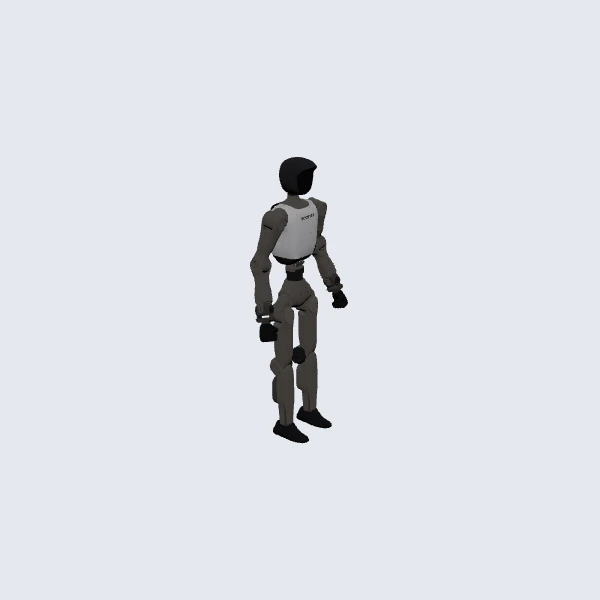
What is the Booster T2?
A 1.4 m, 42 kg humanoid by Booster Robotics (Beijing), launched on 10 July 2026 as a development platform: 31 joint motors (6 per leg, 3 in the waist, 7 per arm, 2 in the neck), push-rod ankles and waist, stereo cameras in the head and the waist, an ARM computer with 375 TOPS (or, on the Professional edition, an NVIDIA Jetson Thor T5000) and a 48 V battery for about 2 hours of walking. Resellers sell it from US$30,000 (15 Oct 2026).
Specifications
Facts about the Booster T2 from its project's published documentation, design files and its makers' own figures. A figure marked Estimate is worked out from those files or parts lists rather than stated by the maker.
| Spec | Detail |
|---|---|
| Size | Height about 1.4 m (Booster: 'Height (standing): ~1.4 m (140 cm)'). Booster's 3D model stands 1,413 mm tall, 463 mm across the shoulders in the pose shown. Booster gives no width or depth. A Beijing government article on the launch says 'nearly 1.7 m'; the authors keep the maker's figure. |
| Weight | About 42 kg (Booster: '~42 kg', varying slightly with version and options). The link masses in Booster's 3D model add up to 42.0 kg (41.99 kg). |
| Joints | 31 joint motors (Booster): 6 per leg (hip pitch, roll and yaw, knee, ankle pitch and roll), 3 in the waist (pitch, roll, yaw), 7 per arm (shoulder pitch and roll, upper-arm twist, elbow, forearm twist, wrist yaw and roll) and 2 in the neck. With hands: 33 joints with grippers, 43 with six-joint dexterous hands (German shop), up to 75 with Booster's most dexterous hands (36Kr). The standard T2 ends in fists. |
| Joint motors | 'Motor: High-speed internal-rotor PMSM' (a brushless permanent-magnet motor) and 'Joint Output Bearing: Industrial-grade crossed roller bearings'; 'Max Peak Torque: 140 N·m' (Booster). Fully torque-controlled joints with dual encoder modules (a German reseller). Booster's 3D model sets four sizes: 135 N·m (hips, knees, waist turn), 74 N·m (shoulder pitch), 60 N·m (the other shoulder and elbow joints, and the six push-rod motors) and 22 N·m (wrists and neck). |
| Ankles and waist | Push-rod linkages, not plain hinges (Booster's parallel model): each ankle is moved by two 60 N·m motors in the front of the shin, 95 mm and 162 mm below the knee, through 25 mm cranks and rods of 172 and 239 mm; the waist's pitch and roll by two 60 N·m motors in the bottom of the torso through 51 mm rods. Booster's URDF and software report them as ankle pitch and roll and waist pitch and roll (their effort limits: 132 and 72 N·m at the ankle, 138 and 144 N·m at the waist). |
| Range of motion | Booster's 3D model: head turn ±63°, nod −18° to 23°; waist pitch −43° to 32°, roll ±20.5°, turn ±138°; hip pitch −168° to 128°, roll −33° to 88° (outward), yaw ±158°; knee 0° to 148°; ankle pitch −37° to 19°, roll ±18°; shoulder pitch −173° to 98°, roll ±87°; upper-arm twist ±118°; elbow 0° to 120.5°; forearm twist ±118°; wrist yaw −43° to 39°, roll −78° to 53°. |
| Computers | Education edition: 'High-performance ARM processor, 375 TOPS AI computing power' (Booster; a German shop lists 350 TOPS): a 16-core Arm Cortex-A78AE CPU at 1.9 GHz, 375 TOPS (INT8), 16 GB memory and 512 GB storage (Booster's T2 manual); the chip's maker is not named. Professional edition: 'Jetson Thor T5000, 2070 TFLOPS AI computing power' (Booster), with a 14-core Arm Neoverse-V3AE CPU at 2.6 GHz, 128 GB memory and 512 GB storage (manual): NVIDIA's US$4,999 module (in lots of 1,000). |
| Cooling | 'Cooling system: Air cooling' on both editions (Booster's T2 manual). Booster does not describe the fans or heat sinks; it warns by voice of joint overheating. |
| Battery | 'Battery Rating: 48 V, 10 Ah'; 'Battery Life: 2 hours of continuous walking'; 'Magnetic charging port; supports charging while in use' (Booster). The battery slides into a slot in the torso, about 2 hours to charge fully, charging only between 0 °C and 45 °C (Booster's T2 manual). A German shop sells the spare as 10.5 Ah, about 2 hours walking or 4 hours standing, with a power indicator, charge balancing and protection against overcharge, deep discharge, short circuits and overheating, for €2,399 (US$2,688.32). |
| Battery energy | Estimate: about 480–504 Wh: 48 V × 10–10.5 Ah. Booster publishes no watt-hours; a 48 V pack is probably 13 lithium cells in series, like the T1's 13S3P pack. (Estimate: Simple arithmetic on the published rating; the usable energy may be a little lower.) |
| Sensors | A binocular (stereo) camera in the head and another in the waist (Booster; a German shop calls them depth cameras); wrist cameras come with grippers or dexterous hands. A 9-axis IMU (a German shop; Booster's T2 manual puts an IMU in the torso). A microphone array and a speaker in the head (Booster; its T2 manual). LiDAR optional: a super-hemispherical 3D LiDAR, 360° × 189°, 40 m at 10% reflectivity and up to 60 m, for head or overhead mounting, €3,290 (US$3,686.77) at a German shop. |
| Buttons, radio and ports | 1 power button and 3 interaction buttons, 1 RGB LED; Wi-Fi 6 and Bluetooth 5.2; external ports for power, a locking USB Type-C connector and Ethernet; a handheld remote controller (Booster). Booster's T2 manual names the back panel's buttons: power (hold 3 s), WALK (walking mode), STAND (PREP mode) and F1 (DAMP mode, or a custom function); its photo shows the Ethernet port beside them and a green light bar below. The manual says to touch no part of the robot except the handle while it moves. |
| Safety | Soft and hard emergency stops; voice warnings for low battery and joint overheating (Booster). |
| Payload | 'Maximum Dual-Arm Payload: 10 kg' with both arms, varying a lot with arm posture (Booster). A German shop lists 5 kg per arm held out level for the Education edition and 3 kg per arm for the Professional. |
| Speed | 'Walking Speed: 3 m/s' (Booster): 10.8 km/h, a running pace for a person. |
| Frame | Estimate: not published. Booster names no materials for the T2. Its photos show a silver-white chest shell, a glossy charcoal helmet with a black visor and gunmetal shells on the neck, arms, pelvis and legs that look like metal; RoboCup teams list its smaller T1 as 7075 aluminium alloy and engineering plastics. (Estimate: Booster publishes no materials; this is inferred from its photos and the T1.) |
| In the box | Remote controller, battery pack, charger and a packaging case (Funduino's T2 Edu listing; its T2 Pro listing: a transport and carrying case). |
| Price | US$38,850 at Robotics Center (San Francisco) for the T2 Edu E1 (no hands), 'In stock', standard delivery 4–6 weeks, US shipping estimated at $1,366.38 (read 29 Oct 2026). Its other configurations: Edu E2 with grippers $52,350, Edu E3 with BrainCo Revo 2 hands $59,850, Pro P1 (no hands) $44,850, Pro P2 with grippers $59,850, Pro P3 with BrainCo Revo 2 hands $67,350, Pro P3-1 with Wuji Hand 2 $139,500, Pro P3-2 with BrainCo Revo 3 tactile hands $148,500. Earlier it listed US$50,000 with $3,000 shipping (23 Oct 2026) and US$30,000 with $2,850 shipping (15 Oct 2026), without naming the edition. A price guide reading US dealer pages on 11 Aug 2026: T2 Edu $32,999, T2 Pro $37,999, with dexterous hands $48,999 / $54,999, with high-DoF tactile hands $118,999. In Germany Funduino lists, with 19% VAT: T2 Edu €32,500 (US$36,419.50), T2 Pro €38,259 (US$42,873.04), Pro with dexterous hands €53,590 (US$60,052.95), at 1 EUR = US$1.1206 (ECB, 9 Oct 2026). Booster itself sells by enquiry: its T2 page shows no price, and its 'Buy now' button opens an inquiry form. |
| Availability | Launched on 10 July 2026 (Booster; 36Kr). On sale: Robotics Center (US) lists it 'In stock' with 4–6 weeks' delivery; Funduino (Germany) 'Available to order – with you in 21 working days' (15 Oct 2026). Booster's own site takes orders by enquiry. |
| Made in | Estimate: China: Booster Robotics is based in Haidian District, Beijing (founded June 2023). It does not name the plant that builds the T2. (Estimate: The maker's home city; Booster does not say where each robot is assembled.) |
| Warranty | 1 year; extended warranty available (Booster). |
| Parts cost | Estimate: ~US$12,123 for the Professional edition: the dataset's own estimate, line by line, from the teardown costs for the Unitree G1, NVIDIA's price for the Jetson T5000 module and known camera prices. No T2 teardown or parts list is public. That is about 27% of the US$44,850 Robotics Center lists for the Pro P1 without hands (29 Oct 2026; 24% of the US$50,000 it listed on 23 Oct and 40% of the US$30,000 it listed on 15 Oct, edition not named) and 32% of the Professional's US$37,999 at a US dealer in August 2026; the Jetson module alone is 41% of the parts cost. (Estimate: Every line is the authors' estimate; the joints are scaled from another maker's teardown, and Booster builds far fewer robots than Unitree.) |
| Pose shown | Arms as in Booster's own default pose for running its software on a T2 (shoulder pitch 0.2 rad, shoulder roll ∓1.3 rad, elbow ∓0.5 rad); legs, waist and head at zero, Booster's default. The Anatomy viewer bends the knees a little when assembled. |
3D model
The interactive 3D model on this page is converted from the project's published design: Booster T2 by Booster Robotics (github.com/BoosterRobotics/booster_assets, robots/T2). 3D model © 2025 BoosterRobotics, BSD-3-Clause licence: commercial use allowed with this notice and the licence's disclaimer. Booster Robotics does not endorse this model.
Sources
- Project repository: github.com/BoosterRobotics/booster_assets