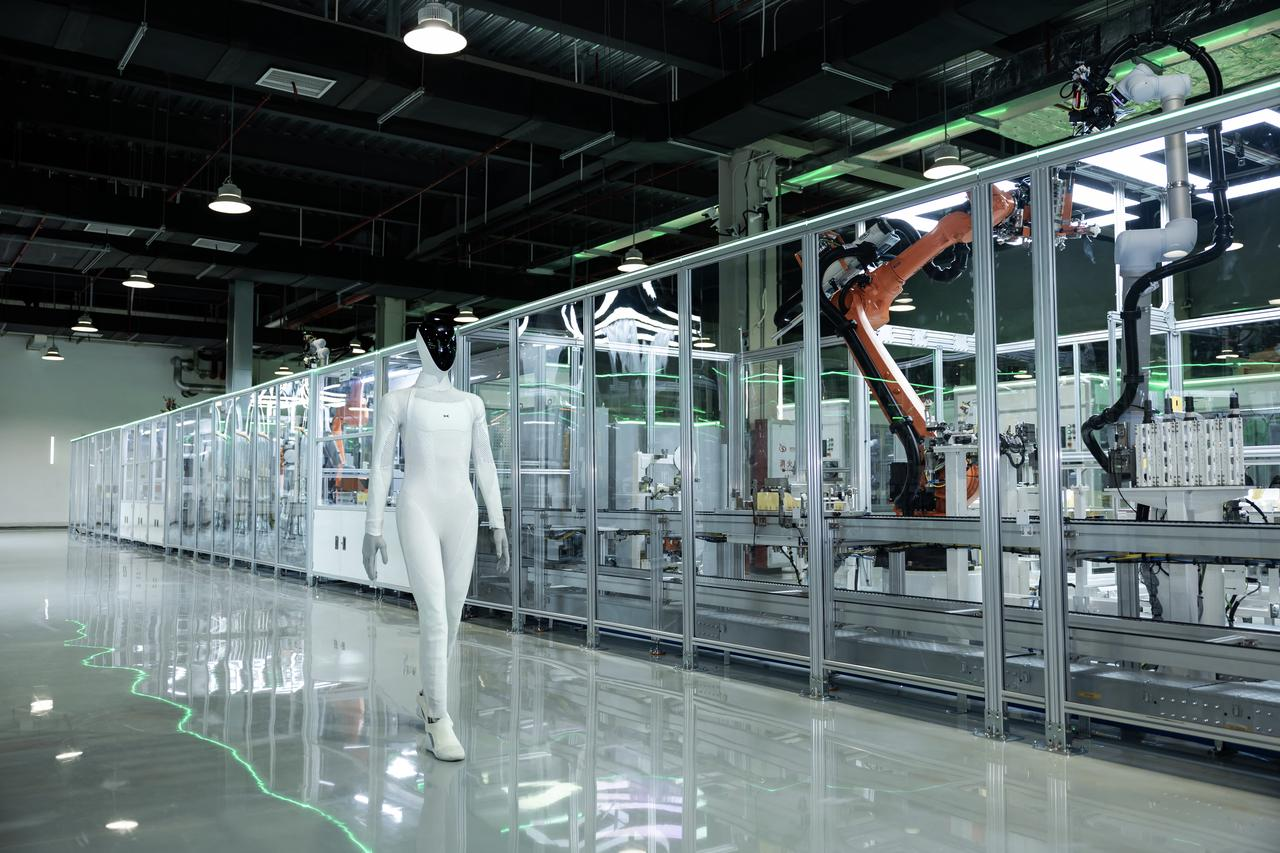

XPENG’s Iron humanoid robot walks off a new production line

XPENG’s Iron humanoid robot walks off a new production line

2 min read•Sep 22, 2026•
Anna Kowalski
Anna Kowalski

XPENG says its Iron humanoid robot walked autonomously off a newly operational production line after assembly, first reported by Engadget. That factory milestone does not establish whether Iron can make it through a working day, and XPENG has not disclosed the line’s current output or how much testing had been done before the walk itself.

XPENG said over 80 percent of the line’s core processes are automated. It is adapting quality systems from its car business to make robots consistently as production increases, while chairman and CEO He Xiaopeng gave Iron a staff badge.

The autonomous exit demonstrates movement after assembly, while customer-facing performance remains to be established. XPENG plans to deploy robots in its stores and campuses first, with reception, guided tours and sales assistance among the planned roles.

Iron has 76 degrees of freedom across its body and 21 in each hand, referring to the independent ways it can move. XPENG says three Turing AI chips provide up to 2,250 trillion operations per second, letting Iron run its AI model onboard and perform complex tasks without a remote operator.

XPENG also says Iron’s outer structure was designed to be flexible with safety in mind. No independent safety evaluation is provided for that design, and the jobs remain planned while everyday performance is still to be established.

In April, Figure reported that it had produced over 350 Figure 03 robots and demonstrated a production cycle of one robot per hour. Those robots were allocated to uses including internal development and data collection, so the total should not be read as customer deliveries. BMW said an earlier Figure 02 inserted sheet-metal parts for welding at its Spartanburg plant and supported production of more than 30,000 BMW X3s over ten months.

Mass production is still a year-end goal, with deliveries in China and overseas markets planned for 2027. The announcement did not specify U.S. availability or a price.

Boston Dynamics names former Amazon AI executive Rohit Prasad CEO

Boston Dynamics has named former Amazon executive Rohit Prasad as CEO, effective tomorrow, nearly nine months after former CEO Robert Playter stepped down, first reported by Therobotreport. Prasad will replace interim CEO Amanda McMaster, as Boston Dynamics says his appointment will accelerate its physical AI strategy of combining robotics and advanced AI to commercialize intelligent machines at scale.

McMaster took over after Playter left in February. Prasad is the company’s third CEO; founder Marc Raibert led it from its creation in 1992 until 2020.

Before joining Boston Dynamics, Prasad was Amazon’s senior vice president and head scientist for Alexa and artificial general intelligence. During 12 years at Amazon, he helped build Alexa from its earliest days and later led development of the Amazon Nova foundation model family used by enterprises. Before Amazon, he spent nearly 14 years at Raytheon BBN Technologies, leading machine-learning research and its real-world application for U.S. government and commercial use.

Prasad said he plans to productize intelligent robotic systems to improve safety, productivity and operational efficiency across industrial and commercial environments. His background spans consumer AI and enterprise foundation models, while Boston Dynamics says its strategy combines advanced AI with robotics to commercialize intelligent machines.

Jaehoon Chang, Hyundai vice chair and chair of Boston Dynamics’ board, said the company’s robotics, Prasad’s AI product experience, and Hyundai Motor Group’s manufacturing, logistics and mobility capabilities provide a foundation to build and scale physical AI. Hyundai acquired a controlling stake in Boston Dynamics from SoftBank Group in 2021.

Subject to the relevant approval process, Prasad is also expected to join the company’s board.