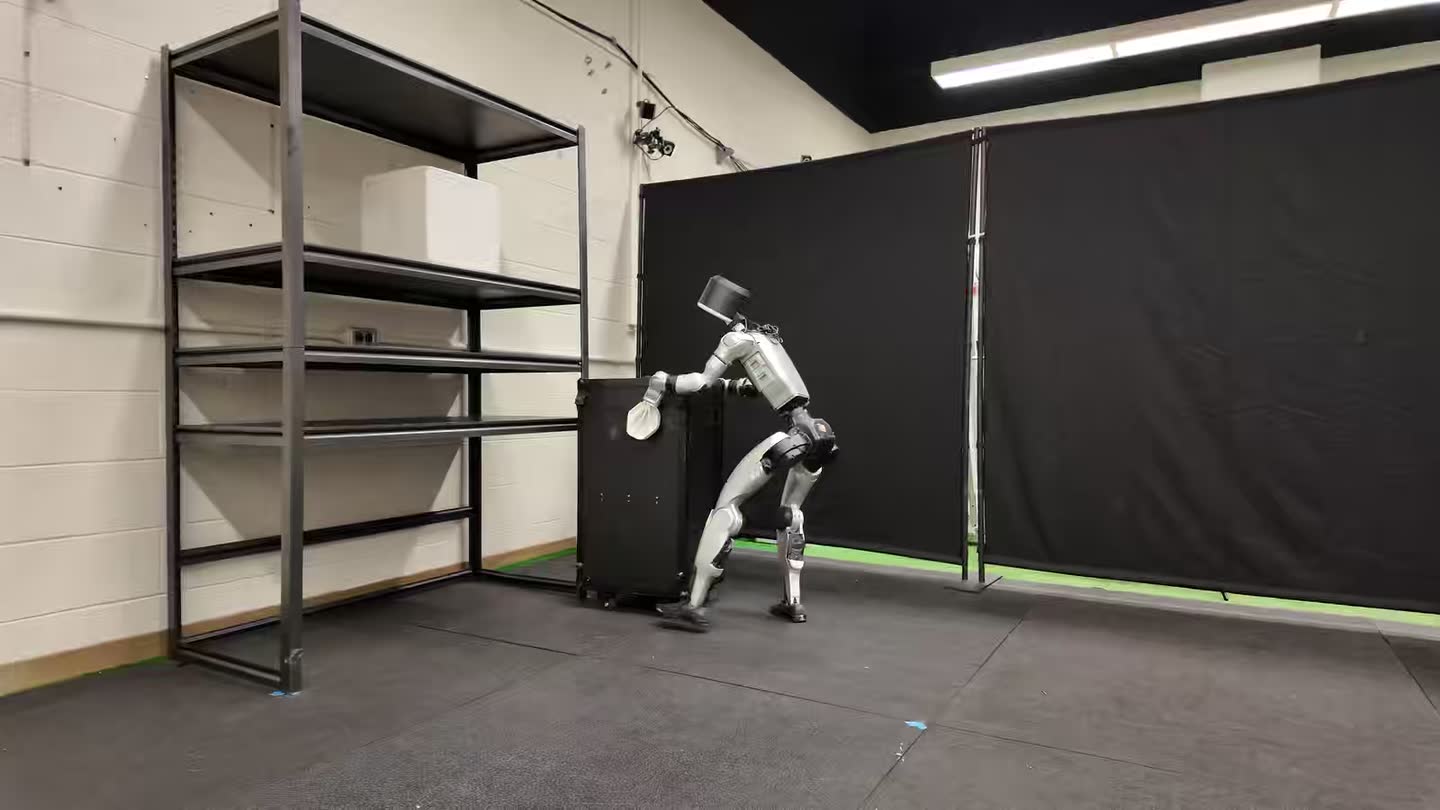

Workhorse learns whole-body humanoid manipulation from human demonstrations and performs tasks on a real Unitree G1, first reported by Arxiv. The system connects human pose demonstrations to visual planning and whole-body robot control; physical box-sorting demonstrations include recovery after a person pushes the robot or takes away the box, and simulation tests measure task completion.
Humanoid robots still struggle to plan contact-rich whole-body manipulation from egocentric RGB and proprioception. Workhorse divides the task between a visual planner and a reinforcement-learning whole-body tracker. The planner predicts five target poses: the torso, both wrists and both feet; the tracker follows them on the robot.
Both policies train separately on the same recorded human poses without retargeting. Each policy's training data is augmented to imitate errors made by the other at deployment, keeping the demonstrations robot-free while bringing cross-policy errors into training.
On a real Unitree G1, Workhorse sorts boxes using its hands and a kick, catches a thrown box, and topples and climbs a suitcase. The box-sorting demonstrations also show recoveries after a person pushes the robot or takes the box away.
In a simulated copy of the demonstration room, box sorting succeeds in 77% of episodes and in 64% under 40 N.s pushes. With both policies retrained from the same demonstrations, a simulated second humanoid completes box sorting in 83% of episodes without pushes.