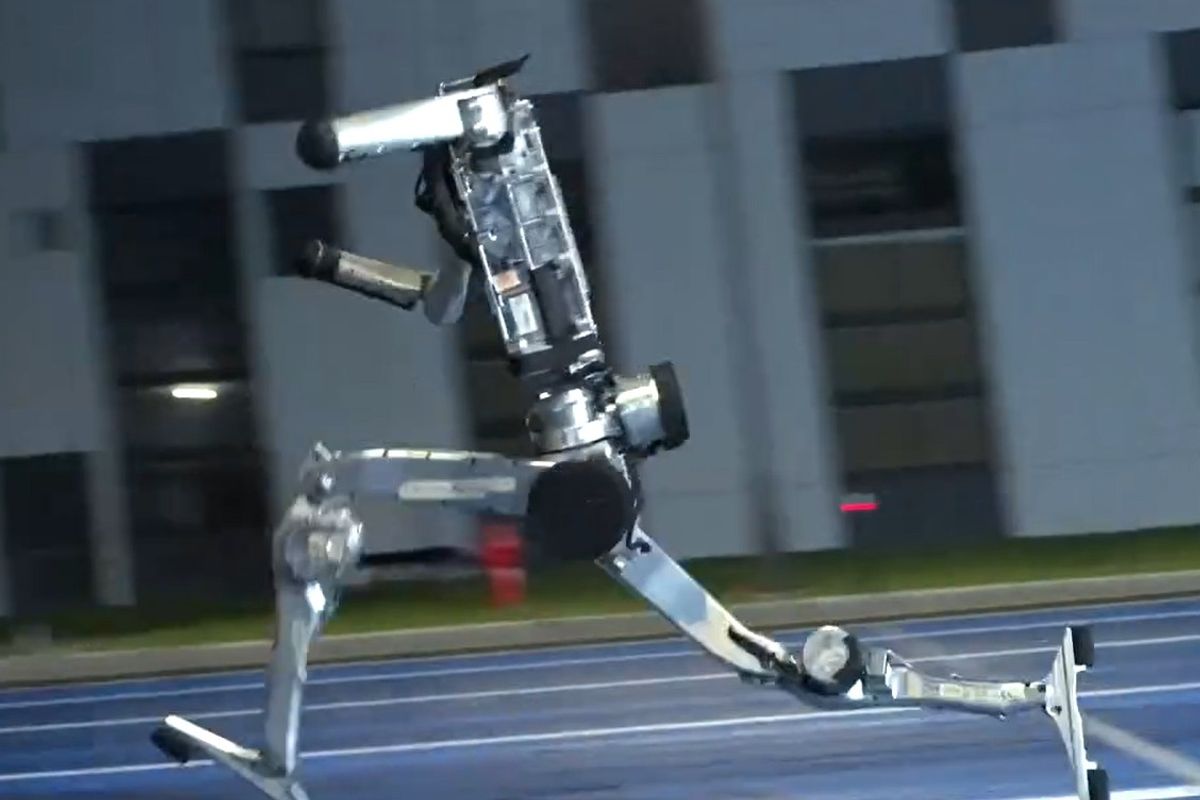

Tiangong Ultra beats Bolt’s 100-meter record at Beijing robot games

Tiangong Ultra beats Bolt’s 100-meter record at Beijing robot games

2 min read•Aug 24, 2026•
Ben Harris
Ben Harris

Tiangong Ultra beat Usain Bolt’s 100-meter record at the World Humanoid Robot Games, finishing in 9.39 seconds, in a result first reported by The Verge. The result puts a robot ahead of Bolt’s 9.58-second mark while the event is designed to showcase bipedal robot technology across competitions involving robots from 16 countries.

Tiangong Ultra was made by the Beijing Humanoid Robot Innovation Center and ran the distance in a preliminary heat on Saturday. Honor-developed Lightning followed at 9.47 seconds.

Tiangong Ultra also ran the 400-meter race in 38.16 seconds, beating the 43.03-second world record set by Wayde van Niekerk in 2016.

The games launched in 2025 and are designed to showcase advancements in bipedal bot technology. This year’s event has 2,056 robots from 16 countries, with categories for sprinting, jumping, football, boxing, and more.

The times provide the clean headline; the finishes are less tidy. Watching the models run can be amusing and a little unsettling because of the bizarre way they move to dash so quickly.

Unlike human athletes, these sprinting bots do not typically get a victory lap. Several videos show them colliding with cushioned walls at impressive speeds, after which the robots or pieces of what remains are collected and carried away on a stretcher.

Plug-in vehicles reach 32% of global registrations in September

Plug-in vehicles reached 32% of global registrations in September, first reported by Cleantechnica. Battery-electric vehicles accounted for 23% of registrations and set a record at 1.54 million, up 8% year over year, while plug-in hybrids fell 9%; year to date in 2026, BEVs were up 12% and PHEVs down 10%.

Global plug-in registrations rose 3% year over year to around 2.16 million in September, close to the all-time record of 2.17 million set last December.

Year to date, plug-in registrations were up 4% year over year: BEVs grew 12%, while PHEVs fell 10%. Their combined share for 2026 stood at 25%, with BEVs at 18% and PHEVs at 7%. The overall growth rate therefore hides a clear split between the two categories.

The Tesla Model Y led the model rankings with a record 165,000 registrations, up 17% year over year. Tesla Model 3 came second with 65,000, enough to move ahead of Geely Xingyuan and BYD Song despite a 4% annual decline.

BYD Song finished fourth at 54,519 registrations, up 19% and the fastest growth rate among the top five. An export push and the new-generation Ultra body helped lift the model.

At the make level, Tesla had a record 232,000 registrations, up 9% year over year. Toyota reached 61,332 for its fourth record in a row, finishing ahead of Volkswagen’s year-best 58,000 to become September’s best-selling legacy make.