
Last updated: 2025
Three robotics stories dropped this week that collectively span the entire arc of the field — from a farewell to one of the most influential research platforms ever built, to a breakthrough in fault-tolerant collective robotics published in Science, to a consumer robot shipping to Bay Area homes in February 2026.
Table of Contents
- Atlas Gets Its Final Run — and It's a Goodbye Worth Watching
- The Modular Robot Collective That Grows More Reliable as It Grows Larger
- Isaac 0: Weave Robotics Is Shipping a Laundry-Folding Robot to Homes
- What This Means for Robotics
- Frequently Asked Questions
Atlas Gets Its Final Run — and It's a Goodbye Worth Watching
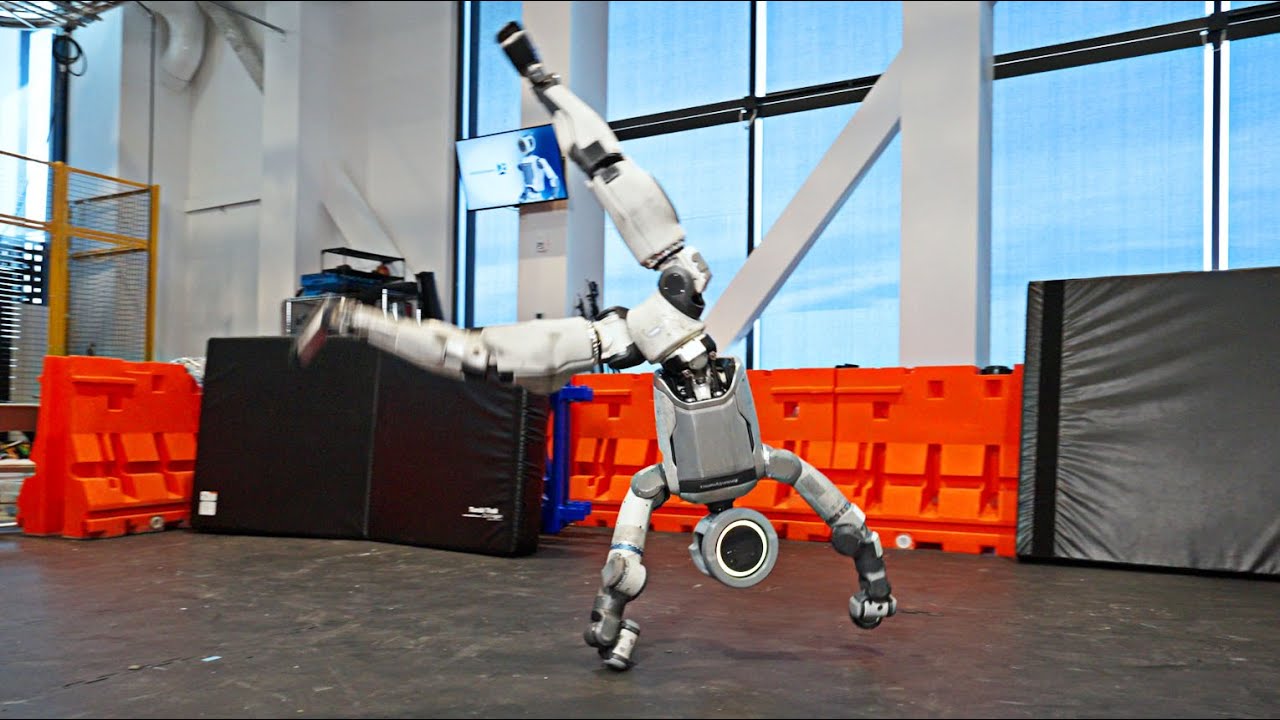
The hydraulic Atlas — Boston Dynamics' research-grade humanoid that spent over a decade being thrown down stairs, shoved off platforms, and made to do backflips — has completed its final test run. The research platform is retired. Its commercial successor, the electric Atlas enterprise platform, is already in the field.
For anyone who has followed humanoid robotics over the past decade, this video lands differently than a typical demo reel. Boston Dynamics, in collaboration with the RAI Institute, pushed the original Atlas through one last full-body mobility evaluation — a final stress test of what hydraulic actuation and whole-body control could achieve before the platform is decommissioned.
The research Atlas represented something rare in robotics: a platform open enough to drive dozens of independent research breakthroughs, yet capable enough to remain credible as hardware for over ten years. Whole-body control algorithms, dynamic balance research, and parkour demonstrations that seemed impossible in 2016 became routine by 2023. That arc matters.
What replaced it is architecturally different in almost every dimension. The new electric Atlas uses rotary actuators rather than hydraulic cylinders, trades raw torque density for energy efficiency, and is built from the ground up for deployment rather than research. Whether the enterprise platform inherits the research community's relationship with Atlas remains an open question — Boston Dynamics has been notably quieter about third-party access to the new system.
The farewell video is worth watching not as a product announcement, but as a record of how far bipedal locomotion research has come. According to IEEE Spectrum, the engineers made one final push to test the limits of full-body control and mobility — and it shows.
The Modular Robot Collective That Grows More Reliable as It Grows Larger
Published in Science Robotics, research from EPFL's Reconfigurable Robotics Lab inverts one of the most persistent assumptions in modular robotics: that larger collectives are inherently less reliable because there are simply more components that can fail.
The conventional engineering logic is sound. More modules means more failure surfaces. A collective of 50 modules has 50 times the failure probability of a single unit, assuming independent failure rates. This trade-off has constrained modular robotics for years — designers have had to choose between functional versatility (more modules, more configurations) and operational reliability (fewer modules, fewer failure points).
The EPFL system breaks this trade-off by exploiting redundancy at the local level. Rather than treating each module as an independent unit that either functions or fails, the collective shares computational and physical resources across neighbouring modules. When one module degrades or fails entirely, adjacent modules redistribute load — locomotion patterns, sensing duties, and structural roles shift dynamically across the collective.
The result, demonstrated in the published paper, is a system where reliability scales with collective size rather than degrading with it. A larger collective is more robust than a smaller one, not less. The team demonstrates this by deliberately disabling modules mid-task and observing the collective maintain function — crawling under obstacles, navigating terrain, maintaining structural integrity — without human intervention or re-programming.
This has direct implications for Physical AI (the emerging field where AI systems are embedded in and inseparable from physical hardware). If fault tolerance can be architected at the collective level rather than the individual unit level, it changes the economics and deployment calculus for modular systems in inspection, search-and-rescue, and environmental monitoring applications where individual unit reliability cannot be guaranteed.
The research was published via the Reconfigurable Robotics Lab at EPFL and is available in full through Science Robotics.
| Design Approach | Reliability Scaling | Functional Versatility | Failure Recovery |
|---|---|---|---|
| Single monolithic robot | High (single unit) | Low (fixed morphology) | None — total failure |
| Traditional modular collective | Decreases with size | High | Partial, requires reprogramming |
| EPFL redundant collective | Increases with size | High | Autonomous, local redistribution |
Isaac 0: Weave Robotics Is Shipping a Laundry-Folding Robot to Homes
Consumer robotics has been "almost ready" for the home market for at least five years. Weave Robotics is making a specific, dated, geographic commitment: the Isaac 0 laundry-folding robot ships to Bay Area homes starting February 2026.
The announcement is deliberately narrow in scope. Isaac 0 is not a general-purpose home robot. It folds laundry. That specificity is the point — the consumer robotics companies gaining ground in 2024 and 2025 are almost uniformly those that have constrained their initial use cases to a single, repeatable, high-value household task rather than chasing the full-stack home assistant vision that has failed repeatedly since the Roomba era.
Laundry folding is a genuinely hard manipulation problem. Textile deformation (the way fabric moves unpredictably when handled) has been a benchmark challenge in robotic manipulation research for years. The fact that Weave is shipping — not demonstrating, not beta-testing with employees, but shipping to paying customers — suggests their manipulation stack handles the variability of real household laundry at a level that clears the commercial viability threshold.
Details on the Isaac 0 hardware configuration, pricing, and whether it requires a dedicated surface or integrates with existing laundry appliances have not yet been disclosed publicly. The February 2026 Bay Area rollout suggests a constrained geographic launch designed to manage logistics and support density before broader expansion.
For those tracking the broader consumer robotics category, Weave's announcement sits alongside a small number of companies — 1X, Aethon, and several others — attempting to establish recurring home robot revenue rather than one-time hardware sales. The laundry vertical is plausible precisely because the task frequency is high, the labour substitution value is clear, and the physical environment (a folding surface, consistent garment types) is more constrained than general household navigation.
What This Means for Robotics
These three stories are not independent data points. They sketch a trajectory.
The research-to-deployment pipeline is accelerating. Atlas spent a decade as a research platform before Boston Dynamics committed to a commercial successor. The EPFL collective research is publishing results in Science while the underlying architecture is already applicable to real-world inspection and search scenarios. Weave is shipping Isaac 0 less than two years after laundry-folding robots were primarily academic demonstrations. The gap between lab and deployment is compressing.
Fault tolerance is becoming a first-class design requirement. The EPFL work is significant not just as a research result but as a signal about what the field is optimising for. As robots move into uncontrolled environments — warehouses, homes, outdoor terrain — the ability to degrade gracefully rather than fail completely becomes more valuable than raw performance under ideal conditions.
Consumer robotics is entering a vertical-first phase. The home robot market will not be won by a general-purpose platform. It will be won by robots that do one thing well enough to justify a purchase, then expand. Weave's move into laundry is consistent with this pattern.
Engineers and buyers evaluating automation platforms should track EPFL's redundant collective architecture closely — the principles apply well beyond swarm robotics, into any multi-robot deployment where uptime requirements are strict. If you're sourcing physical automation hardware, used industrial robots on Robot Overflow offer an entry point for teams that need proven reliability without research-grade price tags. For teams watching the humanoid space as Atlas' commercial successor enters the field, the humanoid robot category on Robot Overflow tracks available platforms and pricing in real time.