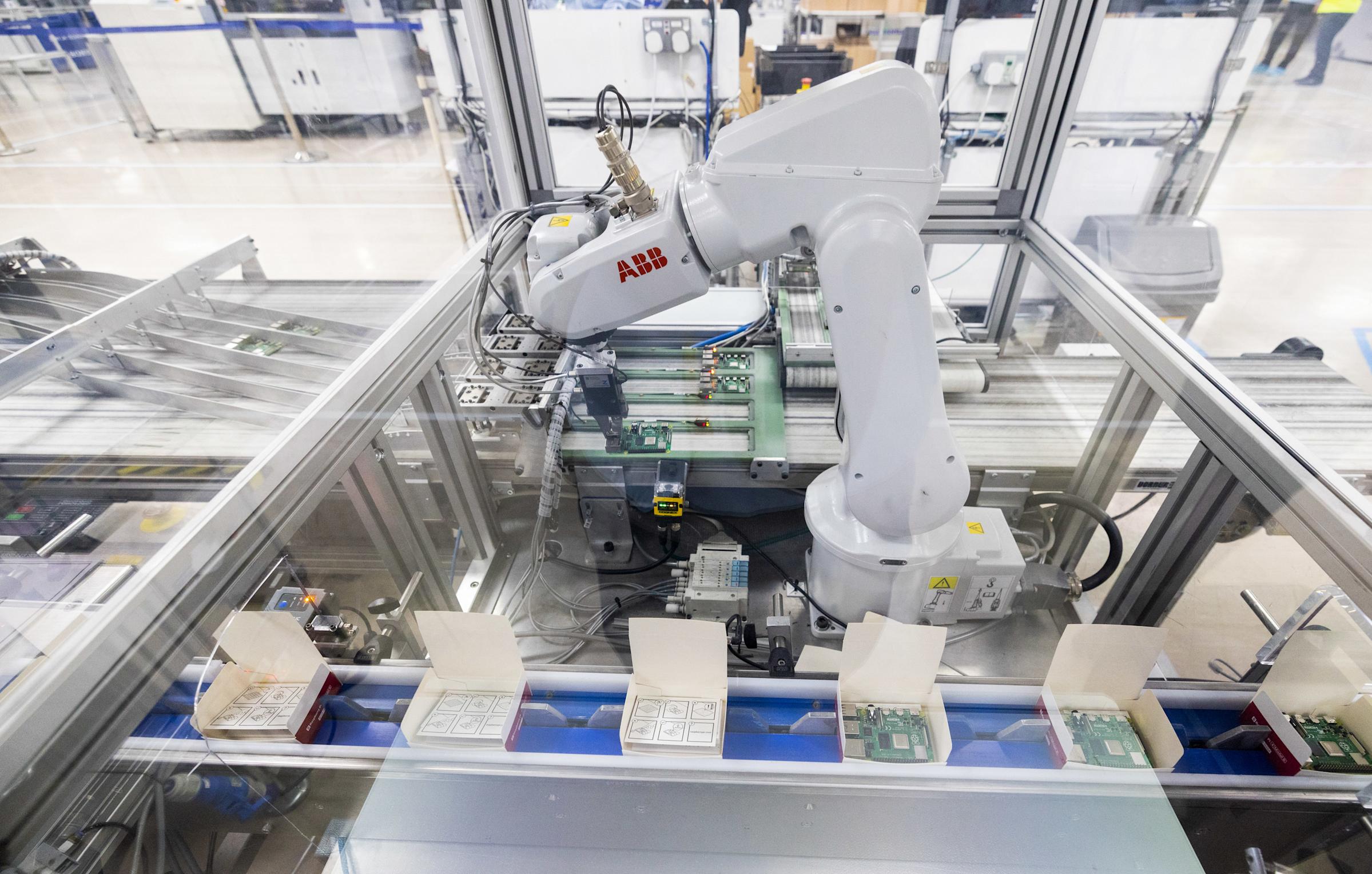

SoftBank has acquired ABB Group's robotics division, adding one of the world's largest industrial robot manufacturers to a portfolio that already includes Boston Dynamics. The deal signals SoftBank's conviction that physical AI — intelligent software embedded in machines that operate in the real world — is the defining technology battleground of the coming decade.
- What the SoftBank–ABB Deal Actually Involves
- SoftBank's Physical AI Playbook
- What Happens to ABB Industrial Robot Pricing?
- How the Used Robot Market Will React
- What This Means for Industrial Automation Buyers
- Frequently Asked Questions
What the SoftBank–ABB Deal Actually Involves
SoftBank is acquiring ABB's robotics and discrete automation division — the unit responsible for ABB's industrial robot arms, collaborative robots (cobots), and machine automation software. ABB's robotics business is one of the four largest in the world by installed base, with hundreds of thousands of robot arms deployed across automotive, electronics, food and beverage, and logistics industries globally.
ABB had previously explored spinning off or partially listing this unit, signalling that the parent company saw more value in focusing on its power and electrification businesses. SoftBank stepped in as the buyer, framing the acquisition as a direct extension of its physical AI strategy.
According to TechCrunch, SoftBank described the deal as helping it "dive deeper into robotics," positioning physical AI as "the next frontier." That language is deliberate — it frames this not as a hardware acquisition but as a platform play.
The financial terms of the deal have not been disclosed at the time of reporting.
SoftBank's Physical AI Playbook
SoftBank is not dabbling in robotics. It is systematically assembling the components of a vertically integrated physical AI stack — and this acquisition makes the architecture visible.
Consider what SoftBank now controls:
| Asset | Capability | Physical AI Role |
|---|---|---|
| Boston Dynamics | Humanoid and quadruped robots (Atlas, Spot) | Mobile, adaptive robot platforms |
| ABB Robotics | Industrial arms, cobots, automation software | Fixed-station and precision automation |
| Arm Holdings | Chip architecture (CPU/NPU designs) | Edge compute for robot intelligence |
| SoftBank Vision Fund portfolio | AI software companies across vision, planning, perception | Software stack for embodied AI |
This is a coherent strategy, not a collection of bets. Arm's chip designs power edge inference — the ability for a robot to process sensor data locally without a cloud round-trip. Boston Dynamics provides the mobile platform. ABB provides the industrial workhorse fleet and, critically, a massive installed base of customers who already trust their manufacturing lines to ABB hardware.
The missing piece has always been the software layer that makes these machines truly intelligent — capable of adapting to unstructured environments, understanding context, and operating alongside humans safely. That is where SoftBank's AI investments become relevant. The thesis is that SoftBank can inject Physical AI software — trained on foundation models, deployed via Arm chips — into both Boston Dynamics platforms and ABB's industrial fleet.
If that integration works, SoftBank would control end-to-end: the silicon, the robot body, and the intelligence layer. That is a genuinely rare position in the industry.
What Happens to ABB Industrial Robot Pricing?
For buyers evaluating ABB robot arms today, the near-term picture is one of continuity — but the medium-term trajectory deserves careful attention.
In the short term, ABB's product lines (the IRB series industrial arms, the GoFa and SWIFTI cobots, the YuMi dual-arm collaborative robot) will continue under existing support agreements. Enterprise customers with multi-year service contracts should not expect disruption to maintenance or spare parts supply chains based on this transaction alone.
The more significant pricing dynamic is what this acquisition does to the used ABB robot market. When a major manufacturer changes ownership, two things typically happen:
- Uncertainty-driven sell-offs: Facilities managers who are uncertain about long-term software support sometimes accelerate refresh cycles, flooding the secondary market with used units.
- Premium erosion on older models: If SoftBank repositions ABB's product line toward AI-enabled variants, older non-AI ABB arms may depreciate faster than usual as buyers hold out for next-generation models.
For buyers on a budget, this could represent a buying window. A used ABB IRB 6700 — a high-payload industrial arm widely used in automotive welding and material handling — currently trades in the secondary market for roughly $25,000 to $60,000 depending on condition, payload configuration, and included controller. If uncertainty drives a near-term supply increase, prices at the lower end of that range could become more accessible.
How the Used Robot Market Will React
Acquisitions of this scale tend to create secondary market ripples that buyers can exploit — if they act with the right timing.
The pattern with large robotics M&A is predictable: a period of uncertainty among existing ABB customers, followed by clarification of the roadmap, followed by stabilisation. During the uncertainty window — typically six to eighteen months post-acquisition — secondary market inventory tends to increase as facilities managers de-risk by rotating to known quantities or delaying new purchases.
For buyers considering used industrial robots, this uncertainty window is worth watching closely. ABB arms have a strong reputation for reliability and a well-established ecosystem of integrators, spare parts, and programming expertise. That ecosystem does not disappear with an ownership change. What does change is the roadmap for AI-enabled features and the long-term software support model.
Buyers should ask two questions when evaluating a used ABB robot in this environment:
- What controller generation does it run? ABB's IRC5 and OmniCore controllers have different upgrade paths. OmniCore is the platform more likely to receive AI-enabled software updates under SoftBank ownership.
- Is the application sensitive to software roadmap changes? For pure mechanical tasks — welding, painting, palletising — software evolution matters less. For vision-guided or adaptive tasks, roadmap continuity is critical.
What This Means for Industrial Automation Buyers
SoftBank's accumulation of robotics assets is ultimately good news for the automation industry — but the benefits will arrive unevenly and not immediately.
For large enterprise buyers: Expect ABB to eventually offer AI-enhanced capabilities integrated at the hardware level, potentially leveraging Arm-based edge compute. This could meaningfully improve the economics of deploying adaptive automation at scale, but it is a multi-year roadmap, not a product launch.
For mid-market manufacturers: The near-term opportunity is the secondary market. If uncertainty drives down used ABB pricing, facilities that have been priced out of ABB's industrial arms may find an entry point. ABB's cobots — particularly the GoFa series rated for 5 kg payload with a 950 mm reach — are competitive collaborative automation platforms at the right price point.
For system integrators: Watch SoftBank's software strategy closely. If they develop a unified AI platform spanning Boston Dynamics and ABB hardware, the integration toolkit for building solutions across both platforms could change significantly. Integrators who develop expertise in SoftBank's emerging Physical AI stack early will have a durable competitive advantage.
For buyers researching options now: Browse used cobots for sale on Robot Overflow to compare current secondary market pricing across ABB, Universal Robots, FANUC, and KUKA — useful context for evaluating where ABB sits in the competitive landscape as this deal develops.