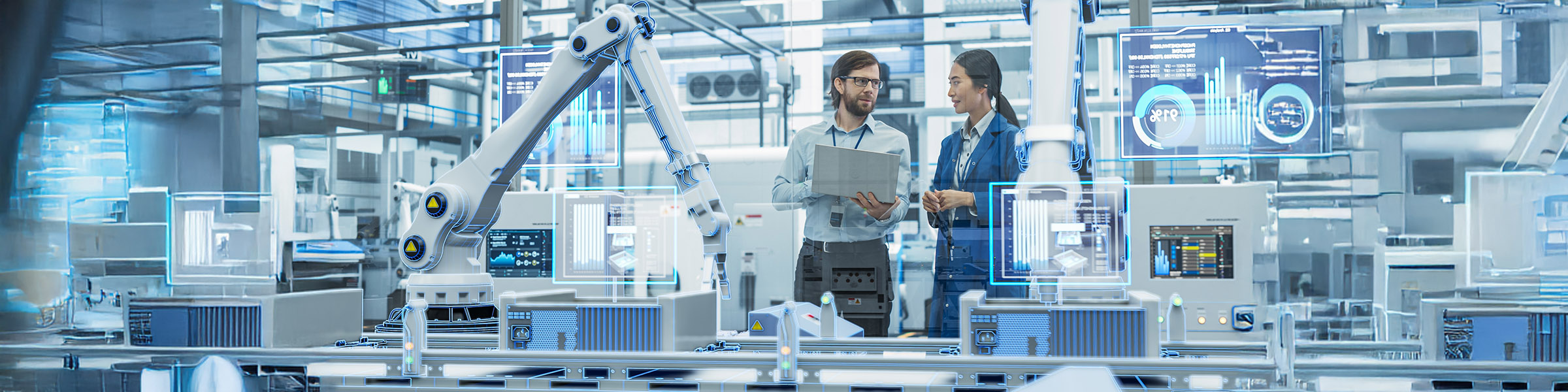

Most small manufacturers can't automate — not because robots are unavailable, but because programming them requires specialist engineers they can't afford. Czech startup RoboTwin is attacking that bottleneck directly, using handheld sensor devices and no-code software to let factory workers train industrial robots through physical demonstration, with a typical setup time of under a minute.
- What Is RoboTwin's Demonstration-Based Training System?
- How Does Imitation Learning Compare to Teleoperation and Simulation?
- Which Industries and Use Cases Does RoboTwin Target?
- What Funding Is Driving RoboTwin's Expansion?
- What This Means for Factory Automation Buyers
- Frequently Asked Questions
What Is RoboTwin's Demonstration-Based Training System?
RoboTwin's core product is a handheld sensor device that records a worker's physical movements during a task — such as spray painting a metal component — and converts that motion capture into a reusable robot programme. No code is written. The entire process typically completes in about a minute.
Founded in Prague in 2021 by mechanical engineer Megi Mejdrechová alongside colleagues Ladislav Dvořák and David Polák, RoboTwin targets the specific gap between "robots exist" and "we can actually deploy them." The company's CTO, Mejdrechová, developed the underlying technology during robotics research combining AI and computer vision, then commercialised it specifically for European SMEs (small and medium-sized enterprises).
"The robot basically copies the human demonstration," Mejdrechová told Robohub. "People with no coding skills can transfer their know-how and experience to robots."
What makes this technically significant is the handling of implicit motion — the small adjustments and instinctive gestures workers make that are notoriously difficult to specify through conventional programming. Traditional robot programming requires an engineer to explicitly define every waypoint and parameter. RoboTwin's system captures those micro-corrections automatically, embedded in the demonstration itself.
The system is compatible with a range of industrial robots, including collaborative robots (cobots) — machines designed with force-limiting sensors that halt motion when a human enters their operating envelope. This makes it viable for mixed human-robot environments where full enclosure isn't practical.
How Does Imitation Learning Compare to Teleoperation and Simulation?
RoboTwin's approach — learning from demonstration (LfD), also called imitation learning — is one of three dominant methods for training robots on new tasks without traditional programming. Each has meaningful trade-offs.
| Method | Setup Time | Specialist Required | Generalisation | Hardware Cost |
|---|---|---|---|---|
| Imitation Learning (RoboTwin) | ~1 minute | No | Low-medium | Low (handheld device) |
| Teleoperation | Minutes–hours | Moderate | Medium | Medium–high (haptic rigs) |
| Simulation + Reinforcement Learning | Days–weeks | Yes (ML engineers) | High | High (compute + sim licences) |
| Traditional Programming | Hours–days | Yes (robot programmers) | Low | Low (software only) |
Teleoperation — where a human remotely operates a robot in real-time to generate training data — is currently favoured by humanoid robot developers like Figure AI and Physical Intelligence (π0). It produces high-quality demonstrations but requires purpose-built hardware and a skilled operator. It also doesn't scale easily to factory-floor workers unfamiliar with robot control interfaces.
Simulation-based training, combined with reinforcement learning (RL), offers the best generalisation across object shapes and environments, but demands ML engineering expertise, high compute resources, and careful sim-to-real transfer to avoid performance gaps when the robot moves from virtual to physical environment.
RoboTwin's approach sits in the practical middle ground: fast, accessible, and sufficient for structured industrial tasks — particularly surface treatment processes where trajectories are repeatable and the environment is controlled. Its near-term roadmap also signals a move toward hybrid operation: using accumulated demonstration data and object geometry to generate programmes automatically without requiring a new demonstration for every product variant.
Which Industries and Use Cases Does RoboTwin Target?
RoboTwin has deliberately opened with the surface treatment sector — powder coating, spray painting, polishing — because it combines high automation demand with a chronic labour shortage.
According to Robohub, the automotive industry alone added approximately 23,000 new robots to production lines in 2024. Large OEMs drive that volume. The surface treatment suppliers feeding those factories — typically SMEs running small batches of varied parts — have been largely left behind, lacking the programming resources to justify automation.
RoboTwin has already deployed with several customers in this space:
- RobPainting (Netherlands) — a company specialising in robotic painting for SMEs, using RoboTwin's device to teach precise spray trajectories for varied product geometries
- Surfin Technology (Czech Republic) — a robotic coating solutions provider
- Innovative Finishing Solutions (Canada) — a North American channel partner extending the technology's geographic reach
The coating and painting use case is a strong technical fit for imitation learning. Unlike pick-and-place tasks — where object position variability demands robust perception — spray painting follows spatial paths that workers have refined through experience. Capturing that path fidelity through demonstration, including learned distance-from-surface and velocity adjustments, is exactly what LfD handles well.
Customers report that most robot programmes can now be created without halting the production line — a significant operational advantage for small-batch manufacturers who cannot afford extended downtime.
What Funding Is Driving RoboTwin's Expansion?
RoboTwin secured a €2.3 million grant from the European Innovation Council (EIC) in 2025, which will fund next-generation product development and expansion into new markets including Central Europe, the Netherlands, Mexico, and Canada.
Earlier backing came from Women TechEU, an EU scheme supporting women-led deep-tech startups. Visibility through the Horizon Results Platform — a showcase for EU-funded research outcomes — led to participation in the EU's Empowering Start-ups and SMEs initiative and a sponsored presence at Hannover Messe 2025, one of the world's largest industrial technology trade fairs.
Mejdrechová was named in Forbes Czechia's 30 Under 30 list in 2025, recognition that reflects both her technical contribution and the commercial traction RoboTwin has built in a short window.
The next development phase will move the system toward generative programme creation — using geometric data about an object's shape, combined with a library of previous demonstrations, to produce robot trajectories automatically. This would substantially reduce the number of live demonstrations needed per product and extend viability to higher-mix, lower-volume manufacturing scenarios.
What This Means for Factory Automation Buyers
For SME manufacturers currently priced out of automation, RoboTwin represents a genuinely different cost structure. The barrier has never been robot hardware alone — it has been the total cost of deployment, including programming labour, integration engineering, and ongoing reprogramming as products change.
No-code imitation learning directly attacks the reprogramming problem. If a new product variant requires a new robot path, a trained worker — not an outsourced robotics engineer — handles it in under a minute. For factories running tens or hundreds of product variants per month, the compounded time saving is substantial.
Where it fits best: - High-mix, low-volume surface treatment operations - Environments where workers already have tacit skill the robot needs to inherit - SMEs without in-house robot programming capability - Applications where trajectories are repeatable and environmental variation is limited
Where it fits less well: - Unstructured environments requiring adaptive perception - Tasks requiring force feedback precision beyond what motion capture resolves - High-generalisation requirements across drastically different object classes
If you're evaluating collaborative robots for surface treatment or light industrial automation, browse cobots available on Robot Overflow to compare platforms compatible with demonstration-based programming approaches. For heavier industrial robot applications in painting or coating, used industrial robots on Robot Overflow offer entry points that reduce capital expenditure while RoboTwin's software layer handles the programming challenge.