
Last updated: 2025
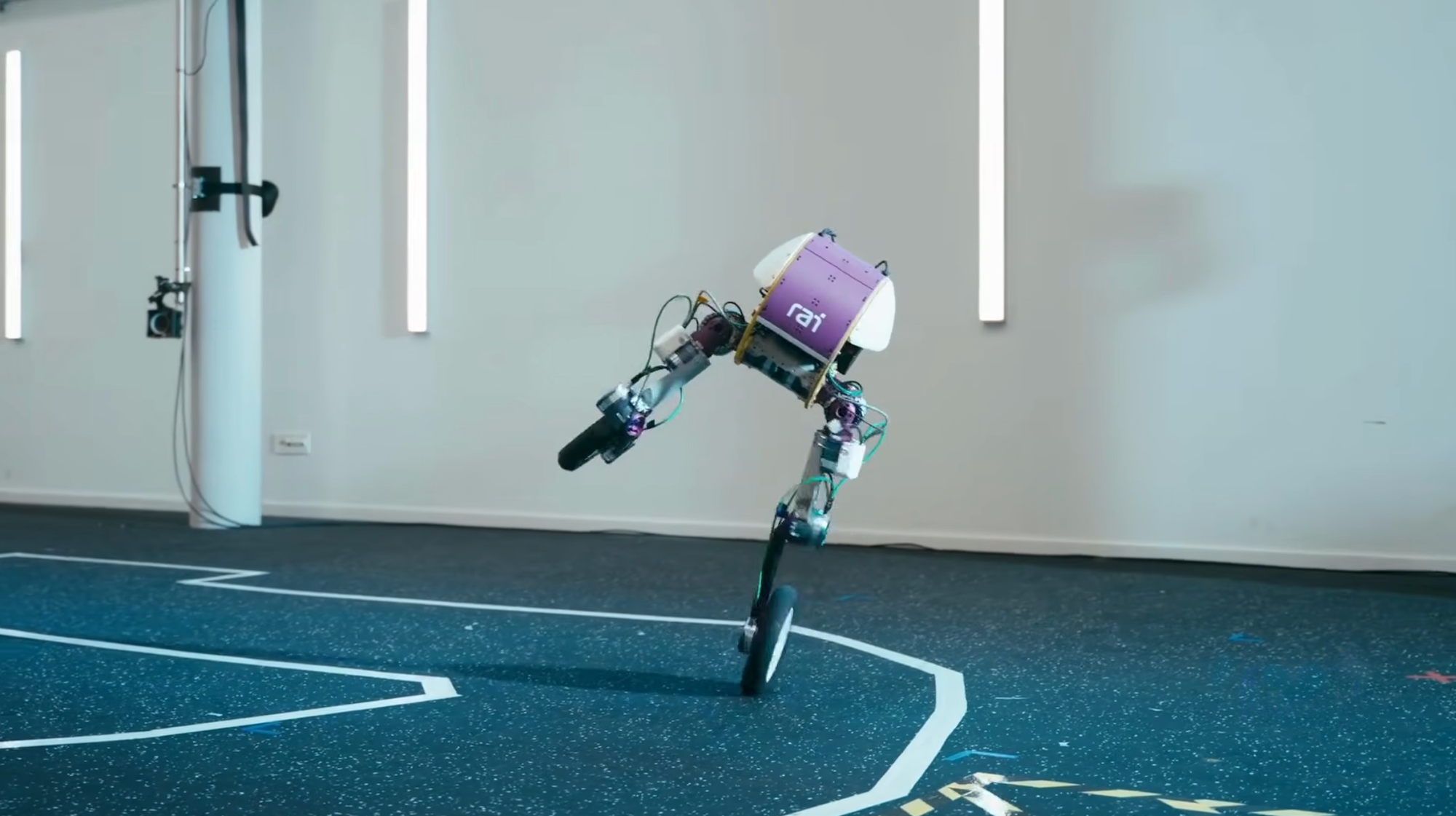
A new bipedal wheeled robot called Roadrunner can switch between side-by-side and in-line wheel configurations, step over obstacles, and balance on a single wheel — all governed by a single trained AI control policy. Developed at the Robotics and AI Institute, the 15 kg prototype represents a meaningful advance in multimodal locomotion and zero-shot policy transfer to physical hardware.
Table of Contents
- What is the Roadrunner robot?
- How does a single AI policy control both wheeled and legged movement?
- What makes Roadrunner's leg design different from other bipedal robots?
- Zero-shot deployment: why it matters for real-world robotics
- What This Means for Robotics
- Frequently Asked Questions
What is the Roadrunner robot?
Roadrunner is a 15 kg (33 lb) bipedal wheeled robot prototype built for multimodal locomotion — the ability to move using wheels, legs, or both simultaneously depending on environmental demands. Its defining feature is an architecture that lets it transition fluidly between a stable side-by-side wheel stance (like a self-balancing scooter) and a narrow in-line configuration (like a bicycle), while also lifting its legs to step over obstacles when rolling isn't an option.
The robot was developed by the Robotics and AI Institute and demonstrated publicly via IEEE Spectrum's Video Friday. According to IEEE Spectrum, the system's behaviors — including standing up from arbitrary ground positions and balancing on a single wheel — were deployed zero-shot on physical hardware, meaning the policy was never explicitly trained on those exact scenarios before real-world testing.
How does a single AI policy control both wheeled and legged movement?
A single control policy trained to handle both side-by-side and in-line driving is the core engineering claim here. Most multimodal robots require separate controllers for each locomotion mode, with hand-designed switching logic to bridge between them. Roadrunner collapses this into one unified learned policy that perceives the robot's state and selects appropriate outputs regardless of which configuration it is currently in.
In reinforcement learning terms, a control policy is a function that maps the robot's current state (joint angles, velocity, balance) to motor commands. Training a single policy across two geometrically distinct wheel configurations is difficult because the stability dynamics differ substantially: side-by-side (parallel) wheels behave like an inverted pendulum in one axis, while in-line (tandem) wheels behave like one in a perpendicular axis. Getting a neural network to generalise across both without mode collapse — where it learns to favour one configuration heavily — requires careful domain randomisation and reward shaping during simulation training.
The practical payoff is significant. A unified policy means no transition seam — the robot does not have a moment of vulnerability while handing off control from one mode to another. For real-world deployment in unstructured environments, that seam is often where failures occur.
What makes Roadrunner's leg design different from other bipedal robots?
Roadrunner's legs are fully symmetric, meaning the robot can orient its knees forward or backward interchangeably. This is a deliberate departure from human-inspired bipedal designs, which typically lock knee direction to mirror human anatomy. The symmetry gives the robot an expanded obstacle avoidance repertoire — a knee can be redirected mid-motion to clear a barrier that would require a full body reorientation in a conventional design.
Compare this to the design constraints of other bipedal wheeled robots in the field:
| Feature | Roadrunner | Typical Bipedal Wheeled Robot |
|---|---|---|
| Wheel configuration modes | 2 (side-by-side + in-line) | 1 (fixed) |
| Leg symmetry | Fully symmetric (bi-directional knees) | Asymmetric (fixed knee direction) |
| Locomotion policy | Single unified policy | Mode-specific controllers |
| Zero-shot hardware deployment | Yes | Rarely demonstrated |
| Mass | 15 kg | Varies (10–80 kg typical range) |
The symmetric leg design also matters for recovery behaviours. When a robot falls or finds itself in an unexpected ground configuration, asymmetric limbs constrain which recovery motions are physically possible. Roadrunner's bidirectional knees expand the state space of valid recovery postures, which is precisely why standing up from various ground configurations (rather than one canonical fallen pose) was achievable without explicit recovery-specific training.
Zero-shot deployment: why it matters for real-world robotics
Zero-shot deployment means the robot executed behaviours on physical hardware that were never explicitly rehearsed in that context during training. The policy generalised from its training distribution — almost certainly simulated environments — to real mechanical hardware without fine-tuning. This is a meaningful distinction from policies that require sim-to-real transfer loops, domain adaptation, or hardware-in-the-loop training runs.
Zero-shot transfer has become a benchmark of legitimacy in Physical AI research. The gap between simulation and reality — called the sim-to-real gap — involves discrepancies in friction, sensor noise, actuator latency, and contact dynamics that can render a perfectly functional simulated policy useless on metal and motors. Roadrunner's team demonstrating zero-shot success for non-trivial behaviours like single-wheel balancing suggests the policy was trained with sufficient domain randomisation to bridge that gap without additional calibration.
The caveat worth naming: zero-shot success in a controlled lab setting is not the same as robust deployment in a complex real-world environment. The demonstration videos show an indoor testing space. How the unified policy degrades on uneven outdoor terrain, under motor heating, or after component wear is an open question the prototype phase is not yet designed to answer.
What This Means for Robotics
Roadrunner is a research prototype, not a product. But the design choices it validates have direct implications for next-generation mobile robots targeting logistics, inspection, and last-mile navigation — precisely the environments where wheel-only robots get stuck and leg-only robots are inefficient.
The single-policy multimodal approach is the thread worth following. If this architecture scales — if a robot can learn to handle rough outdoor terrain, stairs, and flat corridors under one policy rather than a committee of specialised controllers — the operational complexity of deploying mobile robots drops substantially. Fewer failure modes at controller handoff points means higher uptime. Higher uptime means better ROI for buyers.
For teams evaluating used industrial robots or autonomous mobile platforms for facility navigation, Roadrunner's architecture represents a design philosophy to watch. The near-term commercial relevance is likely in warehouse and manufacturing environments where floor transitions — from smooth concrete to dock plates to outdoor aprons — currently require either constrained routing or expensive multi-modal hardware.
The symmetric knee design also hints at a broader rethinking of humanoid morphology. If knee direction is a design variable rather than a biological given, robot limbs can be tuned for mechanical versatility rather than human mimicry. That shift matters for the broader humanoid robot development trajectory, where many teams are discovering that human anatomy is not always the optimal template for machine bodies.