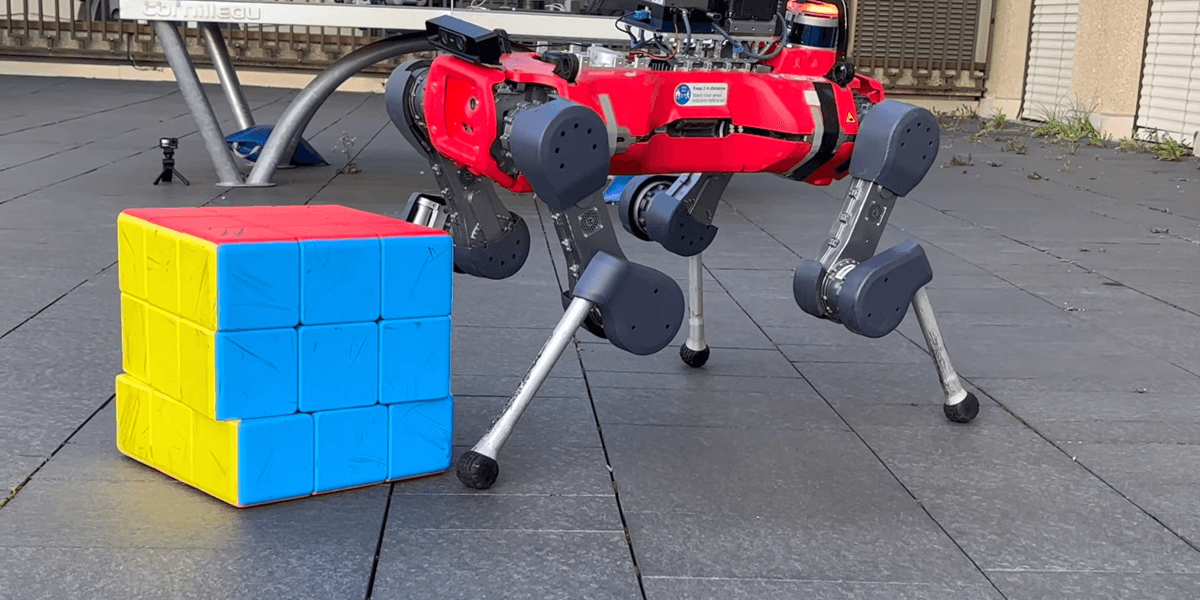

A quadruped robot autonomously solves a giant Rubik’s Cube using only its feet in a clip first reported by Spectrum. Reflex is a three-stage framework for visual, reactive whole-body control, a capability that remains challenging for humanoids and calls for anticipating a moving target before responding with the whole body within about a second.
Reflex learns the capabilities stage by stage and connects them through a compact representation of object dynamics. Its target actions include returning a tennis shot, catching a falling cup, stepping aside from a passing cart and passing a box tossed during truck unloading.
KAIST Humanoid v0.9 uses onboard visual feedback to push objects weighing up to 35 kg and lift objects weighing up to 20 kg while arranging the letters “KAIST.” DRCD Lab developed the humanoid in collaboration with RAILAB, which developed its arms.
AthenaZero has two three-fingered robot hands driven by tendons, with each finger powered by a motor in the robot’s torso to keep the hand light. The fingers interdigitate to hold objects of different sizes, such as an egg or a hammer; the hands close in about 80 milliseconds and can be gentle with highly accurate barometric pressure sensors.
The selection places foot-only cube solving alongside examples of object pushing, lifting and holding.
A biohybrid item describes centimeter-scale bioactuators combining lab-grown skeletal muscle with a soft, 3D-printed scaffold. The work co-optimizes the muscle and scaffold together; the resulting actuators achieve up to 11x more range of motion than previous systems of comparable tissue volume.
SuperMimic surpasses the return of a state-of-the-art motion tracker baseline trained for 7 days on 128 GPUs after 3 hours on a single GPU. It reduces GPU-hours by more than 1000× and fails on 25 of 129,514 benchmark motions, versus 179 failures for the baseline; after 9.8 hours on two GPUs, it achieves zero failures.