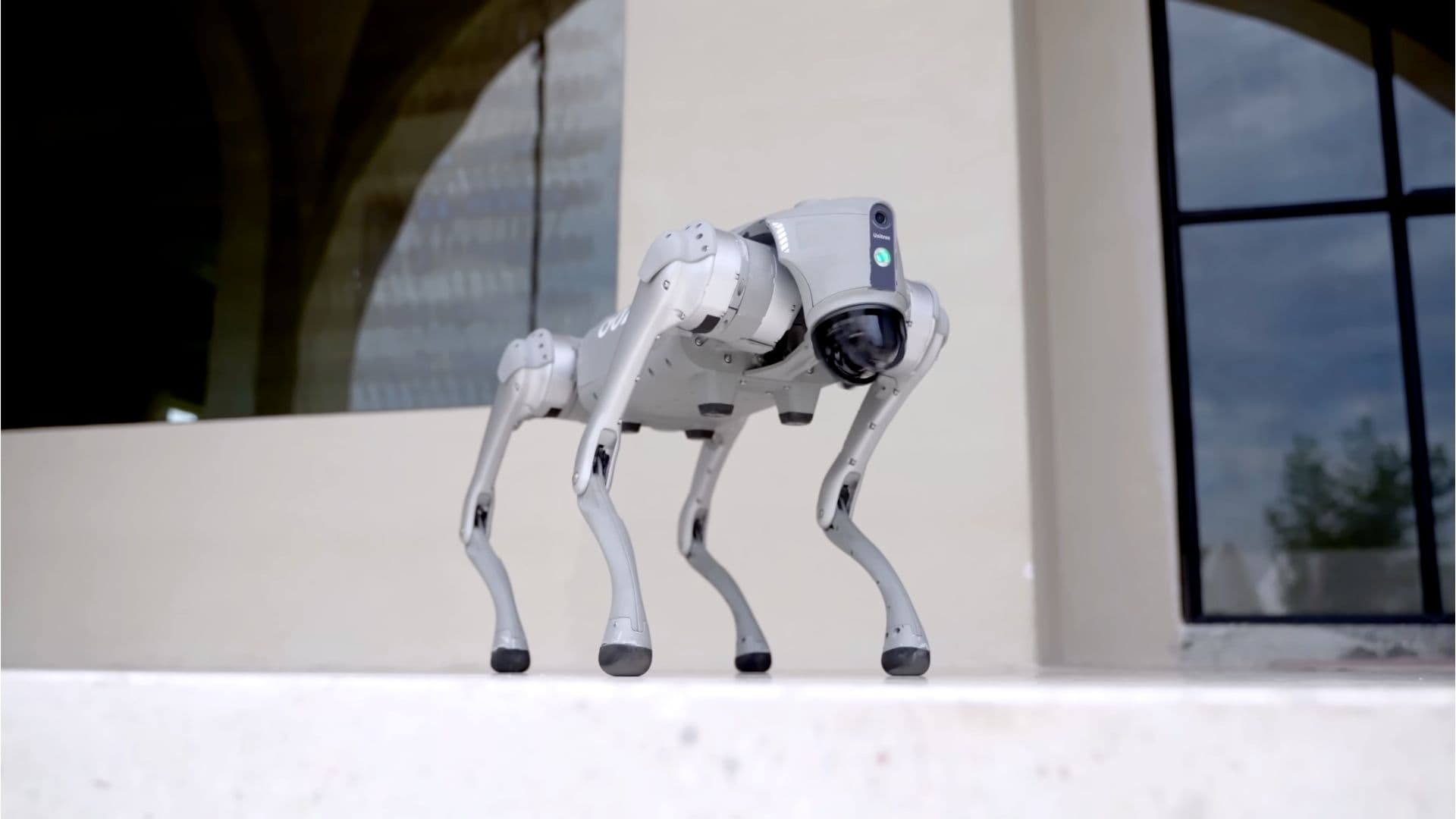

Researchers trained one quadruped policy to perform 22 tasks using eight teachers, in a study first reported by Arxiv. That repertoire includes skills such as walking, digging and hopping, which the method can compose into novel behaviors such as crawling; the resulting policy was deployed on a Unitree B1 quadruped.
The pipeline begins with multiple teacher policies, each trained through reinforcement learning on a narrowly defined task. In the next two stages, multi-teacher distillation uses those teachers to train a student policy, with a combined reinforcement-learning and imitation-learning objective. Adversarial task selection directs training toward the worst-performing task.
Reinforcement learning has enabled legged robots to perform a range of skills in single-task settings, but applications such as farm robotics and space exploration require diverse capabilities. Those include locomotion, digging and close-range surveying; sample inefficiency and gradient conflict between tasks make end-to-end multi-task training difficult.
Evaluations found that the method preserved motion quality and tracked commands more accurately than PPO and distill-then-finetune baselines. In some cases, the student generalized to new tasks without explicit training.
The method concentrates a broad task repertoire in one student policy while each teacher is trained on a narrowly defined task. The resulting policy was deployed on a Unitree B1 quadruped to demonstrate real-world robustness.