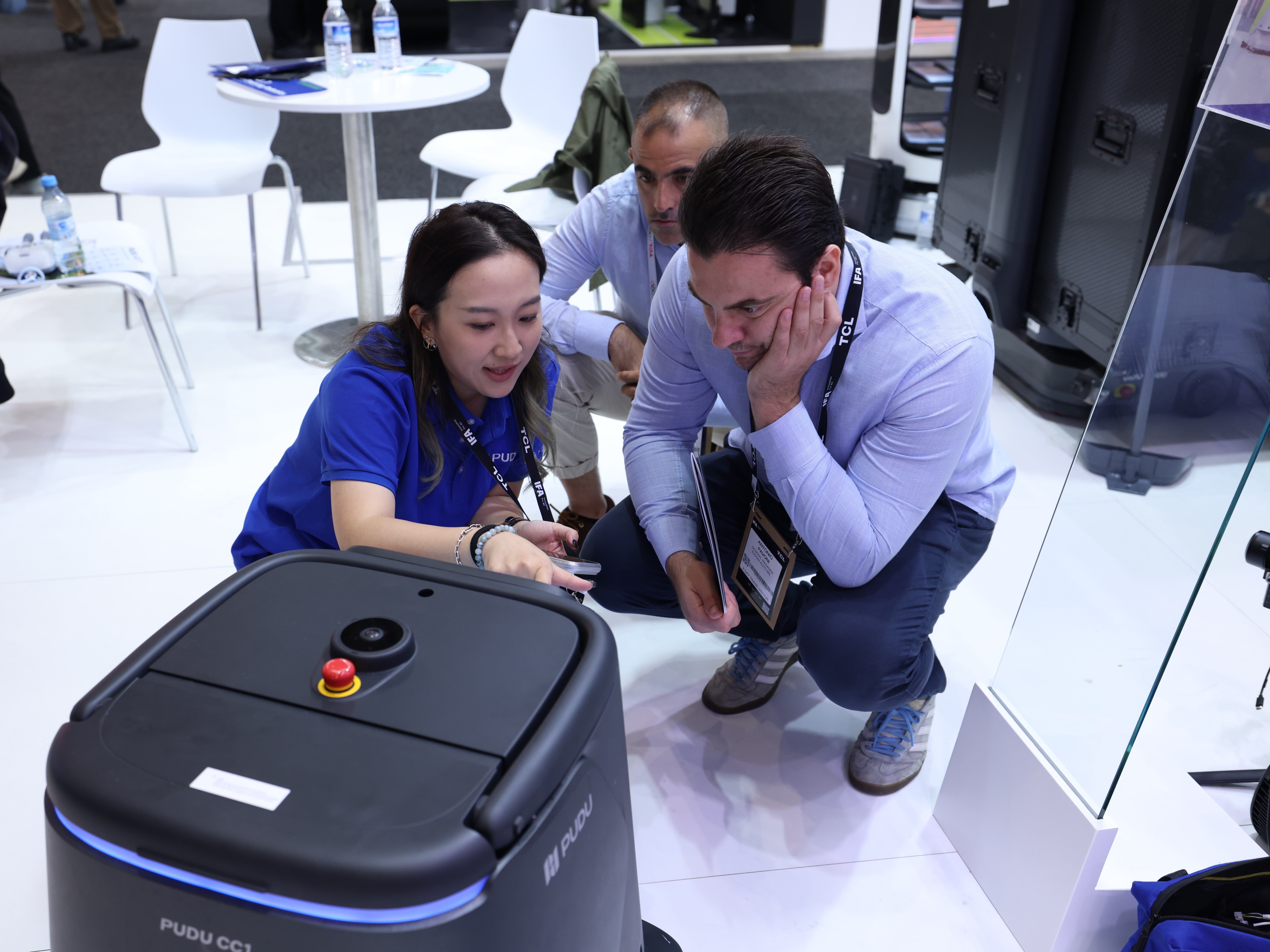

Pudu Robotics introduced its “One Brain, Multiple Embodiments” strategy and presented six product lines together for the first time at its Amsterdam summit, first reported by Roboticsandautomationnews. The approach is built around reusing AI and software across different robot forms while keeping hardware and motion control tailored to the needs of specific tasks.
At the center is a shared architecture built on PuduFM, an Embodied Foundation Model, and PuduAgent OS, an Embodied AI Agent Platform. It is designed to reuse AI capabilities, software modules and skills across platforms while allowing hardware and motion-control systems to stay optimized for specific tasks.
The six lines cover service delivery, commercial cleaning, industrial delivery, general embodied AI, commercial lawn mowing and home lawn care. The home-care line includes the PUDU TOMO S Series, announced November 3 as Pudu’s first consumer robotics product.
The portfolio varies by job and setting; the strategy’s shared layer is reusable AI and software across different robot forms. Pudu says sharing the underlying technologies can reduce R&D and deployment cycles and costs, and make adoption more practical for customers.
Pudu says its technologies serve 16 industries and more than 900 application scenarios. The company operates in more than 20 European countries, where its revenue grew by an average of more than 60 percent annually over the past two years.
Pudu announced the establishment of its European headquarters in Germany on October 30. The regional hub brings together offices, a showroom, warehousing, training, sales, after-sales support and repair services.
Bella Sun, Pudu’s vice president and general manager for Europe, said the company wants Europe to be among the first markets where the strategy is put into practice.