

Palantir CEO Alex Karp went on CNBC last week to warn that enterprises are wasting money on tokens from OpenAI and Anthropic while risking their intellectual property. The rant ignited debate over enterprise AI ROI, but Fortune's reporting argues his critique is self-serving, inaccurate in key ways, and reveals more about his own company's competitive fears than the real state of AI adoption.
- What Karp Said
- The ROI Reality
- Are AI Labs Stealing IP?
- Why Karp Has Reason to Worry
- What This Means for the Industry
- Frequently Asked Questions
What Karp Said
During a scheduled CNBC appearance to discuss a new Palantir-Nvidia partnership for sovereign AI infrastructure, Karp pivoted sharply. "Something has gone completely wrong," he said. "The basic view among enterprises in this country is 'I'm going to chillax and waste my time with tokens, I'm going to get no value, and they're going to get my IP.'" He insisted he was "not throwing shade" before unloading on both OpenAI and Anthropic.
Karp also questioned the token-based pricing model used by frontier AI labs. "Why are they charging for tokens, if it is so valuable?" he asked, suggesting that vendors should instead charge a percentage of the value delivered — precisely the model Palantir itself uses for its Artificial Intelligence Platform (AIP). The message resonated with some business leaders already frustrated by rising AI costs, but it also conveniently promoted Palantir's own approach.
The ROI Reality
Are enterprises genuinely wasting money on AI tokens? The truth is more nuanced. Many large companies are indeed concerned about return on investment, particularly when using advanced models for agentic use cases that consume large numbers of tokens. But that concern contradicts Karp's claim that they are simply "chillaxing."
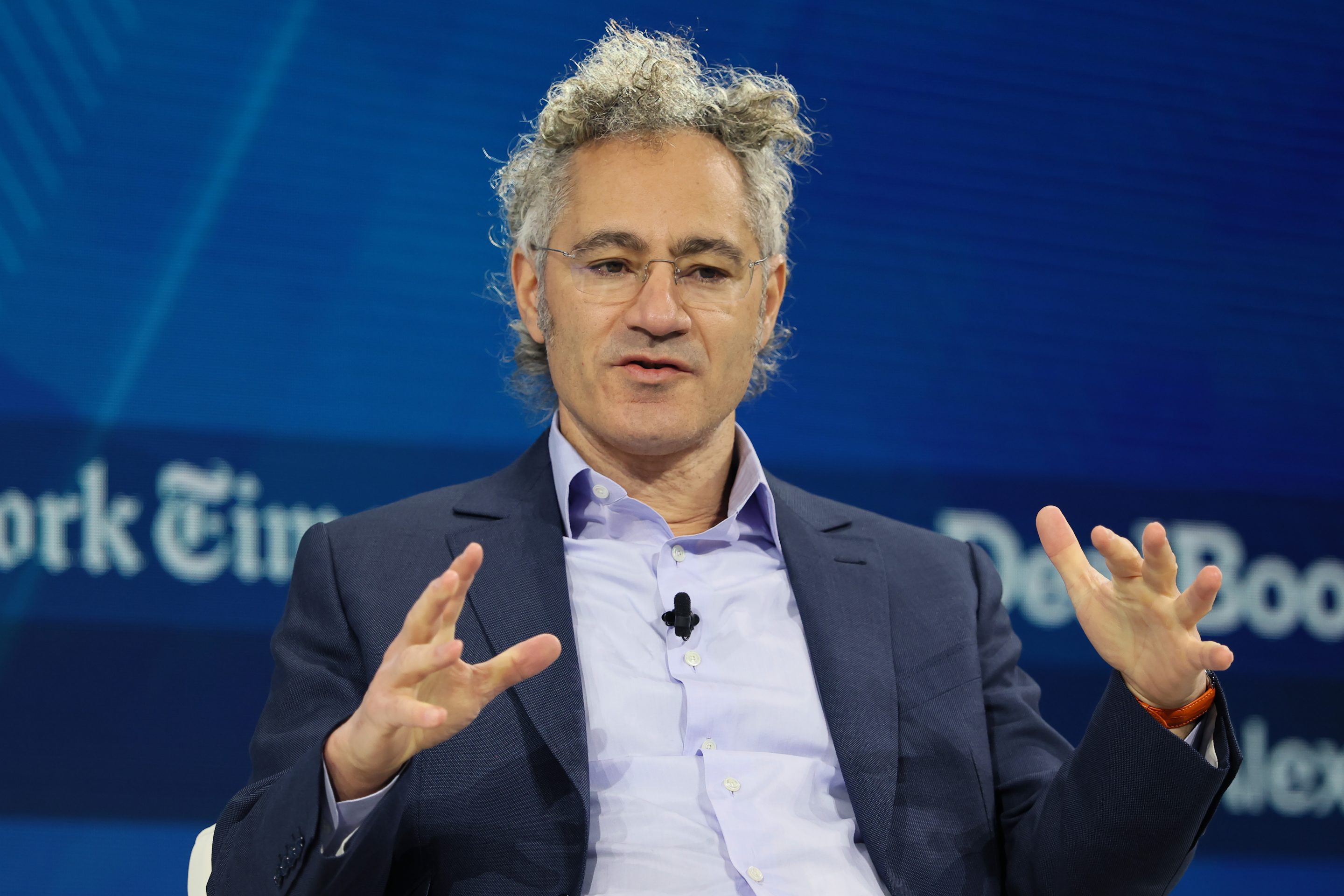
According to a PwC study cited in Fortune's reporting, some enterprises are reporting significant value — especially in software development and customer service. The real problem, the report suggests, is that many companies haven't prioritized the most strategically important use cases or redesigned workflows to fully capture AI's benefits. That's not a failure of the technology so much as a failure of implementation.
Furthermore, Karp's attack on token pricing ignores how general-purpose software has always worked. Microsoft doesn't charge a percentage of the deal you win from an impressive PowerPoint deck; it charges a flat fee for Office. Electric utilities charge per kilowatt-hour, not based on the value of what you power. A value-based pricing model for frontier AI models would be unprecedented and likely unworkable for most enterprises.
Are AI Labs Stealing IP?
Karp's most alarming claim — that enterprises risk handing their intellectual property to AI vendors — lacks solid evidence, according to Fortune's reporting. Both OpenAI and Anthropic have policies stating they do not directly access enterprise customers' prompts, outputs, or data for model training unless customers explicitly opt-in. For customers accessing models through secure cloud services like Microsoft Azure, Amazon Bedrock, or Google Vertex — the standard path for large enterprises — even anonymized usage data is not collected.
But there are exceptions that give Karp's argument some traction. The most notable is the Figma case: Anthropic had been collaborating with design tool Figma and Canva on a "Claude for Design" tool. According to The Information, Figma pulled out of the launch after discovering Anthropic's product competed more directly with its own features than disclosed. Figma CEO Dylan Field reportedly told a private event that Anthropic was "not consistently candid" about the scope of its design tool.

Other allegations come from investors with known axes to grind. Venture capitalist Jason Calacanis, an early Palantir backer, has claimed Anthropic used data from Cursor — an AI coding assistant that heavily used Claude models — to develop its rival product Claude Code. Chamath Palihapitiya, another Palantir supporter, has pointed to Anthropic's partnerships with pharmaceutical companies followed by its announcement of its own drug development program. However, Anthropic says this is about building better tools for science, not competing directly in drug discovery.
For the vast majority of Fortune 500 companies — think Boeing or Archer-Daniels-Midland — the risk that OpenAI or Anthropic will steal their IP and build competing products is essentially zero.
Why Karp Has Reason to Worry
If most of Karp's arguments don't hold up, why is he so agitated? A financier interviewed by Fortune offered a compelling theory: it's not about enterprise waste — it's about upcoming IPOs.
Both OpenAI and Anthropic are expected to go public, and institutional demand will be enormous. To raise cash to buy shares in those highly anticipated offerings, many investors may sell existing tech holdings — and Palantir is a prime candidate. Karp's public attacks on the frontier labs may be a preemptive effort to defend his company's stock from being dumped in favor of these AI giants.
Even Microsoft CEO Satya Nadella has recently made similar complaints about the "rapacious nature" of frontier AI labs, suggesting the concern runs deeper than one company's self-interest. But for Palantir, the stakes are uniquely high: its valuation depends on being seen as the essential AI platform for enterprises and governments — a position that could be eroded if OpenAI or Anthropic become more directly competitive.
What This Means for the Industry
The Karp rant highlights a growing tension in enterprise AI. On one side, companies are spending heavily on AI tokens and services without clear ROI frameworks — a problem that will need to be solved through better measurement and workflow redesign. On the other, the business models of both AI vendors and their customers are still evolving, and the question of who captures the value from AI deployments remains unsettled.
For investors, the coming IPOs of OpenAI and Anthropic represent both an opportunity and a reshuffling of the tech landscape. Expect more public feuds between established players and emerging AI giants as the market works out who owns what.
For enterprises, the lesson is clear: focus on high-value use cases, secure your data through appropriate cloud configurations, and approach vendor partnerships with care — but don't let fear of IP theft paralyze AI adoption.
Conclusion
Alex Karp's CNBC rant captured attention but failed to deliver a coherent critique of enterprise AI. While ROI concerns are real, the evidence does not support claims of widespread waste or systematic IP theft. Karp's real fear may be less about his customers' token bills and more about what the upcoming IPOs of OpenAI and Anthropic will do to Palantir's market position. The enterprise AI market is maturing, and the loudest voices often have the most to lose.