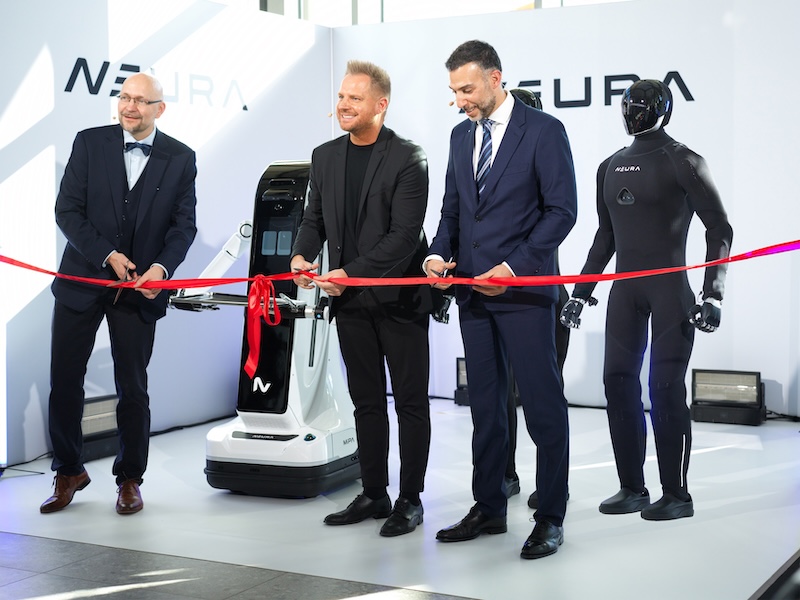

Neura Robotics and the Technical University of Munich opened a €17 million robotics research and training center near Munich Airport, first reported by Roboticsandautomationnews. The facility combines research, training and industrial applications, giving companies a place to bring real industrial tasks into a setting where robots can learn and test new skills.
The TUM RoboGym powered by Neura covers more than 2,300 square meters at LabCampus and was built with TUM’s Munich Institute of Robotics and Machine Intelligence (MIRMI). Companies from more than ten industries are already involved, including automotive, pharmaceuticals, medical technology, packaging, logistics, agriculture and care.
Tasks being trained include handling cardboard boxes, filling bottles, and loading and unloading wooden components. Neura founder and CEO David Reger said companies’ accumulated know-how matters to physical AI: “People know how to work materials, assemble components and master difficult processes.”
The RoboGym generates physical-AI training data through real-world robot operation, human demonstrations and simulation. Human workflows can be captured using sensor-equipped data suits, motion capture and teleoperation, while virtual environments provide additional variations that can later be validated using physical robots. Neura’s Neuraverse connects the training infrastructure with the company’s software and AI tools.
Together, the methods span physical robot operation, human demonstrations and simulated variations, with physical robots used to validate those variations.
Neura also introduced 4NE1 Gen 4, the latest version of its humanoid. The company says it is 20 percent lighter than its predecessor, with a slimmer body, sensorized textile outer skin, more advanced hands and Smart Limbs capable of responding independently to their surroundings.
4NE1 Gen 4 runs Neuron AI, Neura’s Perception-Language-Action model, which uses inputs including vision, touch, force and sound to translate perception into movement. The humanoid is being prepared for series production and is already being used at Neura Gym facilities.
The initiative is initially planned to run for three years. Neura and TUM are investing around €17 million, with approximately €11 million coming from Neura. The RoboGym is intended to become the first in an international network of Neura Gyms, with further locations being established in Europe, the United States and China. Another German facility is being developed with RWTH Aachen.