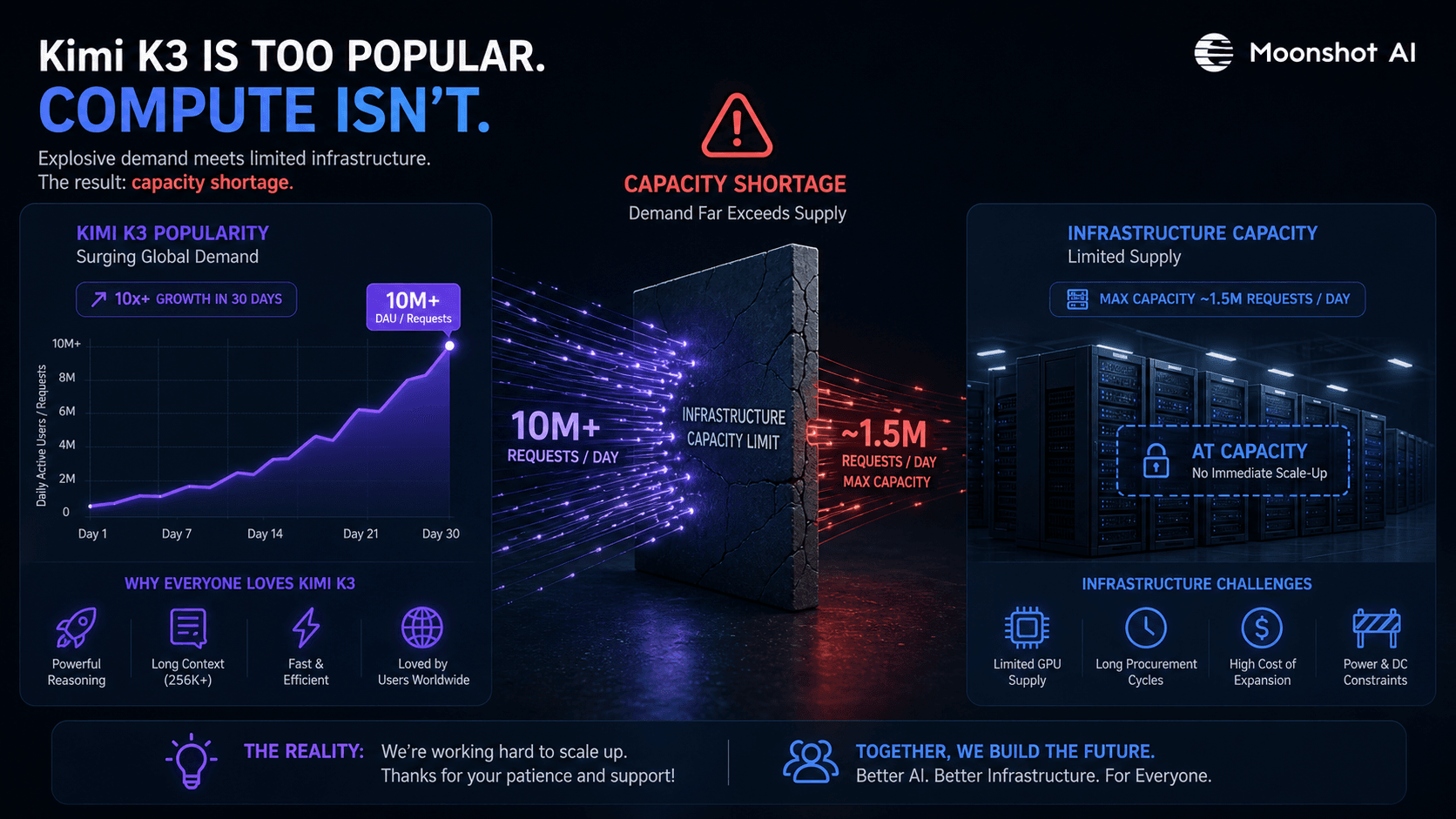

Moonshot AI suspended new consumer subscriptions for its Kimi AI assistant just days after launching the Kimi K3 model, as surging demand pushed the company’s compute infrastructure to its limits. The move highlights the acute compute crunch facing AI companies as user adoption rapidly outpaces data center buildout.
- What Happened: Kimi K3 Launch Sparks Capacity Crisis
- How Moonshot AI Is Handling the Crisis
- Why It Matters: The AI Compute Bottleneck
- Competitive Context: The Race for Inference Infrastructure
- What’s Next for Moonshot AI and Kimi Users
- What This Means for the Industry
- Frequently Asked Questions
- Conclusion
What Happened: Kimi K3 Launch Sparks Capacity Crisis
Moonshot AI, the Chinese startup behind the popular Kimi AI assistant, released its latest model — Kimi K3 — earlier this week. Within 48 hours of launch, user requests surged far beyond the company’s projections, pushing its existing compute cluster close to maximum capacity.
The company posted a public statement titled “To Kimi Users: An Update on Compute Capacity Constraints and Subscription Suspension,” confirming that new consumer subscriptions have been halted with immediate effect. According to TechNode, Moonshot AI is dedicating all available computing resources to existing subscribers to ensure their membership benefits and service experience remain unaffected.

The suspension applies only to consumer (C-end) subscriptions. It is unclear whether Moonshot AI’s enterprise or developer tiers are also affected, though the company’s statement specifically cited consumer demand as the primary driver.
How Moonshot AI Is Handling the Crisis
Moonshot AI said it will not accept new consumer subscriptions until it can add sufficient compute capacity. The company is likely scrambling to procure additional GPU servers and cloud capacity, but the timeline for restoration remains undisclosed.
Existing subscribers will see no interruption in service. The company has promised to “fully safeguard” their member benefits, suggesting that current users are being prioritized at the expense of new customer acquisition. Moonshot AI may also explore throttling free-tier usage to free up capacity, though no such measures have been announced.
The situation mirrors a pattern seen across the AI industry: product launches generate massive demand spikes that existing infrastructure cannot handle, forcing companies into triage mode.
Why It Matters: The AI Compute Bottleneck
The Kimi K3 capacity crisis is the latest example of the widening gap between AI model sophistication and the physical compute infrastructure needed to run them at scale. Inference — the process of running a trained model to generate responses — is far more compute-intensive than training for many large language models, especially as models grow in size and capability.
Kimi K3 is reported to be a significant upgrade over its predecessor, likely handling longer contexts and more complex reasoning tasks. Each query requires substantial GPU compute time, and when millions of users simultaneously begin interacting with the new model, data centers can quickly become saturated.
The Kimi K3 episode underscores a structural weakness in today’s AI economy: even well-funded startups can struggle to scale inference compute fast enough to meet real-world demand. Moonshot AI has raised hundreds of millions of dollars from investors including Alibaba and Tencent, yet still faced capacity constraints.
Competitive Context: The Race for Inference Infrastructure
Moonshot AI is not alone. Competitors like Baidu’s Ernie Bot, ByteDance’s Doubao, and other large Chinese AI assistants have also faced demand surges, though few have publicly suspended subscriptions. The difference may be that Kimi’s user base is growing faster than its infrastructure, partly thanks to the K3 model’s improved performance.
Globally, OpenAI, Anthropic, and Google have all experienced service degradation during peak usage. OpenAI has repeatedly throttled free-tier access and introduced usage caps. Anthropic had to impose rate limits after Claude 3 launch. The Kimi K3 suspension is a more extreme response: outright halting new subscriptions.
This suggests Moonshot AI’s compute procurement may be less flexible than its competitors. The company likely relies on reserved cloud GPU instances from Alibaba Cloud or other providers, and scaling up requires lead times of weeks or months given the global GPU shortage.
What’s Next for Moonshot AI and Kimi Users
Moonshot AI has not provided a timeline for resuming new consumer subscriptions. The company will likely negotiate additional compute capacity — either from cloud partners or by buying more hardware. Given the current GPU supply constraints, that process could take anywhere from weeks to months.
Existing subscribers can continue using Kimi K3 without interruption, but the suspension will slow user growth, potentially giving rivals like Alibaba’s Tongyi Qianwen or ByteDance’s Doubao an opening to capture users looking for advanced AI assistants.
The company may also introduce a waitlist or tiered pricing to manage demand when subscriptions reopen. Another possibility: Moonshot AI could launch a premium tier with dedicated compute to guarantee access, as OpenAI did with ChatGPT Plus.
What This Means for the Industry
The Kimi K3 capacity crisis sends a clear signal to investors and competitors: AI infrastructure spending is not keeping pace with demand. Companies that cannot scale inference compute quickly risk losing users at the worst possible time — right after a major product launch.
- For investors: This is a reminder that AI startups need not just great models but also robust compute supply chains. Valuations may increasingly factor in infrastructure readiness.
- For competitors: Moonshot AI’s vulnerability is an opportunity. Rivals with excess capacity can target Kimi users who find themselves locked out.
- For the broader tech industry: The suspension highlights that compute is becoming a strategic bottleneck akin to chip supply. Hyperscalers like Google, Microsoft, and Amazon may see increased demand for flexible cloud GPU instances.
The incident also raises questions about the sustainability of AI subscription models. If a single model launch can overwhelm infrastructure, companies will need to plan for demand spikes with pre-provisioned buffer capacity — adding significant cost.
Conclusion
Moonshot AI’s decision to suspend new consumer subscriptions after the Kimi K3 launch reveals a raw nerve in the AI industry: demand for inference compute is outstripping supply at an alarming rate. The company’s scramble to add capacity will be closely watched as a test case for how AI startups manage explosive growth. For now, existing users can use Kimi K3 as normal, but new users will have to wait — a reminder that in the age of AI, even the best model is only as good as the infrastructure running it.