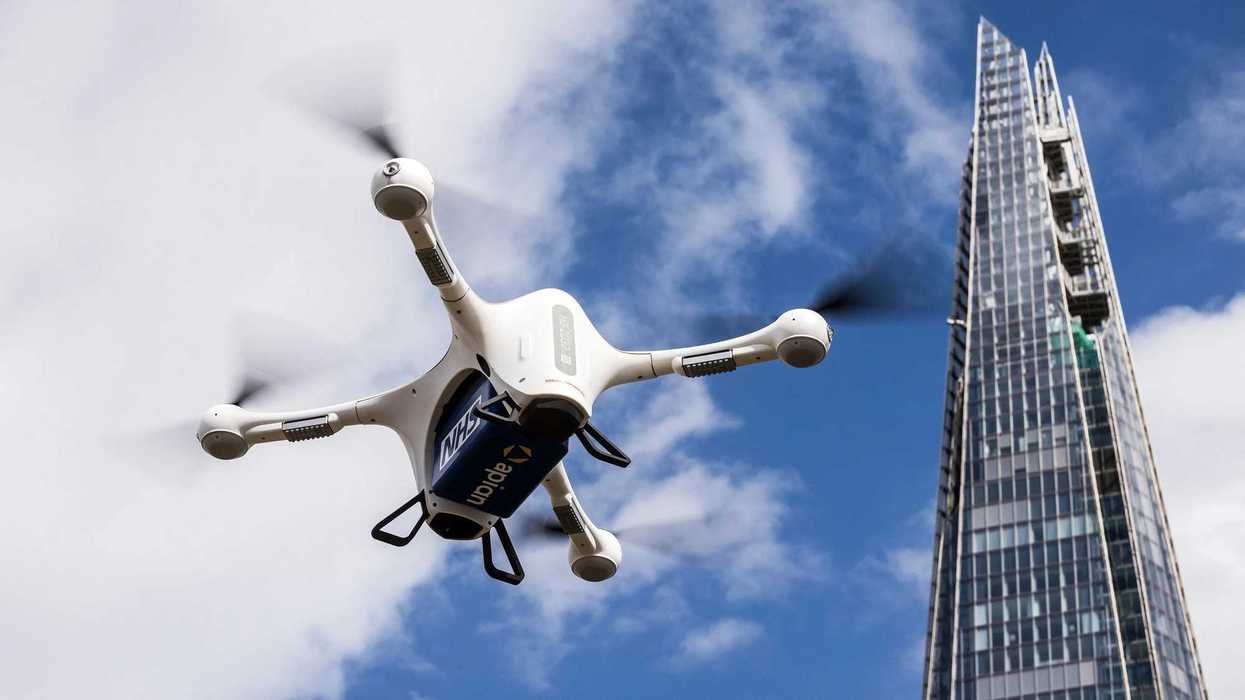

Matternet's M2 drone system is now flying medical payloads between Central London hospital campuses in partnership with autonomous healthcare logistics provider Apian — marking the California firm's UK debut and the NHS's first operational urban drone delivery network. The launch is a concrete proof point that autonomous aerial systems can function reliably inside the world's most complex urban environments, not just controlled test corridors.
- What Is the Matternet–Apian NHS Drone Network?
- How Does the M2 System Work in Urban Healthcare Logistics?
- Why London Is a Critical Test for Urban Physical AI
- What This Means for Robotics and Autonomous Delivery
- Frequently Asked Questions
What Is the Matternet–Apian NHS Drone Network?
Matternet and UK-based Apian have launched a bi-directional aerial delivery service connecting two major Central London hospital campuses, transporting diagnostic samples, laboratory specimens, pharmaceuticals, and other time-critical medical items. The network replaces congested ground courier routes with autonomous aerial hops measured in minutes rather than the unpredictable delays of London's road network.
Apian describes itself as building an "autonomous logistics infrastructure layer" for the NHS — essentially the software, regulatory frameworks, and operational integration that turn drone hardware into a reliable hospital service. Matternet supplies the M2 drone platform and the urban flight operations expertise it has refined over years of deployments in Switzerland and the United States.
The partnership matters beyond its immediate clinical utility. Apian Co-Founder and CEO Alexander Trewby framed the ambition explicitly: "We are laying the foundations for physical AI to operate at scale in the real world, starting with the NHS." That framing positions this not as a logistics project with drones bolted on, but as an early instantiation of physical AI — autonomous systems making consequential decisions in uncontrolled real-world environments.
How Does the M2 System Work in Urban Healthcare Logistics?
Matternet's M2 is a purpose-built urban delivery drone with a roughly 2 kg payload capacity, designed specifically for high-frequency, short-range medical logistics in dense environments. Unlike cargo drones optimised for rural last-mile delivery, the M2 prioritises flight reliability, regulatory compliance, and integration with existing healthcare workflows over raw range or lift capacity.
The London deployment runs bi-directional routes — drones can fly in both directions between campuses, not just outbound — which matters for return logistics like specimen containers and pharmaceutical trays. According to DC Velocity, the system is designed to reduce delays, improve hospital workflows, and lower emissions compared to ground transport through congested city streets.
| Capability | Detail |
|---|---|
| Platform | Matternet M2 |
| Payload types | Diagnostic samples, specimens, pharmaceuticals |
| Route configuration | Bi-directional between hospital campuses |
| Environment | Central London urban airspace |
| Operator | Apian (NHS integration layer) |
| Matternet prior deployments | Switzerland, United States |
The integration layer Apian provides is arguably as important as the drone itself. Connecting autonomous aerial hardware to NHS hospital workflows — scheduling, tracking, chain-of-custody, and clinical handoff protocols — requires the kind of software and regulatory work that rarely makes headlines but determines whether a drone deployment is a pilot or a permanent infrastructure service.
Why London Is a Critical Test for Urban Physical AI
Central London is not a forgiving operating environment. Dense airspace, variable weather, overlapping regulatory jurisdictions, and the political sensitivity of flying autonomous systems over one of the world's most populated urban cores make this a genuinely difficult deployment context — which is exactly why it matters as a validation signal.
Earlier medical drone deployments — Matternet's Swiss partnerships with hospitals in Basel and Lugano, Zipline's US hospital networks, Wing's suburban Australian routes — operated in comparatively lower-complexity airspace. Central London raises the bar substantially on every dimension: population density, air traffic management coordination, and public scrutiny.
Successfully operationalising the M2 inside this environment under NHS clinical standards does something that controlled demonstrations and rural pilots cannot: it establishes that the regulatory, technical, and operational stack for urban physical AI is production-ready, not just prototype-ready.
This distinction is significant for the broader robotics and autonomous systems industry. The gap between "successfully demonstrated" and "operationally deployed at scale in critical infrastructure" has historically been wide. Every month this network runs without incident narrows that gap and builds the regulatory precedent that enables expansion — to additional campuses, additional payload types, and eventually other NHS trusts outside London.
What This Means for Robotics and Autonomous Delivery
For the autonomous delivery sector, the NHS partnership is a reference deployment in the most credibility-demanding vertical available. Healthcare logistics has zero tolerance for reliability failures — a delayed diagnostic sample or misrouted pharmaceutical has direct clinical consequences. If Matternet's M2 can meet NHS service standards in Central London, the case for autonomous delivery in less demanding commercial verticals becomes substantially easier to make.
For physical AI as a category, this is the kind of infrastructure-level deployment that separates the concept from the hype. Autonomous systems operating continuously in uncontrolled real-world environments, integrated with institutional workflows, under regulatory oversight — that is what physical AI at scale actually looks like. It is unglamorous compared to a humanoid robot demo, but it is operationally more mature.
For competing autonomous delivery providers — Zipline, Wing, Joby's cargo ambitions, and emerging European players — a validated urban NHS deployment creates both a competitive benchmark and a regulatory template. UK Civil Aviation Authority frameworks developed for this deployment will likely inform how other operators seek urban approvals.
For the NHS itself, the emissions and speed case is straightforward: London's road congestion means ground courier times are both slow and unpredictable, while aerial routes between fixed campus locations are deterministic. As the network scales to additional hospital campuses and payload types, the operational ROI case will sharpen.
Those tracking the broader autonomous delivery landscape can also browse industrial and logistics robots on Robot Overflow to understand where ground-based autonomous systems sit relative to aerial alternatives for last-mile and campus logistics.