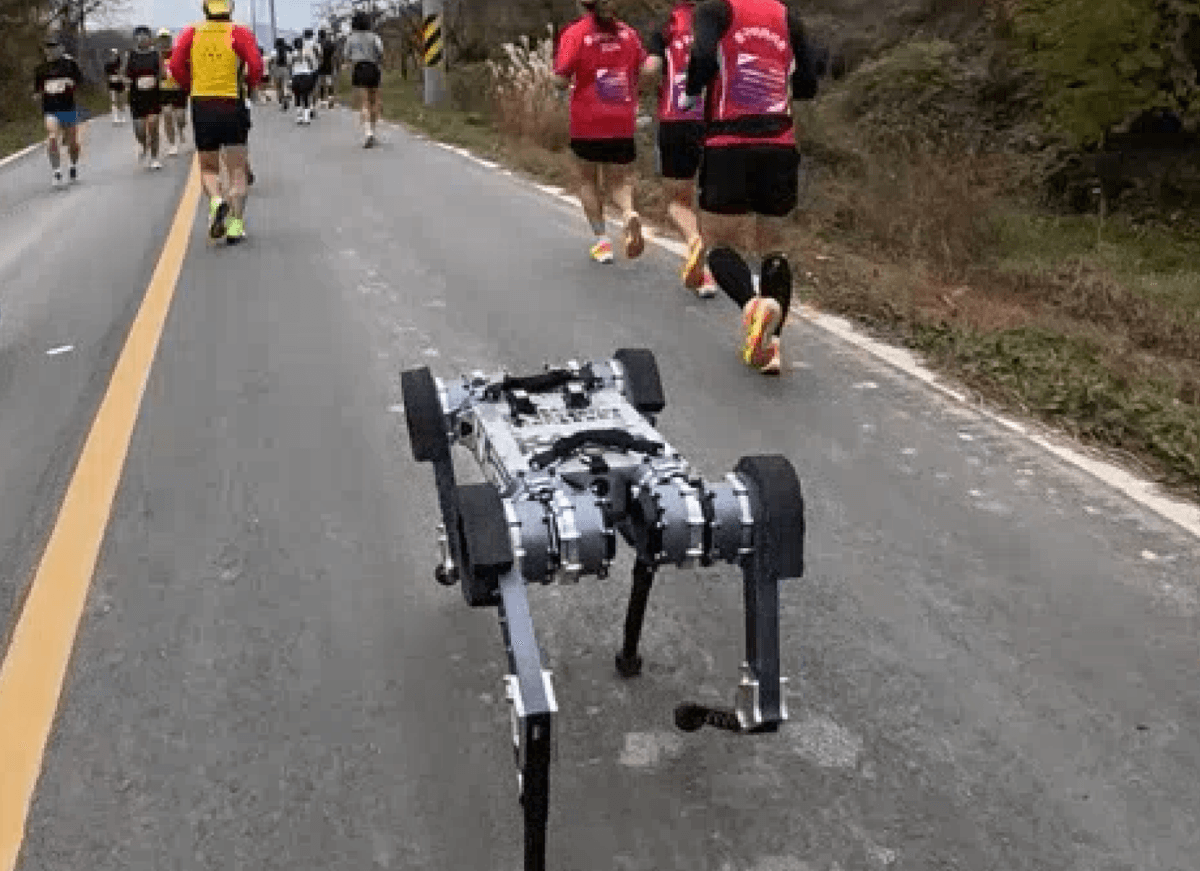

A KAIST team demonstrated RAIBO2 completing the Sangju Marathon on one battery charge, first reported by Techxplore. The demonstration matters because recent quadruped robots have been limited to approximately 20 kilometers, while longer operational ranges could improve the usefulness of legged machines that may assist rescue operations in mountainous or disaster-stricken areas.
The four-legged robot completed the course in 4 hours and 19 minutes alongside human runners, maintaining an average speed of 2.64 meters per second (5.9 miles per hour). The route included 286 meters (938 feet) of elevation change and slippery sections of terrain.
Legged robots must continuously spend energy supporting their body weight and compensating for energy lost with each step. That burden helps explain why recent quadruped robots have been limited to approximately 20 kilometers, unlike robots on wheels.
RAIBO2 addresses that range problem through hardware and software: lightweight legs, optimized motor-driving circuits and movement rules reinforced by machine learning. The design is intended to reduce energy loss and extend the distance the robot can travel between charges.
After the marathon, RAIBO2 had used 1,280 watt-hours and achieved an average total cost of transport of 0.25, a measure of energy expended during motion that factors in the robot’s weight. The paper’s authors propose that RAIBO2 is the first quadruped robot with a lower cost of transport than the human value of 0.37.
That gives the demonstration two distinct efficiency markers: marathon distance on one charge and a transport cost below the human reference. RAIBO2’s total battery capacity was 2,016 Wh, and the authors estimate that it could have traveled a further 25 kilometers (16 miles).
The robot travels approximately three times as far per battery charge as existing quadruped robots. The findings aim to extend the operational ranges and utility of legged robots, which have potential to assist in rescue operations in mountainous or disaster-stricken areas.