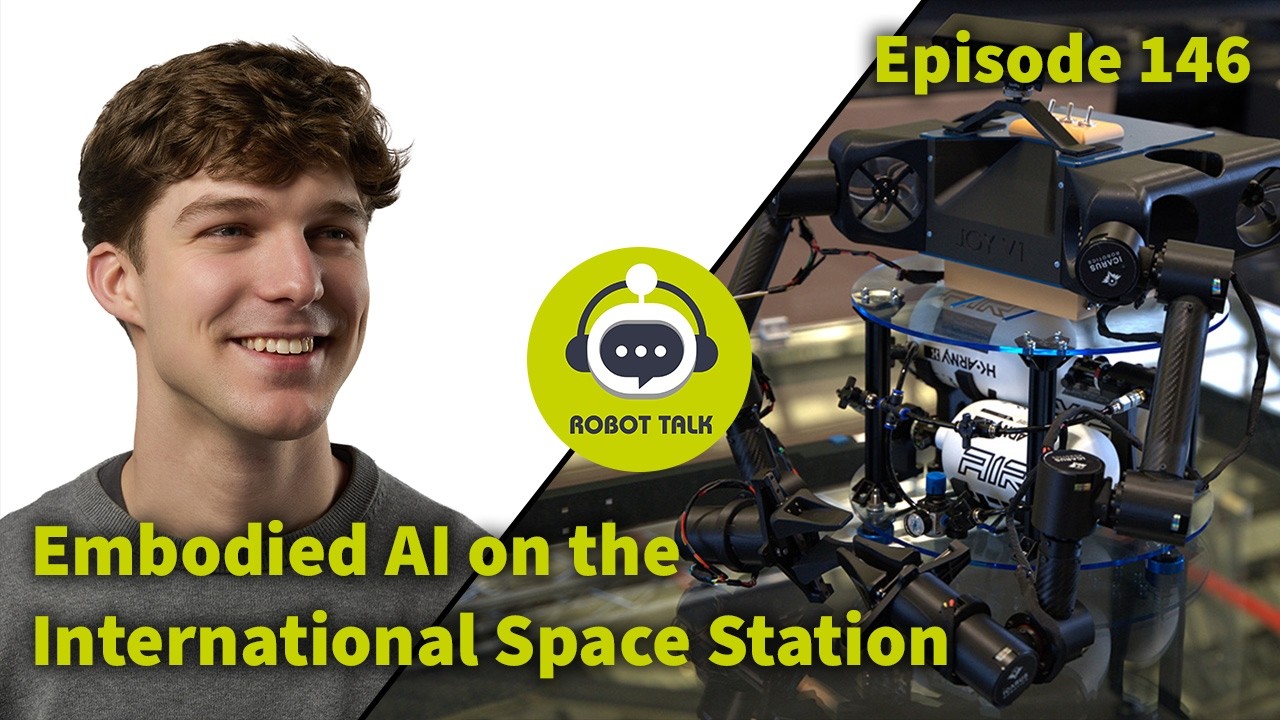

Icarus Robotics is building a robotic labour force for the International Space Station — and the manipulation challenges they're solving in microgravity may be the hardest testbed embodied AI has ever faced. Jamie Palmer, co-founder and CTO, argues that every constraint space imposes on a robot maps directly back to unsolved problems in terrestrial humanoid development.
- Why Space Is the Ultimate Stress Test for Embodied AI
- What Icarus Robotics Is Actually Building
- The Microgravity Manipulation Problem
- What ISS Robotics Teaches Earth-Based Humanoids
- What This Means for Robotics and Automation
- Frequently Asked Questions
Why Space Is the Ultimate Stress Test for Embodied AI
Space robotics strips every assumption out of conventional robot design. There is no gravity to stabilise a grasp, no easy human override when something goes wrong, and latency makes teleoperation impractical. If your manipulation stack cannot handle genuine uncertainty — in object pose, contact dynamics, and environmental state — it fails visibly and expensively.
That is precisely why what Jamie Palmer and Icarus Robotics are engineering for the ISS matters beyond the space industry. The International Space Station is a confined, cluttered, safety-critical environment full of non-cooperative objects, awkward reach geometries, and zero tolerance for dropped hardware. Sound familiar? It should — those are the same constraints that make warehouses, hospitals, and construction sites so resistant to robotic automation.
Palmer's background makes him unusually positioned to attack this problem. He holds a Master's in Robotics from Columbia University, where he researched intelligent dexterous manipulation in the ROAM lab. He then deployed autonomous hospital robots during the COVID-19 pandemic — arguably the most chaotic real-world robotics deployment of the last decade — before working as a race-winning engineer at the Mercedes-AMG Petronas Formula One team, an environment where hardware reliability under extreme conditions is non-negotiable.
What Icarus Robotics Is Actually Building
Icarus Robotics is developing a robotic labour force designed to perform routine and high-risk tasks aboard the ISS, reducing astronaut time spent on maintenance and inspection work that currently consumes a significant share of crew hours each day.
The core design philosophy centres on dexterous manipulation in unstructured environments — robots that can interact with existing ISS hardware without requiring that hardware to be modified. This "manipulation-first" approach is a deliberate departure from space robotics systems that typically require purpose-built interfaces, fixtures, or specially marked objects for robots to interact with reliably.
The distinction matters enormously. Legacy space robotic systems — including the Canadarm2 and JAXA's HTV robotic arm — excel at large-scale, pre-planned operations with well-characterised payloads. Icarus is targeting the opposite end of the task spectrum: the routine, unplanned, close-quarters work that currently requires a human in a spacesuit or an astronaut crawling through a module.
The Microgravity Manipulation Problem
Grasping in microgravity breaks most assumptions baked into manipulation algorithms trained or tested on Earth. Here is why that matters technically.
On Earth, gravity provides a constant, predictable force that helps seat objects in a grasp and stabilise them against disturbances. In microgravity, that stabilising force disappears. Any contact force a robot applies to an object will propagate as a reaction force through the robot's own body — which is itself floating unless anchored. This means every manipulation action is simultaneously a locomotion problem. The robot must control its own position and orientation while controlling the object it is interacting with, treating them as a coupled dynamic system.
This is a significantly harder version of the manipulation problem than anything most Earth-bound robotic systems face. It demands:
| Challenge | Earth Context | ISS/Microgravity Context |
|---|---|---|
| Grasp stability | Gravity assists seating | Zero passive stabilisation |
| Reaction forces | Robot base absorbs them | Propagates through floating body |
| Object pose estimation | Gravity constrains resting poses | Arbitrary 6-DOF object states |
| Error recovery | Drop and retry | Floating object drift, potential collision |
| Latency tolerance | Teleoperation viable | Round-trip delay makes autonomy mandatory |
The practical implication: any manipulation AI that works reliably on the ISS has been forced to solve contact-rich, uncertainty-aware dexterous manipulation without crutches. That is exactly the capability gap holding back humanoid robots in cluttered terrestrial environments.
What ISS Robotics Teaches Earth-Based Humanoids
The lessons flowing from space robotics back to humanoid development are more direct than most people in the industry acknowledge.
Consider the reaction force problem. When a humanoid robot in a warehouse reaches to pick an object off a shelf, it faces a simplified version of the same coupling problem — the robot's arm motion shifts its centre of mass, which affects balance, which affects the precision of the reach. Most current humanoid platforms handle this with conservative motion planning and wide safety margins. The microgravity case, where this coupling is extreme and unavoidable, forces researchers to solve it properly rather than engineer around it.
Palmer's pandemic hospital deployment adds another layer. Hospitals share critical ISS characteristics: confined corridors, non-standard objects (IV poles, medical equipment, patient belongings), human operators who are busy and cannot babysit the robot, and consequences for failure that are genuinely serious. His path from hospital deployment to space deployment is a studied escalation of environmental difficulty — each step removing another assumption the robot is allowed to make.
For teams developing humanoid robots for industrial and logistics applications, the Icarus work points toward a methodological insight: design for the hardest version of the problem first. Robots that learn manipulation under maximum constraint generalise better to easier environments than robots trained on simpler settings and then pushed toward harder ones.
The reinforcement learning and sim-to-real transfer communities have reached a similar conclusion through empirical work — domain randomisation at training time, which artificially makes the training environment harder and less predictable, consistently produces more robust real-world policies. ISS robotics is, in a sense, the physical embodiment of maximum domain randomisation.
What This Means for Robotics and Automation
For robotics engineers, the Icarus Robotics approach is a signal that dexterous manipulation in unstructured environments is approaching commercial deployment readiness — not just in research labs, but in the harshest operational environment available. That credibility gap between lab demos and real-world deployment has been the persistent obstacle for manipulation-heavy robotics applications.
For industrial buyers evaluating used cobots and automation hardware, the relevant takeaway is about capability trajectory. The manipulation capabilities being stress-tested on the ISS today typically propagate into commercial cobot and humanoid platforms within a three-to-seven year window. Investments in flexible, manipulation-capable automation platforms now position facilities to absorb capability upgrades as the underlying AI matures.
For the broader physical AI ecosystem, space robotics represents an underappreciated data source. Every hour a robot operates on the ISS generates contact-rich manipulation data in a domain where the physics are unambiguous and well-instrumented. That data, if accessible to the research community, could meaningfully accelerate the manipulation capabilities of Earth-based systems.
The Formula One engineering background Palmer brings to Icarus also carries a practical signal for hardware development. F1 is one of the few commercial domains where hardware reliability, software iteration speed, and performance under uncertainty must all be maximised simultaneously under strict resource constraints. Those are exactly the engineering tradeoffs that define capable, deployable robotics systems.