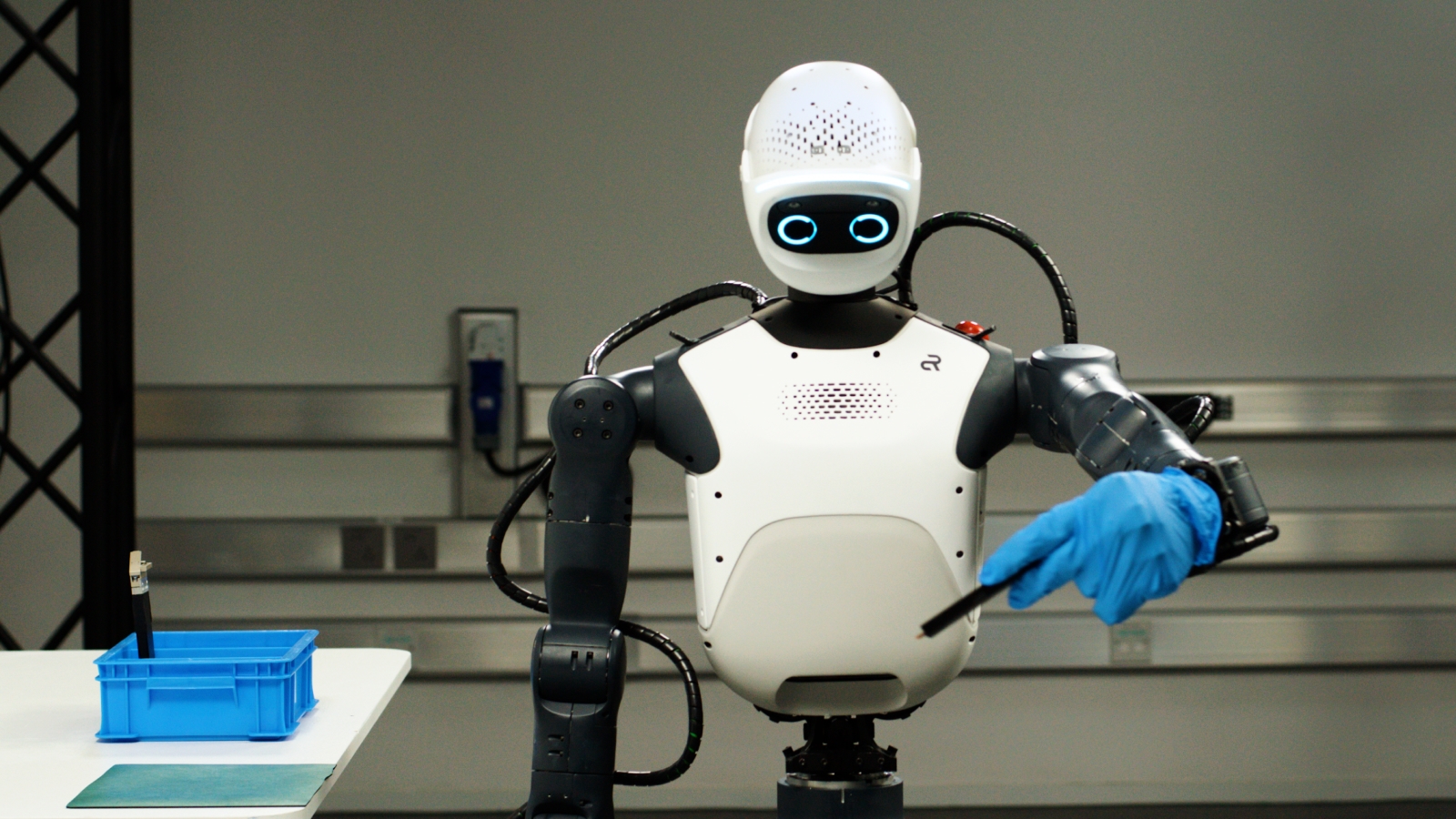

Humanoid is expanding its Nvidia collaboration to develop a high-performance robotic edge runtime for its next-generation humanoid robots, first reported by Roboticsandautomationnews. The system is intended to process sensor data and run AI onboard, coordinating perception, reasoning and control so the robots can respond to the physical world in real time.
The build includes Nvidia Jetson Thor for onboard compute, Nvidia Isaac OS, Nvidia Holoscan Sensor Bridge and Holoscan SDK. Humanoid already uses Nvidia Isaac Lab and Nvidia Isaac Sim to train and simulate models before deploying them on physical robots, linking that work to real-world operation.
Jetson Thor is a key part of the architecture: Humanoid has consolidated two onboard computers into one system while maintaining computing capacity, with potential additional headroom in the future. Its unified CPU and GPU memory reduces unnecessary data movement and latency and simplifies how workloads share computing resources.
Holoscan Sensor Bridge creates a faster path from the robots’ sensors to AI models. Camera data can be placed directly in GPU-accessible memory, reducing data copies and CPU workload and enabling lower-latency processing across perception, inference and control.
Isaac OS, an open, deterministic runtime framework, provides a GPU-native runtime for coordinating multiple robotics workloads. Multi-Gigabit Ethernet provides up to 100Gb of bandwidth for sensor data and command and control signals; together, the technologies are intended to reduce hardware and software complexity and make the platform easier to develop, test and scale.
Humanoid’s stack links training and simulation before deployment to onboard computing during robot operation, while Jetson Thor consolidates two computers and maintains computing capacity. The companies will continue working together as Humanoid advances its platform and prepares its next generation of robots for increasingly complex real-world applications.