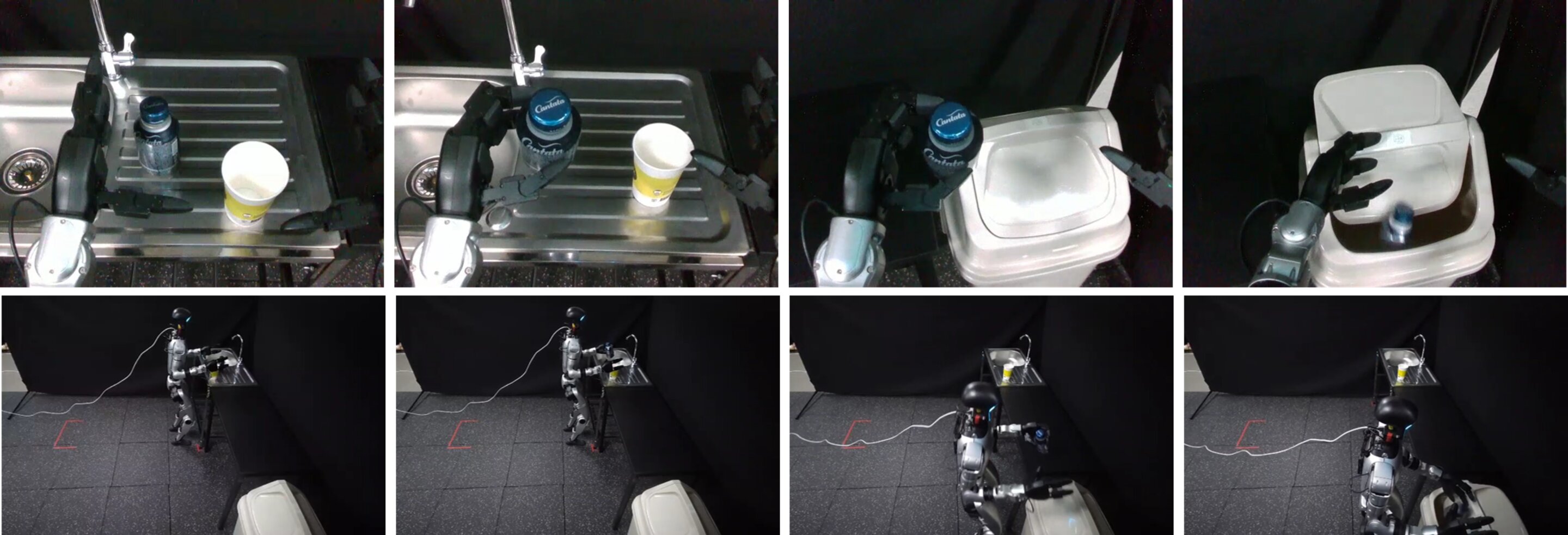

Researchers at Seoul National University developed RISE, a humanoid AI system that links separately demonstrated walking and object handling, first reported by Techxplore. In tests, it completed multistage tasks without demonstrations covering transitions between the behaviors, reaching 50.0% average success on a real robot versus 30.0% for the GR00T-based baseline.
RISE was developed by a team led by Professor Songhwai Oh at Seoul National University. It combines a shared model that interprets visual and language input with multiple action experts and a meta-controller that coordinates them.
During training, experts that predict the current action more accurately receive higher responsibility and greater influence, allowing them to specialize in locomotion or object manipulation without preset roles. During execution, changes in the expert weights signal when the current behavior has ended and the next predefined task should begin.
Collecting full sequences is harder than recording walking, picking and placing separately: a failure midway can leave a demonstration incomplete. Separate examples also do not tell the model when to stop one behavior and start another.
Simulation trials covered two- to four-stage tasks involving apples, bottles and cups, including sequences that combined moving, picking up and placing objects. RISE averaged 87.3% success, compared with 73.6% for a GR00T-based baseline using a single expert.
On a real Unitree G1 equipped with two Dex3-1 hands and 43 controllable degrees of freedom, RISE averaged 50.0% success on tasks with two, four and up to five stages, compared with 30.0% for the GR00T-based baseline. RISE performed more reliably than the baseline as the number of stages increased.
The research was accepted for IROS 2026. Oh said the team plans to extend the approach beyond sequential locomotion and manipulation to whole-body behaviors such as manipulating objects while moving.