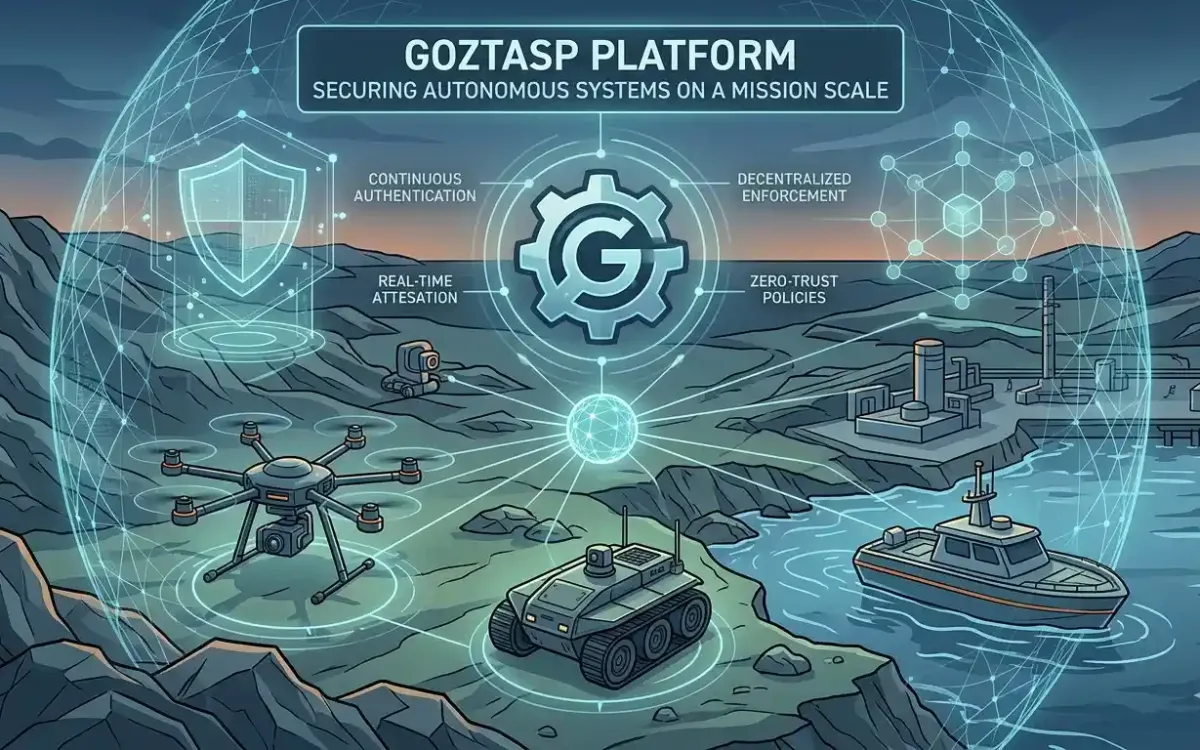

Autonomous systems—from drones to robots—are increasingly deployed in mission-critical environments where safety and security are paramount. GoZTASP (Zero-Trust Autonomous Systems Platform) addresses these needs by providing a unified governance framework that ensures continuous assurance and resilient operation across diverse autonomous agents and human operators. This blog post explores GoZTASP’s core features, readiness status, and implications for industries adopting autonomous technologies.
What is GoZTASP and Why Does It Matter?
GoZTASP is a zero-trust, mission-scale platform designed to govern heterogeneous autonomous systems in complex real-world environments. It integrates drones, robots, sensors, and human operators into a single security architecture that continuously verifies operational integrity and enforces safety constraints. By adopting a zero-trust approach, GoZTASP minimizes risks associated with compromised components, ensuring robust, resilient autonomy even in degraded or contested conditions.
Core Technologies: Secure Runtime Assurance and Spatio-Temporal Reasoning
At the heart of GoZTASP are two crucial technologies: Secure Runtime Assurance (SRTA) and Secure Spatio-Temporal Reasoning (SSTR). SRTA enables real-time verification of system behaviors and integrity, detecting anomalies or deviations from intended operation. SSTR provides contextual understanding by analyzing spatial and temporal relationships among autonomous agents and environmental factors. Together, these technologies enable GoZTASP to enforce safety policies dynamically and maintain mission continuity under various scenarios.
Maturity and Deployment Status
GoZTASP has advanced well beyond the conceptual stage, achieving Technology Readiness Level 7 (TRL7), which indicates system prototype demonstration in operational environments. Key components such as Saluki secure flight controllers have reached TRL8, denoting actual system completion and demonstration in relevant mission contexts. These advancements underscore GoZTASP’s readiness for integration into customer systems, particularly in high-consequence environments such as defense and critical infrastructure.
Applications Beyond Defense: Healthcare, Transportation, and Infrastructure
While GoZTASP was initially developed for defense and high-risk missions, its assurance and governance capabilities are increasingly relevant to other sectors. Autonomous systems in healthcare, transportation, and critical infrastructure face similar challenges around safety, security, and operational continuity. GoZTASP’s zero-trust framework and continuous verification mechanisms can provide these industries with enhanced governance tools, facilitating safer deployment of robots and autonomous assets in sensitive environments.
What This Means for Buyers of Autonomous Systems
For organizations looking to adopt autonomous systems, GoZTASP represents a significant step forward in ensuring secure, resilient, and trustworthy operations. Buyers should consider platforms and products that incorporate zero-trust governance architectures like GoZTASP to mitigate risks associated with system compromise or failure. This is especially crucial in sectors where mission-critical performance and safety are non-negotiable.
By choosing autonomous robots and systems that align with GoZTASP principles, buyers can benefit from continuous runtime assurance and context-aware safety enforcement. For those interested in exploring autonomous platforms and robots that prioritize security and resilience, browse robots on Robot Overflow.
Conclusion
GoZTASP offers a comprehensive zero-trust solution for governing autonomous systems at mission scale, combining advanced runtime assurance and spatio-temporal reasoning to maintain integrity and safety in complex environments. Its maturation and deployment in high-stakes settings demonstrate its potential to address broader industry needs. As autonomous systems become more prevalent across sectors, platforms like GoZTASP will be critical enablers of secure and trustworthy autonomy.
For more detailed technical insights, consider downloading the full GoZTASP whitepaper.