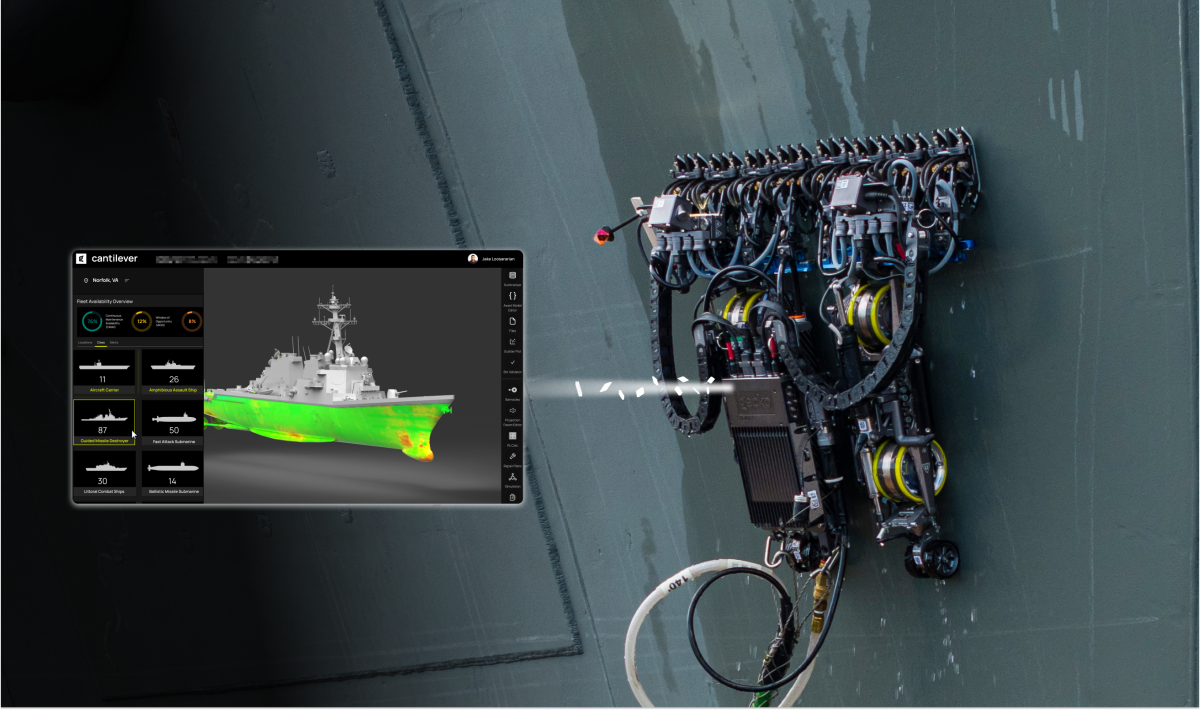

Gecko Robotics has secured the largest robotics contract in US Navy history — a five-year deal deploying autonomous inspection robots across the Navy's fleet to monitor hull integrity and predict maintenance needs before failures occur. The contract signals a structural shift in military procurement: autonomous physical inspection is no longer a pilot program, it's becoming standard infrastructure.
Table of Contents
- What Is the Gecko Robotics Navy Contract?
- How Do Gecko's Inspection Robots Actually Work?
- Why the Navy Is Betting on Autonomous Inspection
- What This Signals for Defense Robotics Procurement
- What This Means for Industrial Robotics Buyers
- Frequently Asked Questions
What Is the Gecko Robotics Navy Contract?
Gecko Robotics has signed a multi-year agreement with the US Navy to deploy its wall-climbing inspection robots across the naval fleet — making it the largest robotics deal the Navy has awarded to date. The contract spans five years and focuses on predictive maintenance: using autonomous robots to continuously monitor hull conditions, structural integrity, and corrosion before those problems ground ships or generate emergency repair costs.
According to TechCrunch, the deal represents a significant escalation from the Navy's previous robotics engagements, which were largely confined to trials and limited deployments. This is operational-scale commitment.
The contract positions Gecko — founded in Pittsburgh and backed by investors including Andreessen Horowitz — as the dominant robotics vendor in US military hull inspection, a market that has traditionally been served by human dive teams and dry-dock inspections conducted on fixed schedules rather than on-condition data.
How Do Gecko's Inspection Robots Actually Work?
Gecko's robots use magnetic adhesion to crawl across steel ship hulls — both above and below the waterline — while carrying ultrasonic testing (UT) sensors that measure wall thickness at thousands of points per hour. Ultrasonic testing works by sending sound waves through metal and measuring how long the echo takes to return; thinner readings indicate corrosion or material loss that would otherwise require human divers or dry-docking to detect.
The raw sensor data feeds into Gecko's software platform, which builds a continuous digital model of each ship's structural condition. Rather than inspecting on a calendar schedule — every 18 months in dry dock, regardless of actual condition — the Navy gets a living dataset that flags degradation as it develops.
This is the critical technical distinction: Gecko's system shifts maintenance from time-based to condition-based, a transition that aviation maintenance completed decades ago but naval surface fleet maintenance has lagged on.
| Inspection Method | Coverage Speed | Requires Dry-Dock | Data Output | Schedule Type |
|---|---|---|---|---|
| Human dive team | Low | Sometimes | Manual report | Fixed interval |
| Traditional dry-dock survey | High (stationary) | Yes | Point-in-time survey | Fixed interval |
| Gecko autonomous robot | High | No | Continuous digital model | On-condition |
The robots can operate while ships are in port, cutting the operational disruption that dry-dock inspections impose — a factor with direct readiness implications for a Navy managing fleet availability under sustained global deployment pressure.
Why the Navy Is Betting on Autonomous Inspection
The US Navy faces a compounding maintenance backlog. Aging fleet assets, shipyard capacity constraints, and a shortage of skilled inspection personnel have pushed deferred maintenance costs into the billions. Traditional inspection schedules were designed for a world where labor was relatively cheap and abundant, and where data collection was inherently episodic. Neither condition holds today.
Predictive maintenance enabled by continuous robotic inspection attacks three cost drivers simultaneously:
First, it catches failures earlier. A corroded hull section identified at 15% wall-loss is a scheduled weld repair. The same section identified at 5% wall-loss — after a failure event — is an emergency dry-dock, potential mission abort, and safety incident investigation.
Second, it reduces inspection downtime. Gecko's robots work in port without pulling ships out of rotation. For the Navy, ship availability is a readiness metric with direct strategic implications; every day in dry dock is a day unavailable for deployment.
Third, it addresses workforce constraints. Qualified marine inspectors and commercial divers capable of performing hull surveys are in short supply. Autonomous systems don't compete with these specialists — they extend what a smaller human team can monitor and validate.
The defense procurement logic here is straightforward: the Navy is buying capability that reduces total lifecycle cost while improving operational readiness. That's a rare combination in defense contracting.
What This Signals for Defense Robotics Procurement
The scale of this contract — a five-year commitment rather than a pilot purchase order — is the most important signal for anyone tracking the defense robotics economy. It indicates that the Navy's acquisition community has moved past the proof-of-concept phase for autonomous inspection and is now treating it as a standard maintenance tool.
This has upstream implications. Defense robotics procurement tends to cascade: when one branch of the armed forces makes a large-scale commitment to a robotics category, sister services and allied militaries study the outcome closely. US Army Corps of Engineers dam and levee inspection programs, Air Force aircraft structure monitoring, and Coast Guard cutter maintenance all face analogous challenges to what Gecko is solving for the Navy.
The commercial parallel is equally important. Industrial sectors that share the Navy's inspection challenge — offshore oil and gas platforms, liquefied natural gas storage tanks, chemical processing vessels, bridge infrastructure — are watching military deployments of autonomous inspection systems as a validation signal. When a customer with the Navy's engineering rigor and safety standards commits to robotic inspection at scale, it reduces perceived risk for industrial buyers sitting on the fence.
The defense robotics market is currently valued at approximately $16 billion globally and is projected to grow significantly as autonomous systems shift from experimental to standard equipment across military branches. Inspection and surveillance robotics represent one of the fastest-growing sub-segments, driven precisely by deals like this one.
Gecko is not alone in this space — companies including Flyability (drones for confined space inspection) and Eddyfi Technologies (NDT sensor systems) compete in adjacent segments — but Gecko's naval contract establishes a reference deployment at a scale that competitors will struggle to match as a credibility signal.
What This Means for Industrial Robotics Buyers
The technology Gecko is deploying for the Navy — magnetic-adhesion crawlers with ultrasonic NDT payloads and predictive analytics backends — is not military-exclusive. The same system architecture is commercially available for infrastructure inspection in oil and gas, power generation, and heavy manufacturing.
For industrial buyers evaluating autonomous inspection systems, this contract matters in three practical ways:
- Validation at scale: A five-year Navy contract is one of the most demanding operational references a robotics vendor can hold. It signals production-grade reliability, not demo-grade performance.
- Data maturity: Gecko's software platform will accumulate hull degradation datasets across the Navy fleet. That training data improves the predictive models that commercial customers also benefit from.
- Procurement pathway: Defense contracts often accelerate a vendor's commercial pricing maturity and support infrastructure — both factors that reduce procurement risk for industrial buyers.
If your operation involves large steel structures subject to corrosion, pressure, or fatigue — tanks, vessels, pipelines, bridges, marine infrastructure — the autonomous inspection category is worth evaluating now rather than after forced failures trigger the conversation.
For broader context on where autonomous inspection sits within the industrial robotics landscape, browse industrial robots on Robot Overflow to see what's currently available across inspection, manipulation, and mobility categories.