

The 2026 Fortune 500 generated a record $21 trillion in revenue and $2.1 trillion in profits, yet total employment across the list fell 1% to 30.5 million. The divergence underscores how AI investment and outsourcing are enabling America’s largest companies to produce more with fewer workers.
- Record Revenue and Profit, with a Headcount Catch
- Why Headcount Fell: Departures and Steady Hiring
- Sector Breakdown: Retail and Tech Shrink, Financials Grow
- AI and the Productivity Puzzle
- What This Means for the Industry
- Frequently Asked Questions
- Conclusion
Record Revenue and Profit, with a Headcount Catch
The Fortune 500’s 2026 rankings, released recently, show aggregate revenue climbed 5% year-over-year to $21 trillion and total profits jumped 12% to $2.1 trillion. Market capitalization rose 19% to $55 trillion, fueled by heavy AI spending and market enthusiasm. By almost every financial metric, corporate America’s biggest public companies have never been more prosperous.
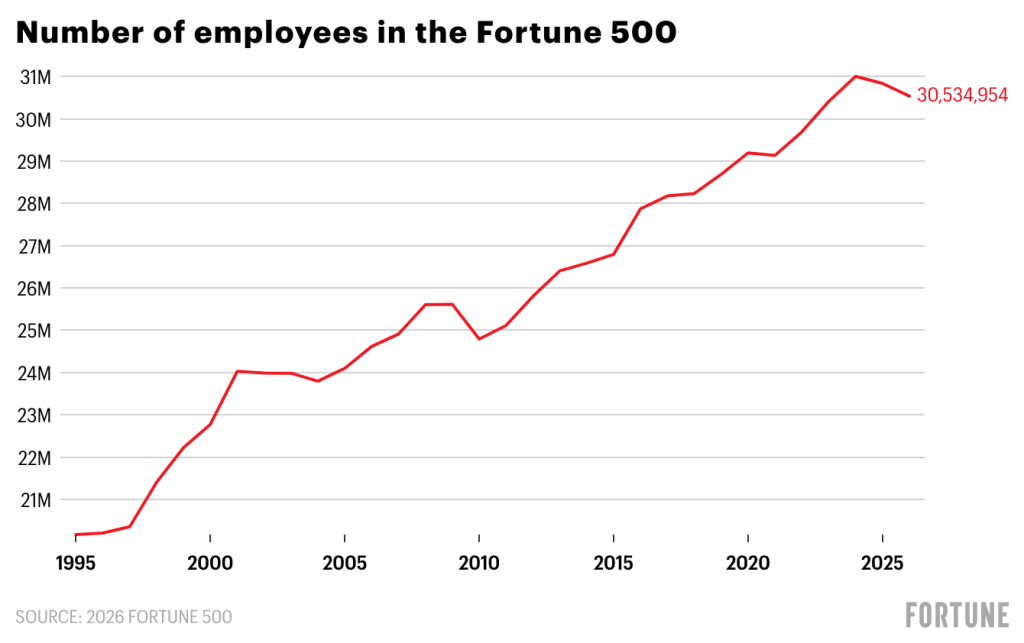
Yet the workforce behind those results is shrinking. Collective headcount dropped for the second consecutive year to 30.5 million — a loss of 301,049 workers. Since 1995, when the Fortune 500 began including service firms, a decline in total employment has only occurred during or immediately after recessions. The current dip is happening in a period of strong economic growth.
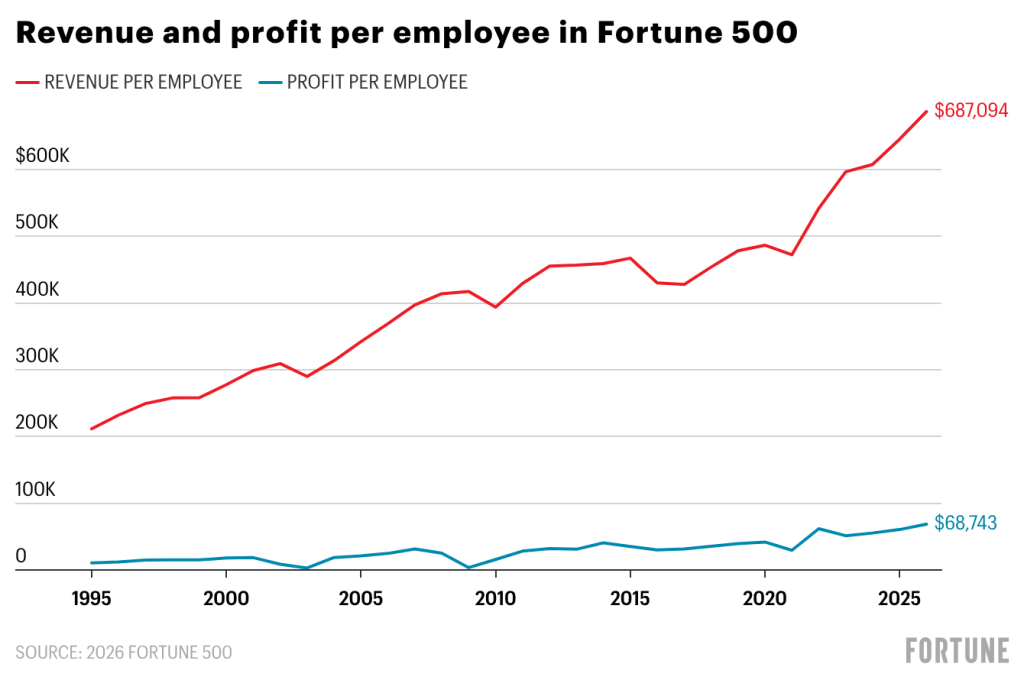
Revenue per employee reached $687,094, and profit per employee hit $68,743 — both all-time highs. Meanwhile, inflation-adjusted wages have stayed relatively flat over the same span, according to data from the Economic Policy Institute.
Why Headcount Fell: Departures and Steady Hiring
The decline in total employment is partly explained by companies leaving the list. Walgreens Boots Alliance, which employed 252,500 workers — placing it among the top 25 employers on the 2025 list — fell off after being acquired by private equity firm Sycamore Partners. Retailer Nordstrom also dropped off after a take-private deal, shedding 41,000 jobs. In total, the 22 companies that left the 2026 Fortune 500 accounted for 659,640 workers.
The 22 newcomers that replaced them employ fewer than half that number: 317,414 people. The largest new entrant, Amentum Holdings — an engineering and technology services company — brings 50,000 employees. Medline, a health care supply firm, adds 45,000.
Among firms that remained on the list from 2025 to 2026, headcount grew just 0.1%, adding 41,177 workers. Dick’s Sporting Goods recorded one of the biggest jumps, up 83.1% (31,050 employees) after acquiring Foot Locker. Carvana, the online used car seller, added 5,700 workers, a 32.8% increase as its rebound continued.
Harvard economics professor Lawrence Katz describes the environment as a “low-hire, low-fire economy.” The top three companies — Amazon, Walmart, and UnitedHealth Group — each saw minimal employment changes: Amazon added 20,000 employees (1.3%), Walmart was flat, and UnitedHealth dipped by 10,000 (-2.5%).
Sector Breakdown: Retail and Tech Shrink, Financials Grow
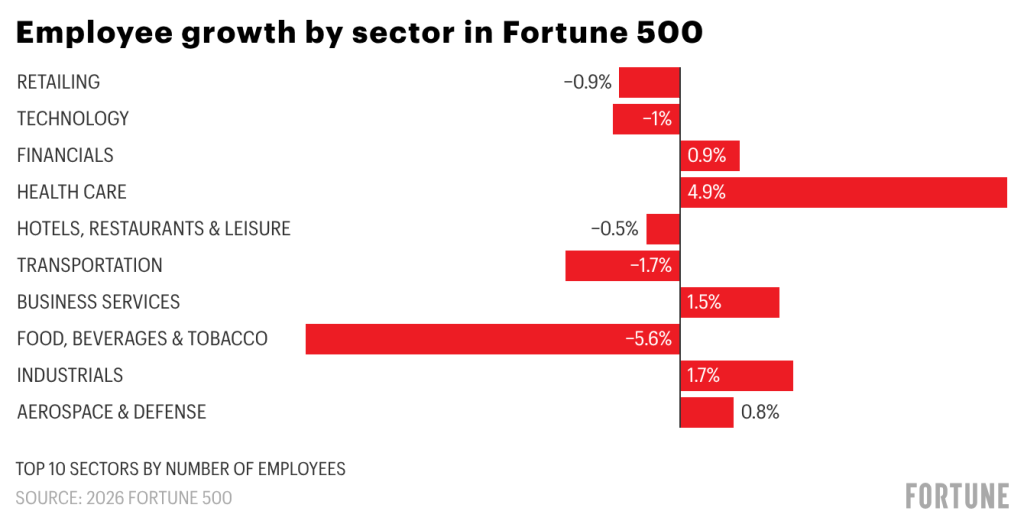
Retailing is the Fortune 500’s largest sector, employing just over 7 million people, but its headcount dropped 0.9% from the previous year. The second-largest sector, technology, shed 1% of its workforce to reach 3.8 million employees. Financials, the third-largest, bucked the trend with 0.9% growth to 3.5 million workers.
The sector-level data reflects a broader pattern: large companies are outsourcing labor-intensive functions while doubling down on technology investments that boost productivity without proportional headcount growth. Katz notes that big firms hire “professional, talented individuals who are rewarded dramatically, but they’re not sharing the huge productivity gains with this broader workforce in the way that old, often unionized manufacturing companies or even old-style banks once did.”
SectorHeadcount (2026)Year-over-Year ChangeRetail7,068,000-0.9%Technology3,821,000-1.0%Financials3,512,000+0.9%
AI and the Productivity Puzzle
The record revenue-per-employee figures come amid a surge in corporate AI spending. Executives across industries are pushing teams to adopt AI tools for efficiency, and the data suggests the efforts are showing up on income statements — but not on hiring budgets. According to Fortune’s analysis, the productivity gains from technology investments are enabling companies to grow revenue without commensurate staffing increases.
This trend is not limited to the Fortune 500’s largest incumbents. Two newcomers to the 2026 list operate with remarkably small workforces. Bitgo Holdings, a Sioux Falls, S.D.-based digital asset firm, employs just 603 people and landed at No. 278. Galaxy Digital, a New York-based crypto financial services company, has only 700 employees and cracked the top 100 at No. 76 — the next smallest employer in the top 100 has nearly eight times as many workers.
Katz adds a note of caution: “We are seeing a rise in new business startups, a flourishing of smaller scale enterprises, some of which may eventually become huge, but maybe, as they’re re-engineered to focus on AI agents as their main sort of workers, maybe they don’t end up having as large an employment imprint as traditional firms.” He emphasizes that the economy is still in the early stages of AI adoption.
What This Means for the Industry
The Fortune 500’s record profits and shrinking headcount present a stark picture for investors, competitors, and the broader labor market. For investors, the data reinforces the thesis that companies successfully deploying AI and other productivity tools can expand margins faster than revenue. The $55 trillion combined market cap — up 19% — suggests markets are rewarding this efficiency.
For competitors — especially smaller firms or startups — the trend opens a strategic window. Companies like Bitgo and Galaxy Digital demonstrate that firms with minimal headcount can achieve sufficient revenue to land on the most prestigious corporate list. As AI agents take over tasks that previously required large teams of white-collar workers, the cost of scaling may drop dramatically, enabling leaner business models across sectors.
For the technology industry specifically, the 1% headcount decline among Fortune 500 tech companies signals that even the sector driving the AI revolution is not immune to the efficiency dynamic. The shift could accelerate consolidation as larger firms use their AI capabilities to outcompete smaller rivals that rely more heavily on labor.
The broader economic implication is a widening gap between productivity gains and wage growth. If the largest employers continue to generate more value per worker without passing gains down the pay scale, pressure on social safety nets and political pressure for redistribution could intensify. Katz’s observation about “low-hire, low-fire” may become a structural feature rather than a cyclical one.
Conclusion
The 2026 Fortune 500 marks a historic inflection point: America’s largest companies are richer and more profitable than ever, yet they employ fewer people than a year ago. The combination of record $21 trillion revenue, $2.1 trillion profit, and a 301,000 headcount drop signals that technology investment and outsourcing are structurally reshaping corporate behavior. Whether this “do more with less” model becomes a permanent fixture — and how the labor market adapts — will define the next era of American business.