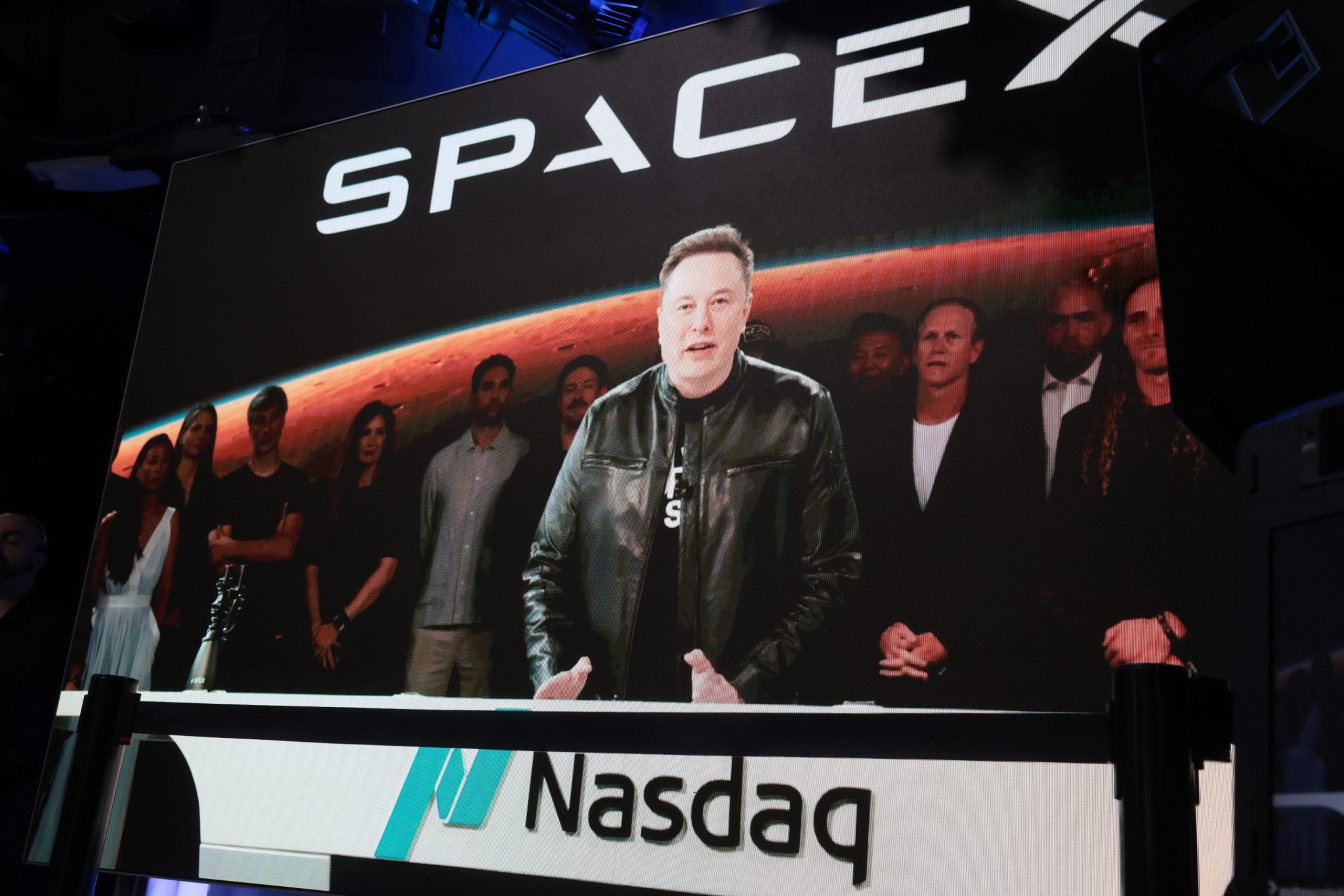
SpaceX’s IPO has made Elon Musk the world’s first trillionaire, boosting his net worth past $1.1 trillion after shares opened at $150. The milestone comes as Musk argues that AI-powered production systems will eventually render currency obsolete, creating a post-scarcity economy.
- What Happened: From IPO to Trillionaire
- Musk’s Vision for a Post-Money World
- The Irony of Wealth and a Moneyless Future
- Universal Basic Income: A Divisive Solution
- What This Means for the Industry
What Happened: From IPO to Trillionaire
SpaceX went public recently, with shares opening at $150 each, adding approximately $180 billion to Musk’s net worth in a single day. The valuation, built on the company’s dominant position in satellite internet and space launch services, pushed Musk’s total wealth past the trillion-dollar mark — a first for any individual.
In an interview with XPrize Foundation executive chairman Peter Diamandis, Musk acknowledged his new status but downplayed its significance. “It just represents some percentage ownership in companies that I built,” he said. “It’s not like sitting in the bank account.”
Musk’s Vision for a Post-Money World
During the same conversation, Musk laid out his long-held belief that AI will eventually make money unnecessary. He predicted that AI systems will produce goods and services so efficiently that output will permanently outstrip demand, causing persistent deflation. With AI performing most productive work, the traditional link between labor and income breaks down.
“I think money will stop being relevant at some point in the future,” Musk told Diamandis in a clip shared on X. “AI and robots are going to make so much stuff and provide so many services that they’ll run out of things to do for humans.”
Musk has previously floated the idea of “universal high income” as a transitional mechanism. He cites the Culture series by Iain M. Banks, a science fiction universe where superintelligent AIs manage a post-scarcity society without traditional employment.
The Irony of Wealth and a Moneyless Future
Diamandis pressed Musk on the apparent contradiction: becoming a multi-trillionaire while arguing that money lose its value. “So just as you’re becoming a multi-trillionaire, money starts to have less value?” Diamandis asked. “Yeah, pretty much,” Musk replied.
Musk’s own companies have faced challenges in realizing his production visions. While he has set ambitious targets for advanced manufacturing systems at Tesla, those systems have experienced repeated delays. The gap between Musk’s utopian predictions and the practical difficulties of scaling AI-driven production underscores the tension in his message.
Universal Basic Income: A Divisive Solution
Musk’s vision aligns with some policymakers. U.K. Minister for Investment Lord Jason Stockwood told the Financial Times that the government is considering universal basic income (UBI) to support workers in AI-exposed industries. “Undoubtedly we’re going to have to think really carefully about how we soft-land those industries that go away,” he said.
OpenAI CEO Sam Altman, once a prominent UBI advocate and funder of a $1,000-per-month study, has since shifted toward “collective ownership” models instead.
However, economists remain skeptical. Ioana Marinescu, an economist at the University of Pennsylvania, notes that UBI provides only modest spending increases for low-income individuals saddled with debt. More pointedly, she raises questions about whether the ultrawealthy will agree to fund such programs. “Essentially, I’m worried that people who benefit from AI, after the fact, are going to say, ‘Well, why do we have to pay for all these people’s problems?’” she told Fortune.
What This Means for the Industry
Musk’s trillionaire status resets expectations for how large personal fortunes can grow from technology companies. SpaceX’s success validates the model of building capital-intensive, long-horizon ventures — space, infrastructure, AI — as paths to extreme wealth. Other tech founders may now pursue similarly ambitious projects.
His prediction about money’s irrelevance carries real implications for investors. If Musk is correct, long-term asset allocation would need to account for permanent deflation — a scenario most current models ignore. Countries like the U.K. and others exploring UBI are already laying groundwork for a world where traditional employment erodes.
Yet the gap between Musk’s wealth and his rhetoric raises governance questions. Future AI-driven prosperity will require decisions about distribution, taxation, and ownership. Without clear mechanisms to share the gains, Musk’s vision could result in unprecedented concentration of wealth rather than universal abundance.
According to Fortune, SpaceX did not respond to a request for comment.
Conclusion
Musk’s trillionaire moment is both a personal milestone and a bellwether for tech-driven wealth concentration. While his vision of a money-less, AI-saturated future is provocative, the practical path from today’s economy to that world remains unclear — and Musk’s own struggles to deliver on ambitious production goals highlight the gap between prediction and reality.