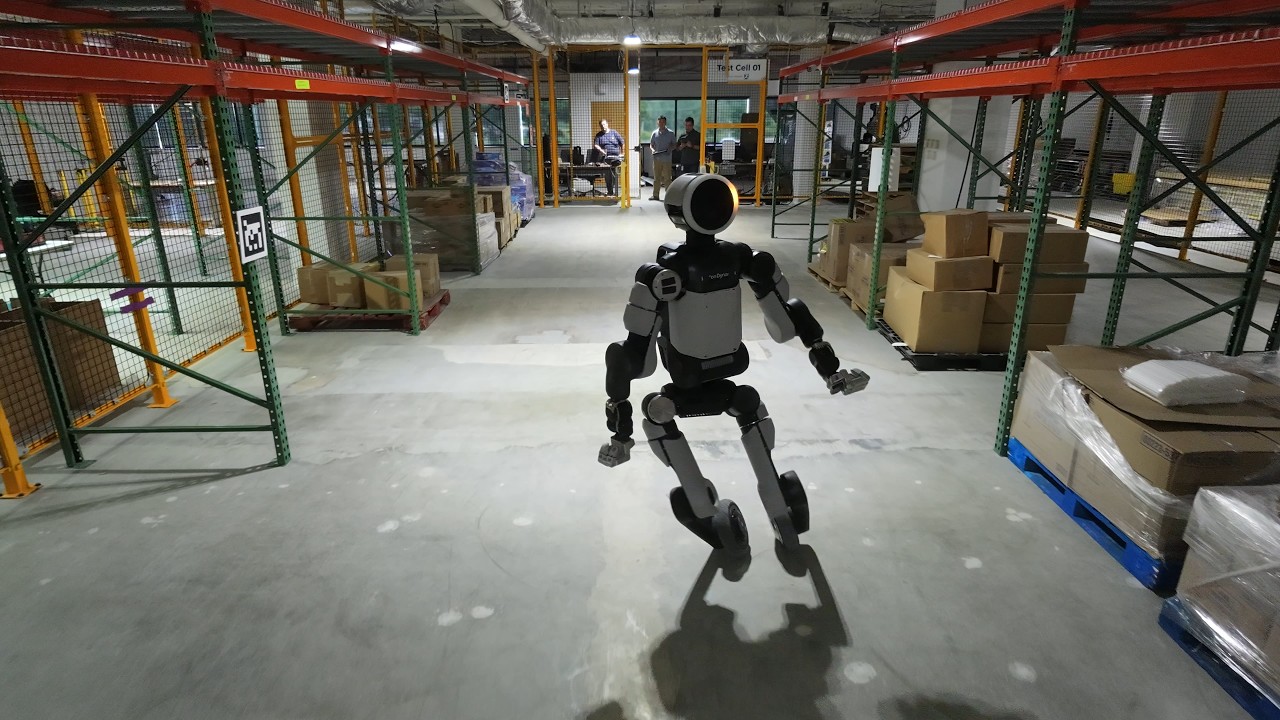

Boston Dynamics has fitted wheels to its Atlas humanoid for a set of controls engineering experiments, first reported by Therobotreport. The experiment tests how the combined control approach supports dynamic stability as Atlas moves across unstructured, real-world terrain, shifting between rolling on flat ground and legged motion over obstacles or irregular surfaces.
Boston Dynamics describes a wheeled Atlas as a research testbed, not a product. Controls engineer Andy Wu attached wheels to Atlas’ legs to push actuation to its limits; the experiment also examines adaptability in conditions that are difficult to model or simulate.
Wu said a custom adapter mounts an off-the-shelf scooter rim onto Atlas’ existing ankle actuator and is the only new part in the build. On the software side, each wheel is modeled as an ankle that can spin continuously, replacing the feet in Atlas’ baseline robot model.
The system learned all of the behaviors in simulation and executed them in real life, with surprising accuracy, Wu said. The video also shows Atlas performing pirouettes and aggressive actuation maneuvers, alongside rolling and legged movement.
The whole-body reinforcement-learning policy processes real-time proprioceptive feedback and velocity commands. Separately, the experiment outputs dynamic pose and force adjustments to mitigate unmodeled disturbances and non-ideal contact states.
For Wu and the controls engineering team, the main takeaway is control synergy: classical motor control provides baseline stability, while whole-body reinforcement learning supports reactive adaptation. The combination yields greater real-world agility than either method alone.
Wu’s next question is how the policy will respond to failed actuators. That matters for safety and for understanding how the system will respond to a system failure.