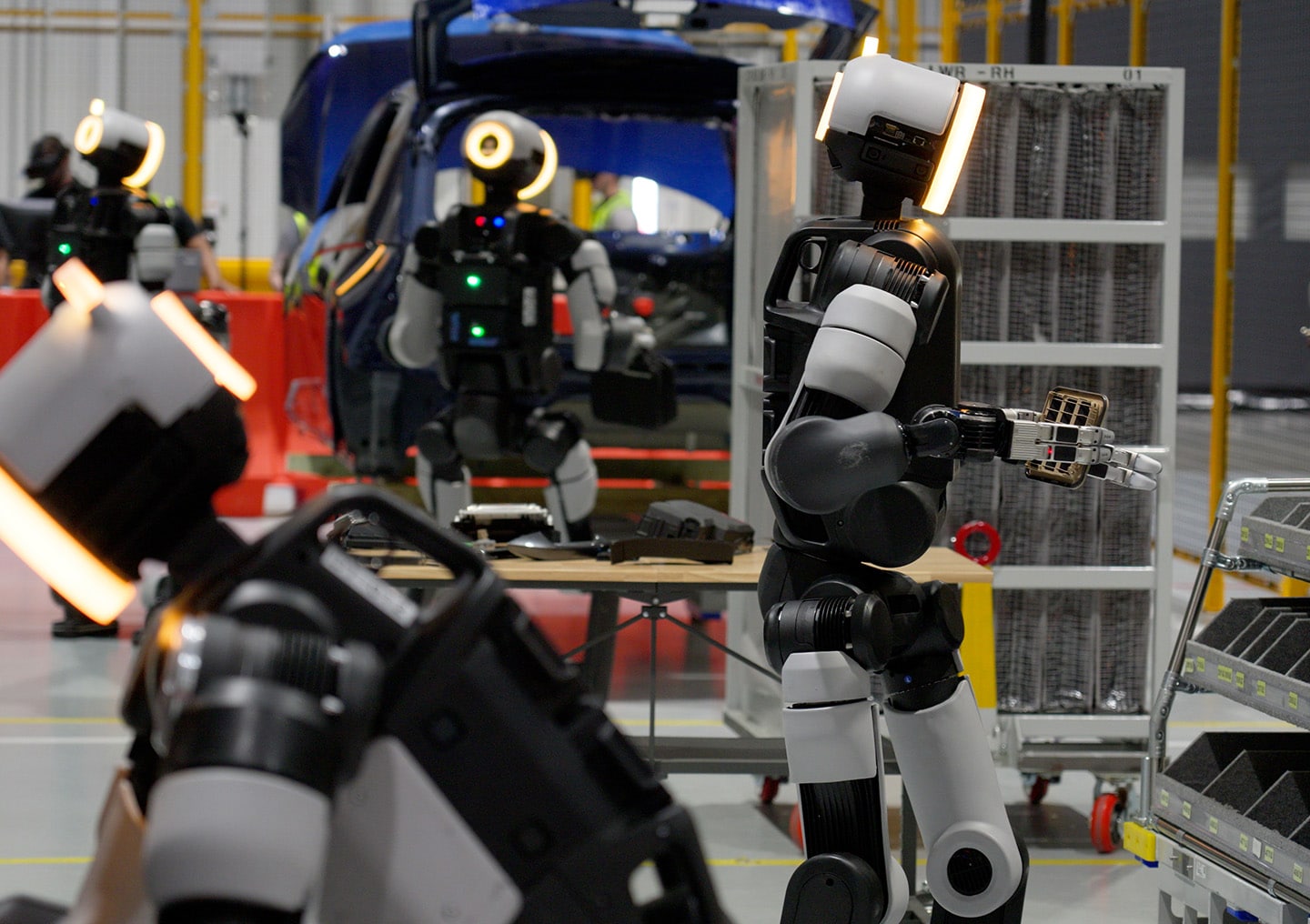

Boston Dynamics has opened a Georgia center to train Atlas humanoids for automotive work, first reported by Therobotreport. The permanent Robotics Metaplant Application Center (RMAC) will use real automotive parts, fixtures, workcells, and production data to test applications and build the capabilities needed to deploy Atlas across Hyundai’s global network over time.
RMAC trains Atlas on factory handling
RMAC sits at Hyundai Motor Group Metaplant America near Savannah, Ga. Boston Dynamics describes it as a permanent testbed and training center for integrating Atlas into Hyundai’s automotive manufacturing operations, unlike earlier time-boxed, small-scale trials focused on gathering deployment lessons.
Atlas is learning from teleoperation, reinforcement learning in simulation, and Universal Manipulation Interface devices. At RMAC, work includes preparing and sequencing automotive parts before assembly, handling complex surfaces, respecting cosmetic or fragile areas, and extracting parts from shipping packaging before inserting them into high-density cubbies for transport to the line.
Those tasks can require bimanual manipulation because parts may be large, awkwardly weighted, or fragile. The center combines real parts, fixtures, and workcells with Atlas robots and skilled pilots to produce diverse data for behavior training.
The early lessons point in two directions: production-version design assumptions have been close to right, while the applications have exposed questions about modifying fixtures and packaging, collecting data in production environments, and building support processes for humanoids.
Boston Dynamics plans to expand Atlas to component assembly by 2030. Over time, the company said, Atlas will take on repetitive and strenuous work such as lifting heavy loads, while data collection and other training tasks continue through 2027.
Hyundai said it will deploy Atlas across its global network, beginning with 25,000 units at Hyundai Motor and Kia global plants over the next few years. Hyundai is also planning a U.S. factory that can manufacture up to 30,000 robots annually by 2028.
RMAC’s first phase is already operational. Next year, operations will move into a new building that will expand the center by about 10 times and support further preparation of Atlas for automotive deployments, while Boston Dynamics plans to explore use cases in other industries.