

The Bank for International Settlements, the global central bank coordinator, released its latest annual report Sunday warning that the $1 trillion AI capital expenditure boom mirrors historical investment bubbles that ended in recessions. The report cautions that hyperscaler spending is already outpacing earnings and free cash flow, leaving the entire sector vulnerable to a sudden bust that could trigger a broader economic downturn.
- What Happened: The BIS Issues a Stark Parallel
- Why It Matters: Competition-Driven Overcommitment
- The Hidden Wiring: Circular Financing and Opaque Debt
- The Wealth Effect Problem: From Silicon Valley to Main Street
- The Hormuz Complication: A Second Shock Waiting to Interact
- What This Means for the Industry
- Frequently Asked Questions
- Conclusion
What Happened: The BIS Issues a Stark Parallel
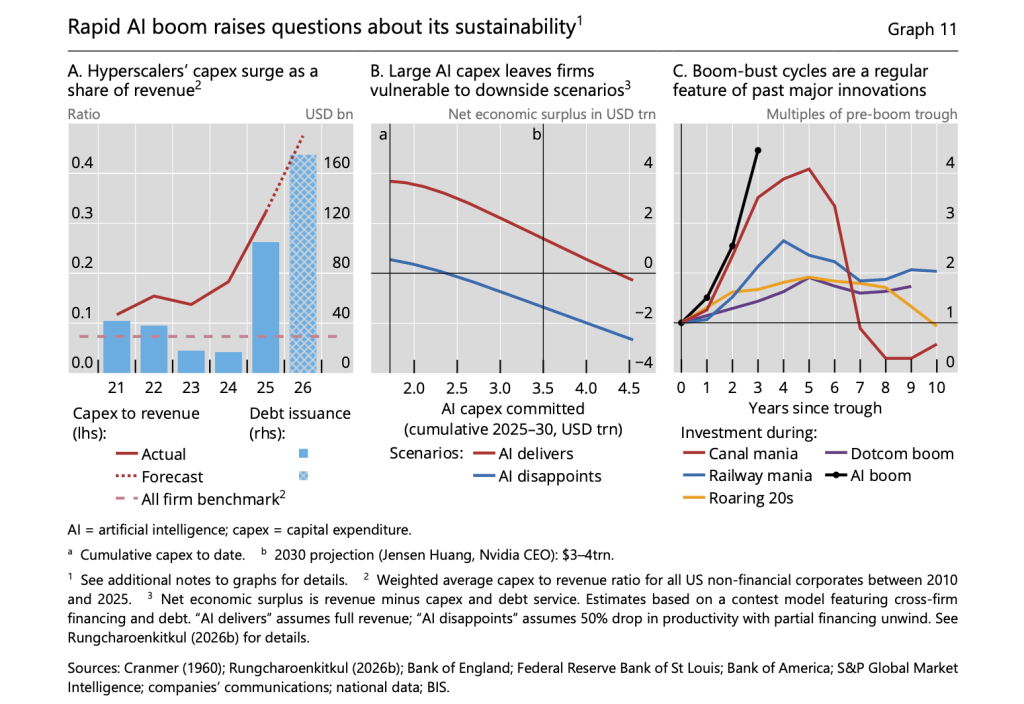
The Bank for International Settlements — the Basel-based institution that coordinates the world’s central banks — drew direct comparisons between today’s AI investment frenzy and historical episodes such as the British railway bubble of the 1840s and the dot-com crash of 2000. The key message: each began with a genuine technological breakthrough that attracted more capital than commercial returns could ultimately justify, and each ended in a recession.
“The scale and pace of the current AI investment boom, accompanied by expectations of large productivity payoffs, bear resemblance to these precedents,” the BIS wrote in its Annual Economic Report 2026. “These episodes ended with an eventual reversal in investment, inducing economy-wide recessions.”
The report notes that the five largest hyperscalers are on pace to spend more than $1 trillion on AI-related capital expenditure over the current and previous year combined — a sum that is already outpacing their earnings and free cash flow, forcing some to issue debt to cover the gap. The BIS acknowledges that the technology itself is real, with task-level studies showing productivity gains of 20% to 50% in time savings. But the problem, it says, is that every major player is making the same massive bet simultaneously, driven by the perception that only a handful of firms will ultimately dominate.
Why It Matters: Competition-Driven Overcommitment
The BIS’s concern is rooted in contest theory: as competitive pressure drives capital expenditure higher, the net economic surplus for the sector as a whole — total payoffs minus investment costs — declines and could turn negative in adverse scenarios. The report warns that if AI payoffs disappoint, it “could trigger a sudden pullback in financing and turn the capex boom into a protracted investment bust.”
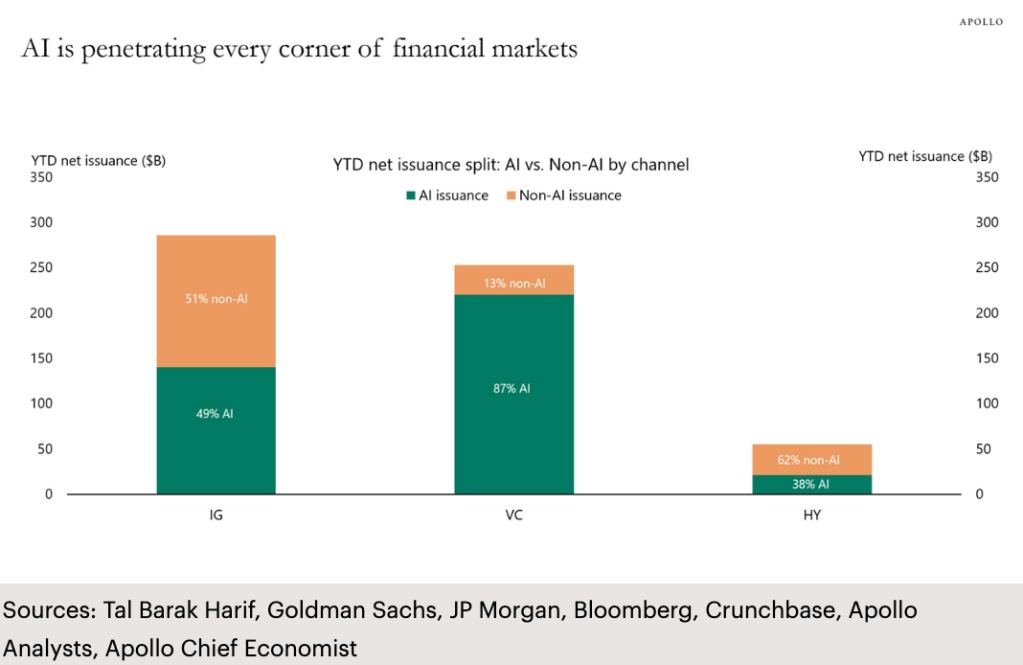
This isn’t a fringe concern. The BIS is the central bank of central banks, and its annual report is a closely watched barometer of systemic risk. The warning comes at a moment when AI-related spending has saturated financial markets: it accounts for nearly half of all investment-grade bond issuance, 87% of venture capital funding, and a growing share of high-yield debt. Apollo Global Management Chief Economist Torsten Slok argued recently that AI was “penetrating every corner of financial markets,” with an equity market phenomenon mutating into a capital markets-wide transformation.
The Hidden Wiring: Circular Financing and Opaque Debt
What makes an AI bust particularly dangerous, the BIS argues, isn’t just the scale of the spending — it’s how it’s financed. Hyperscalers, chipmakers, and AI labs are linked through what the report calls “a complex web of private arrangements.” The most prominent is circular financing: hyperscalers take equity stakes in AI labs, which in turn commit to multi-year purchases of chips or computing power from those same hyperscalers. Data centers are outsourced to third-party contractors that lease the facilities back under long-dated contracts with embedded exit clauses.
“The terms of such deals are typically poorly disclosed,” the BIS writes, “with risks of the same asset being pledged multiple times.”
If hyperscalers slow or halt their aggressive capex deployment, the entire supply chain — infrastructure contractors, chipmakers, AI labs, and the private credit lenders behind them — would face simultaneous revenue shortfalls. The engineering and construction firms at the end of that chain are particularly vulnerable, carrying “comparatively weak” balance sheets with little cushion against a sudden reversal. BIS Asia-Pacific representative Zhang Tao told the South China Morning Post that a correction could unwind “much faster than previous banking crisis episodes” because so much of the financing flows through hedge funds and private credit vehicles with less regulatory oversight than traditional banks.
The Wealth Effect Problem: From Silicon Valley to Main Street
The financial fallout wouldn’t stay contained in tech. U.S. stocks now account for roughly 64% of the MSCI Global index, and household equity exposure has more than doubled relative to income since 2010. A major repricing of AI-related stocks, the BIS warns, “could have more pronounced wealth effects and sharper consumption pullback than in the past.” Given the U.S. market’s global footprint, the wealth destruction would propagate internationally.
Direct lending funds — already a $1 trillion-plus ecosystem — have quadrupled their lending to the AI and IT sectors over the past five years, now representing about 15% of their portfolios. Signs of stress are already visible: some retail-facing direct lending funds have faced mounting redemption requests, forcing asset liquidations.
“A larger shock,” the BIS writes, “whether from a renewed inflation surge or a sharp AI-led repricing, could trigger a more widespread credit crunch.”
The Hormuz Complication: A Second Shock Waiting to Interact
The AI risk doesn’t exist in a vacuum. The report’s opening chapter documents a second major shock: the closure of the Strait of Hormuz following the start of the Iran conflict earlier this year, which cut more than 10 million barrels of crude oil per day from global supply — a larger disruption than either the 1973 oil embargo or the 1979 Iranian revolution. Oil prices surged 67% to an intraday peak of $120 a barrel within two weeks. Fertilizer and plastics prices both soared 50%.
Financial markets have remained buoyant — equity valuations rich, credit spreads compressed — on the assumption that the Hormuz disruption is temporary and that the AI boom will continue. But if inflation proves stickier than expected and central banks are forced to raise rates, the same tightening needed to contain energy-driven inflation could pop the AI-financed debt bubble.
“The current tension between exuberant risk appetite and elevated macroeconomic risks,” the BIS writes, “could unwind abruptly.”
What This Means for the Industry
For tech investors and hyperscaler executives, the BIS report is a formal, data-backed challenge to the prevailing narrative that AI infrastructure spending is a sure bet. The report’s warning carries weight because it comes from an institution with no skin in the game — unlike sell-side analysts or corporate management with incentives to talk up spending.
For the hyperscalers (Microsoft, Amazon, Google, Meta, and others): The pressure to show returns on $1 trillion in combined capex will only intensify. If revenue growth from AI services doesn’t materialize as expected, the debt-laden balance sheets of some players could quickly become a liability. The report implicitly questions the strategy of “spend at all costs to win the frontier model race.”
For AI startups and labs: The BIS highlights how dependent they are on hyperscaler spending. If capex pulls back, the circular financing that keeps many labs afloat — equity stakes from cloud providers paired with chip purchase commitments — could unravel. Liquidity could dry up almost overnight.
For the broader tech industry: The wealth effect from U.S. equity markets is a double-edged sword. If AI stocks correct sharply, consumption and business investment could pull back across sectors, not just in AI. The report’s analysis of direct lending exposure suggests that a credit crunch could hit private market tech companies before public ones.
For regulators and central banks: The BIS calls for extending prudential standards to non-bank financial institutions that now dominate AI financing. That could mean tighter oversight of private credit funds, hedge funds, and even some venture capital vehicles, potentially reshaping how AI infrastructure gets funded going forward.
Conclusion
The BIS report is the most authoritative institutional warning yet that the AI infrastructure boom carries the seeds of a potential financial crisis. It does not claim that AI is a bubble, but it argues that the structure of the investment — competitive, circular, opaque, and leveraged — makes a disorderly unwind more likely than the industry wants to admit. For now, the markets remain exuberant, but as the BIS puts it, “the current tension between exuberant risk appetite and elevated macroeconomic risks could unwind abruptly.”
According to Fortune, this story was originally featured on Fortune.com.