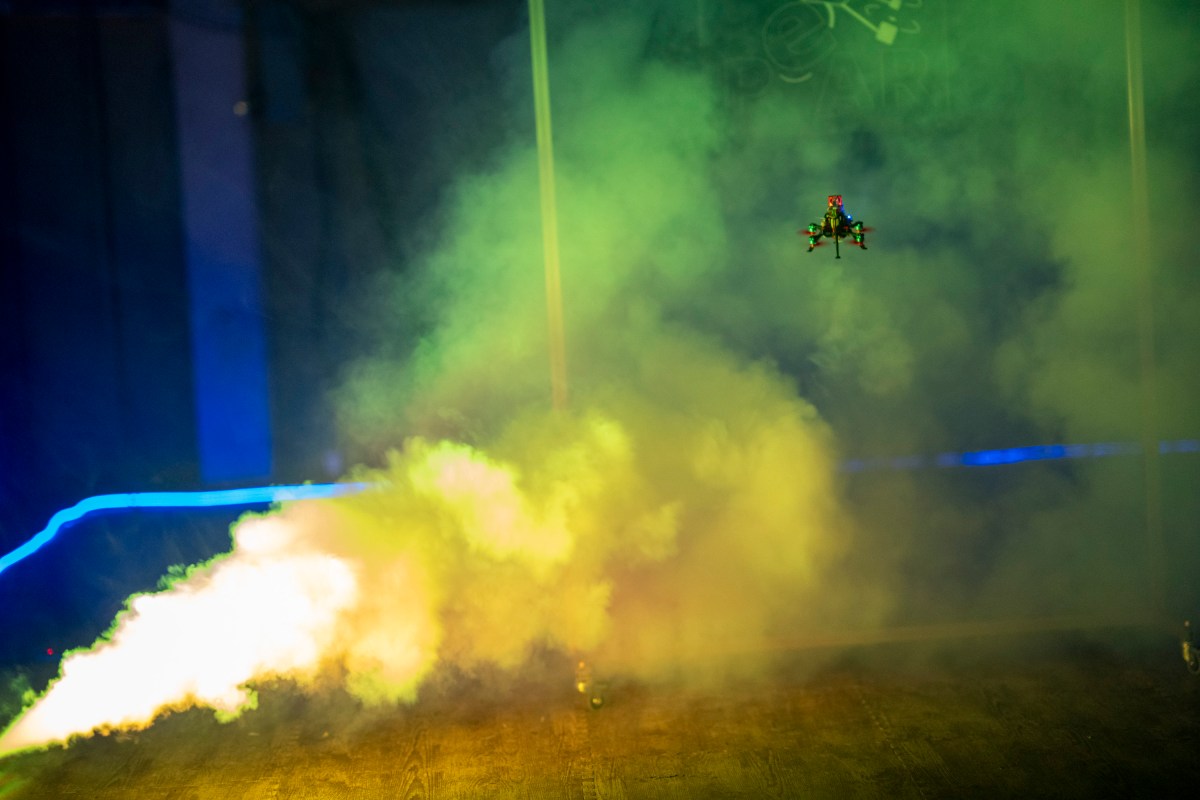

A researcher is building palm-sized robots that mimic bat echolocation — emitting ultrasound pulses to map and navigate environments where cameras go blind and GPS fails entirely. The approach challenges the orthodoxy of LiDAR-first robotics design, offering a potentially lighter, cheaper, and more fog-tolerant sensing stack for search and rescue deployment in GPS-denied, visually obscured spaces.
- Why Conventional Robot Sensors Fail in Search and Rescue
- How Bat Echolocation Works — and What Robots Can Copy
- Ultrasound vs. LiDAR vs. Cameras: A Sensing Comparison
- The Engineering Challenges of Building a Bat Robot
- What This Means for Robotics and Automation
- Frequently Asked Questions
Why Conventional Robot Sensors Fail in Search and Rescue
Camera-based and LiDAR-equipped robots dominate the current generation of autonomous systems — but both technologies share a critical weakness. They depend on optical clarity. Smoke, dust, fog, and total darkness degrade or completely neutralise their sensing capability precisely when search and rescue missions demand reliable navigation the most.
LiDAR (Light Detection and Ranging) works by firing laser pulses and measuring their return time to build a 3D point cloud of the environment. In clear conditions, it is extraordinarily precise — sub-centimetre accuracy across tens of metres. But suspended particulates scatter laser light, flooding the sensor with noise and collapsing the usable range. Camera-based vision systems face the same fundamental constraint: they need photons organised into coherent images, which smoke and darkness deny them entirely.
GPS compounds the problem in a different direction. Collapsed structures, underground tunnels, and dense urban canyons all block satellite signals. A robot relying on GPS for positional awareness becomes effectively blind to its own location before it even encounters sensor-degrading smoke.
These aren't edge cases — they are the defining conditions of disaster environments. Which is exactly why one researcher is looking 50 million years into evolutionary history for a better answer.
How Bat Echolocation Works — and What Robots Can Copy
Bats navigate in complete darkness with sub-centimetre precision by emitting high-frequency ultrasound pulses — typically between 20 kHz and 200 kHz — and processing the returning echoes to build a continuous spatial model of their surroundings. This is echolocation (also called biosonar), and it is arguably the most sophisticated biological navigation system outside of the human vestibular complex.
The key insight that makes bats relevant to robotics is what ultrasound doesn't depend on: light. Ultrasound propagates as a mechanical pressure wave through air. Smoke particles are too small to meaningfully scatter ultrasonic frequencies. Darkness is irrelevant. The physics that defeat cameras and LiDAR simply don't apply.
Bats also demonstrate something computationally remarkable — they process echo returns in real time, filtering their own outgoing signal from incoming reflections, compensating for the Doppler shift of their own flight velocity, and distinguishing target objects from background clutter. Their auditory cortex dedicates disproportionate neural resources to this task. The robotics challenge is replicating that signal processing pipeline in embedded hardware small enough to fly.
The analogy to bat biology is instructive but imperfect. A bat's pinnae (outer ear structures) are mechanically complex, shaped to encode directional information into the echo waveform itself — a trick called Head-Related Transfer Function encoding that passive microphone arrays approximate but don't replicate. The robot can get close. It cannot get identical.
Ultrasound vs. LiDAR vs. Cameras: A Sensing Comparison
Understanding where ultrasound-based navigation wins — and where it concedes ground — requires comparing the sensing modalities directly across the conditions that matter for field deployment.
| Sensing Method | Range | Angular Resolution | Works in Smoke/Dust | Works in Darkness | Works GPS-Denied | Weight/Cost |
|---|---|---|---|---|---|---|
| LiDAR | 5–200 m | Very high (< 0.1°) | No | Yes | Yes | High / High |
| RGB Camera | 0.5–50 m | Very high | No | No | Yes | Low / Low |
| Depth Camera | 0.3–10 m | High | No | Partial (IR) | Yes | Low / Medium |
| Radar | 1–300 m | Low (1–5°) | Yes | Yes | Yes | Medium / High |
| Ultrasound (biosonar-inspired) | 0.1–10 m | Medium | Yes | Yes | Yes | Very Low / Very Low |
The trade-off is immediately visible. Ultrasound-based sensing concedes range and angular resolution to LiDAR — a 10-metre effective range versus LiDAR's potential 200-metre reach. For wide-area outdoor surveying, this is a disqualifying limitation. For navigating rubble-filled corridors, collapsed ceilings, and tight indoor environments under smoke, the range gap is irrelevant and the smoke-penetration advantage is decisive.
The weight and cost columns matter enormously for small-platform robotics. A palm-sized aerial robot simply cannot carry a full LiDAR unit. Ultrasound transducers — the hardware that emits and receives ultrasonic pulses — are inexpensive, lightweight, and consume modest power. That combination makes them uniquely suited to the micro-scale platforms that can reach spaces a Boston Dynamics Spot or a DJI drone physically cannot enter.
The Engineering Challenges of Building a Bat Robot
Biomimicry is never a direct copy — evolution optimises for reproduction, not engineering convenience. Building a robot that performs like a bat means solving several hard problems simultaneously.
Signal processing latency is the first constraint. A bat emitting a call at 50 kHz and receiving an echo from an object one metre away has approximately 5.8 milliseconds to process that return before emitting the next pulse. At flight speeds, that's the entire decision window. Embedded processors on small platforms must execute echo-processing algorithms within that window, which demands careful optimisation of the signal processing stack — likely using dedicated DSP (digital signal processing) hardware rather than a general-purpose ARM core.
Beam-forming and directional sensing is the second challenge. A single ultrasound transducer emits a relatively wide, undirected beam. Bats achieve directional precision through the physical geometry of their ears and the complex modulation patterns of their calls. Robotic equivalents typically use arrays of multiple transducers and apply beamforming algorithms — mathematically combining signals from spatially separated receivers — to infer directionality. This adds computational overhead and hardware complexity.
Multi-path interference creates a third obstacle unique to enclosed environments. In a rubble-filled space, an ultrasound pulse reflects off multiple surfaces before returning to the robot, producing a cacophony of overlapping echoes. Distinguishing the direct-path return from secondary and tertiary reflections requires sophisticated signal separation. Bats handle this through neural adaptation; the robotic equivalent requires algorithmic solutions that remain an active research area.
Platform integration — fitting all of this sensing, processing, and communication hardware into a palm-sized flying robot while maintaining adequate flight time — is arguably the hardest constraint of all. Every gram added to a micro aerial vehicle (MAV) reduces flight endurance non-linearly.
What This Means for Robotics and Automation
Bat-inspired ultrasound navigation is not a near-term replacement for LiDAR across mainstream robotics. It is a specialised sensing modality that unlocks a specific class of deployments where current technology fails.
The practical implication is a sensing diversity argument: the best autonomous systems in complex environments may combine modalities rather than commit to one. A robot entering a burning structure might rely on ultrasound for close-range obstacle avoidance through smoke, radar for longer-range structural mapping, and camera-based AI for object recognition when conditions clear. Bat-robot research is expanding the toolkit, not retiring the existing tools.
For the search and rescue sector specifically, the development pathway points toward small, disposable or semi-reusable scout robots — platforms cheap enough to send into high-risk collapsed structures without mission-critical loss if they don't return. The low cost profile of ultrasound sensing hardware supports this use case directly.
The broader research signal here connects to a growing trend in Physical AI development: biological systems have spent millions of years solving the navigation problems that robotics engineers are tackling with decades of iteration. Evolution is a benchmark. If you're designing robots for the used industrial robots market today, conventional sensing stacks are fine — structured environments with good lighting and GPS coverage don't demand biosonar. But for the frontier cases — disaster response, underground inspection, GPS-denied aerial navigation — the bat is worth studying seriously.
Teams building the next generation of search and rescue platforms would do well to browse emerging autonomous robot designs on Robot Overflow as sensing diversity increasingly defines platform capability.