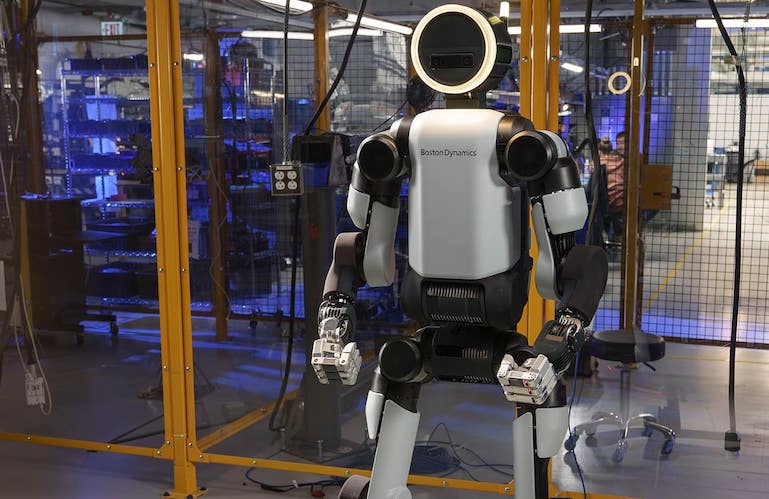

Boston Dynamics’ Atlas is sorting roof racks autonomously at Hyundai’s plant, in a shift toward factory work first reported by Therobotreport. But Atlas still cannot handle basic home tasks such as getting dressed or pouring a cup of coffee and carrying it around the house, and it could be several years before it joins Hyundai’s team permanently.
Atlas learns tasks through human demonstrations and machine learning. A virtual-reality operator guides its hand and arm movements step by step, producing data used to train its AI models. Engineers also trained more than 4,000 digital Atlases for six hours in simulation, with challenges such as slippery floors, bending and stiff joints.
The approach puts more weight on demonstrations and machine learning than on manually written algorithms. The next-generation Atlas is all-electric and runs on NVIDIA chips.
Hyundai’s auto plant has more than 1,000 robots working alongside nearly 1,500 people. Boston Dynamics’ quadruped Spot conducts quality checks there, as well as safety checks and industrial inspections at hundreds of facilities around the world.
The contrast is stark: Atlas can perform an autonomous assembly-line task, while ordinary household routines remain beyond its reach. Robots still need to be built, trained and maintained. Goldman Sachs predicts the humanoid robot market will reach $38 billion within a decade.